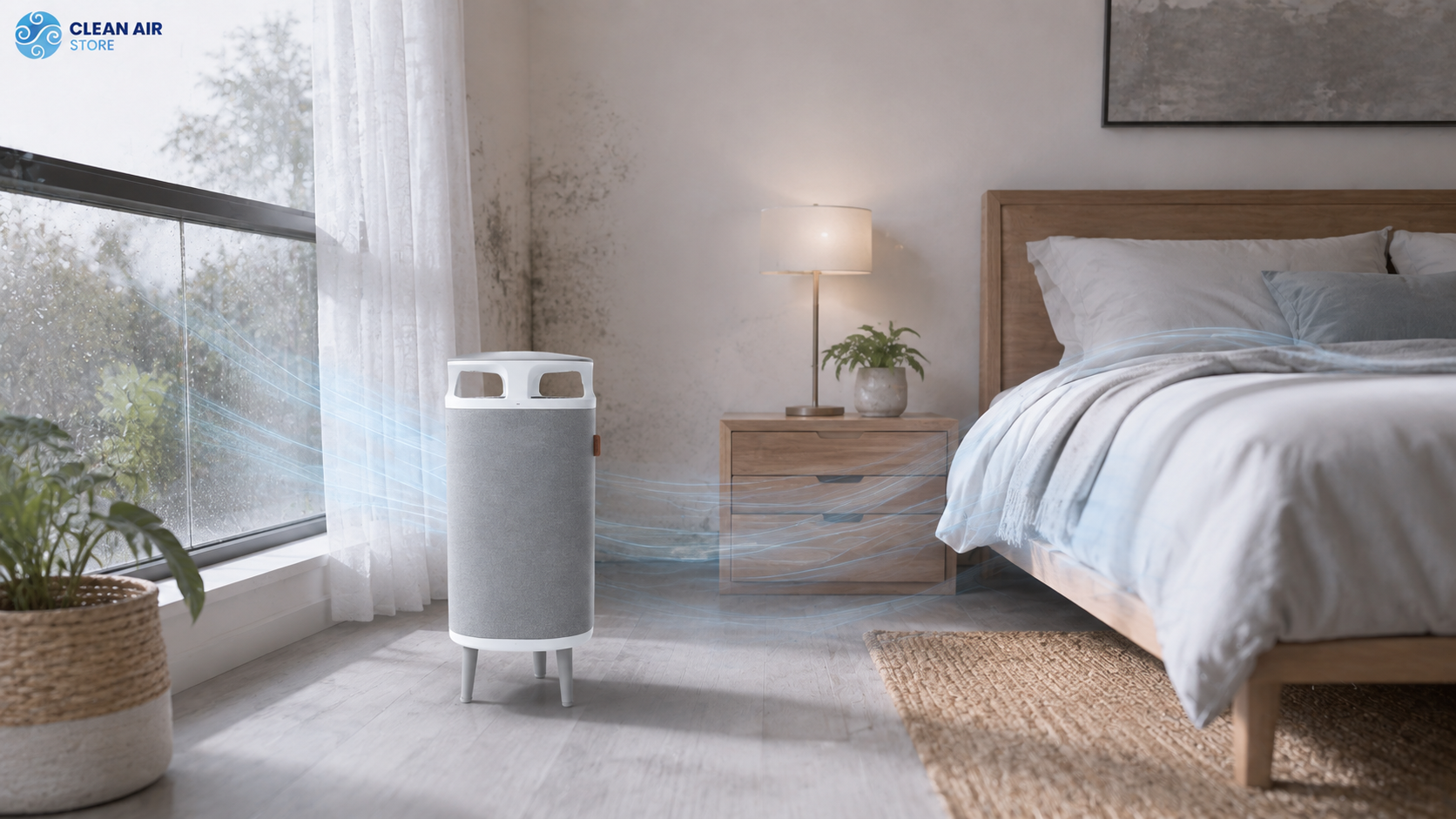
Dark patches on bathroom walls, a persistent musty smell or damp spreading during the monsoon can all indicate a mould problem. This often raises an important question: can an air purifier remove mould and improve the air inside your home?
An air purifier can help by capturing airborne mould spores, particularly when it uses a HEPA filter. However, it cannot remove mould growing on walls or furniture, prevent further growth or fix the moisture causing it. In simple terms, an air purifier can manage spores in the air, while cleaning, ventilation and moisture control are needed to address the source.
What Is Mould and Why Does It Grow Indoors?
Mould is a type of fungus that reproduces through tiny spores found naturally in outdoor and indoor air. A spore that lands on a damp material may begin to grow.
Bathrooms, kitchens, basements, wardrobes and rooms affected by leaks are common problem areas. Mould can grow on paint, wood, fabric, carpet, paper-faced plasterboard and other materials when enough moisture is present. Common causes include:
- Leaking roofs, pipes or windows
- Flooding or water that was not dried quickly
- Condensation on cold walls, glass or pipes
- High indoor humidity
- Poor ventilation in bathrooms and kitchens
- Furniture placed tightly against damp walls
- Indoor laundry drying without enough airflow
The colour of a patch does not reliably show how serious it is. When mould is visible or can be smelled, the priority is safe removal and moisture correction, not identifying the species first. The US Environmental Protection Agency states that indoor mould growth should be controlled by addressing moisture.
Do Air Purifiers Help With Mould?
Yes, within limits. The single most useful thing an air purifier does for mould is remove spores from the air before you inhale them.
Every time mould is disturbed, by cleaning, by a draught, or simply by daily activity, it can release a fresh cloud of spores. A running purifier pulls that air through its filter and lowers the spore count in the room.
This matters most for people with allergies or asthma, and for anyone spending long hours in a damp-prone room. Fewer airborne spores usually means less irritation.
What it does not mean is a mould-free home. The purifier is cleaning the air; the mould on the surface is still there, still growing, still releasing new spores. That is the part people most often misunderstand.
How HEPA Filters Capture Airborne Mould Spores
Mould spores are small, but not so small as to be missed by a proper filter. Most fall between 2 and 10 microns, which is well within the range a true HEPA filter is designed to capture. A true HEPA filter traps at least 99.95% of particles at 0.3 microns, the hardest size to capture. Since most mould spores are larger than that, a HEPA air purifier removes them from passing air very effectively.
Blueair uses a HEPASilent approach that pairs mechanical filtration with an electrostatic charge, which lets the unit capture fine particles at lower fan speed and lower noise. If you want the full breakdown of how these filters work, our HEPA filter air purifier guide covers it in plain language.
What Air Purifiers Cannot Do?
This is the honest part, and it is the part sellers often skip. An air purifier is not a mould treatment.
Here is what it genuinely cannot do:
- It cannot remove mould from walls, ceilings, grout, or fabric. Surface mould has to be physically cleaned or removed.
- It cannot stop mould from growing. As long as the surface stays damp, the colony keeps spreading regardless of your purifier.
- It cannot fix the moisture problem. Leaks, condensation, and poor ventilation are the root cause, and a purifier does nothing about them.
- It cannot reach spores that have settled into carpets, mattresses, or soft furnishings. It only filters air that moves through it.
If a product claims to “eliminate mould” from your home on its own, treat that claim with suspicion. No air purifier does that.
The Role of Activated Carbon: Tackling That Musty Smell
That damp, earthy, musty smell is not the spores themselves. It comes from gases that mould releases as it grows, and HEPA filters cannot capture gases because gas molecules are far smaller than the fibres can hold. This is where an activated carbon filter earns its place. Carbon adsorbs odour molecules onto its porous surface, which is why it reduces the musty smell that lingers in damp rooms.
A purifier with both HEPA and carbon layers therefore does two useful jobs at once: it lowers airborne spores and softens the smell. If odour is your main concern, our post on air purifiers for smoke, odour, and cooking fumes goes into more detail. Just remember the smell will return if the mould and the damp are still there.
Why Moisture Control Is the Real Fix
You can run a purifier around the clock, but if the wall stays damp, the mould will keep growing and keep releasing spores faster than the filter can clear them. Moisture is the cause; everything else is a symptom. No mould problem is solved until the moisture is solved.
Practical moisture control looks like this:
- Ventilate, especially bathrooms and kitchens, and open windows on dry days
- Fix leaks in pipes, roofs, and walls promptly
- Use a dehumidifier in persistently damp rooms, aiming to keep humidity below around 50%
- Wipe down condensation on windows and cold walls
- Dry wet areas quickly rather than leaving them
For a fuller room-by-room approach suited to local conditions, see our guide on how to improve indoor air quality at home. During and after the monsoon, this step matters more than any device.
What an Air Purifier Can and Cannot Remove
An air purifier can reduce airborne mould spores and some musty odours, but it cannot remove visible mould or solve the moisture problem causing it. The table below explains where air purification helps and where another solution is required.
| Mould-related concern | Can an air purifier help? | What is required? |
| Airborne mold spores | Yes | A properly sized air purifier with a HEPA filter |
| Exposure to spores in the air | Yes, it can reduce exposure | Continuous HEPA filtration |
| Musty odors | Partly | Activated carbon filtration and removal of the mould source |
| Mould growing on walls or surfaces | No | Safe cleaning or professional remediation |
| Ongoing mould growth | No | Moisture control and removal of existing mould |
| Dampness, leaks or condensation | No | Repairs, ventilation or a dehumidifier |
| Spores settled in carpets or fabrics | No | HEPA vacuuming, washing or replacement |
| Long-term mold prevention | Not on its own | Moisture control, proper ventilation and air purification |
The key distinction is simple: an air purifier manages mould spores suspended in the air, while cleaning and moisture control address the mould itself.
How to Clean Up Mould Safely
For small patches, many people can handle cleanup themselves. As a general rule, a mould area smaller than about one square metre is usually manageable at home. Anything larger deserves a professional.
If you do clean it yourself:
- Wear a mask, gloves, and eye protection, since disturbing mould releases spores
- Open a window and, if possible, run your air purifier in the room to catch spores stirred up during cleaning
- Clean hard surfaces with soap and water or an appropriate cleaner, then dry thoroughly
- Throw away porous items like heavily affected fabric, cardboard, or ceiling tiles that cannot be fully cleaned
- Do not just paint over mould, as it will grow back through the paint
- Fix the moisture source afterwards, or it will simply return
If you have asthma, a weakened immune system, or a strong mould allergy, do not disturb mould yourself. Let someone else handle it, or call a professional.
Best Placement for an Air Purifier in a Damp or Mouldy Room
Placement affects how well the purifier does its limited but real job. Put it in the room you actually use, and let it run continuously rather than in short bursts.
Sensible placement tips:
- Keep it 30 to 50 cm away from walls and furniture so airflow is not blocked
- Place it near the source of spores where practical, such as closer to the damp area, but not pressed against a wet wall
- Keep windows and doors closed while it runs, except when you are actively airing the room out
- Do not hide it behind curtains, under a low table, or in a cupboard
- Run it during and after cleaning to catch the spores that get disturbed
Common Mistakes When Using an Air Purifier for Mould
These are the errors that lead to disappointment and wasted money:
- Expecting the purifier to remove the mould itself. It only cleans the air.
- Ignoring the moisture. Without fixing damp, mould keeps winning.
- Buying a unit too small for the room, so the air is barely cycled
- Running it only for an hour a day instead of continuously
- Skipping filter changes, leaving a clogged, less effective unit
- Relying on ioniser-only or ozone devices, which do not remove spores well and can irritate airways
- Leaving windows open on a damp day, letting more spores and moisture in
Maintenance and Filter Replacement
An air purifier used in a damp or mould-prone room requires regular maintenance. Dust buildup restricts airflow, while persistent humidity may shorten the filter’s useful life and reduce filtration performance.
To keep the purifier working effectively:
- Check the filter monthly and replace it approximately every 6 to 12 months, or sooner in particularly dusty or damp conditions.
- Use genuine replacement filters designed for the model, as unsuitable filters may fit poorly or capture fine particles less effectively.
- Wipe the exterior and clean the intake grilles regularly to maintain clear airflow.
- Keep the purifier away from standing water, wet surfaces and direct sources of moisture.
Local conditions can affect replacement schedules, so understanding how often Blueair filters should be changed can help you plan maintenance more accurately.
Choosing the Right Air Purifier for a Damp Room
The right choice depends on room size and how humid the space is, not on price alone. For mould, you want strong HEPA particle filtration plus activated carbon for the musty smell, sized correctly to the room.
A rough guide:
| Room / Situation | Priority | Blueair Option |
| Small bedroom or bathroom-adjacent room | Compact, quiet, HEPA + carbon | Blue 3410 |
| Standard bedroom or study | Good coverage, low noise | Blue 3610 |
| Larger living room or damp-prone space | High coverage, quiet all-day running | Classic 405 |
| Larger room, want the highest level of protection | Advanced filtration, 24/7 use | HealthProtect 7470i |
The Blue 3410 and Blue 3610 suit most bedrooms, while the Classic 405 fits larger or shared rooms that need quiet, steady coverage. For a bigger space where you want the most advanced option running around the clock, the HealthProtect 7470i is the natural step up. Confirm the exact coverage on each product page before deciding, or read our guide to choosing the right air purifier.
FAQs
Do air purifiers help with mould?
Yes, but only by capturing airborne mould spores so you breathe in fewer of them. They do not remove mould from surfaces or stop it from growing.
Can an air purifier remove mould from walls?
No. Mould on a wall or surface must be physically cleaned or removed. A purifier only filters spores that are floating in the air.
Do air purifiers kill mould spores?
A HEPA air purifier traps spores inside its filter rather than killing them in the room. Trapping them still reduces the number circulating in the air you breathe.
Will an air purifier stop mould from growing?
No. Mould grows because of moisture. Until the dampness is fixed, mould will keep growing no matter how long the purifier runs.
Do air purifiers help with the musty mould smell?
Yes, partly. An activated carbon filter reduces the musty odour, but the smell returns if the mould and moisture remain.
What kind of filter is best for mould spores?
A true HEPA filter for the spores, paired with activated carbon for the odour. Avoid ozone-only or ioniser-only devices.
Where should I place an air purifier in a mouldy room?
In the room you use most, away from walls, with doors and windows closed. Running it near the damp area while cleaning helps catch disturbed spores.
Can I run an air purifier while cleaning mould?
Yes, and it is a good idea. Cleaning disturbs mould and releases spores, and a running HEPA purifier helps capture them.
How often should I change filters if I have mould?
Check monthly and replace every 6 to 12 months, often sooner in damp conditions. Damp, spore-heavy air can shorten filter life.
What size air purifier do I need for a damp room?
Match it to your room size so the air is cycled several times per hour. A small bedroom needs a compact unit, while a larger room needs higher coverage.