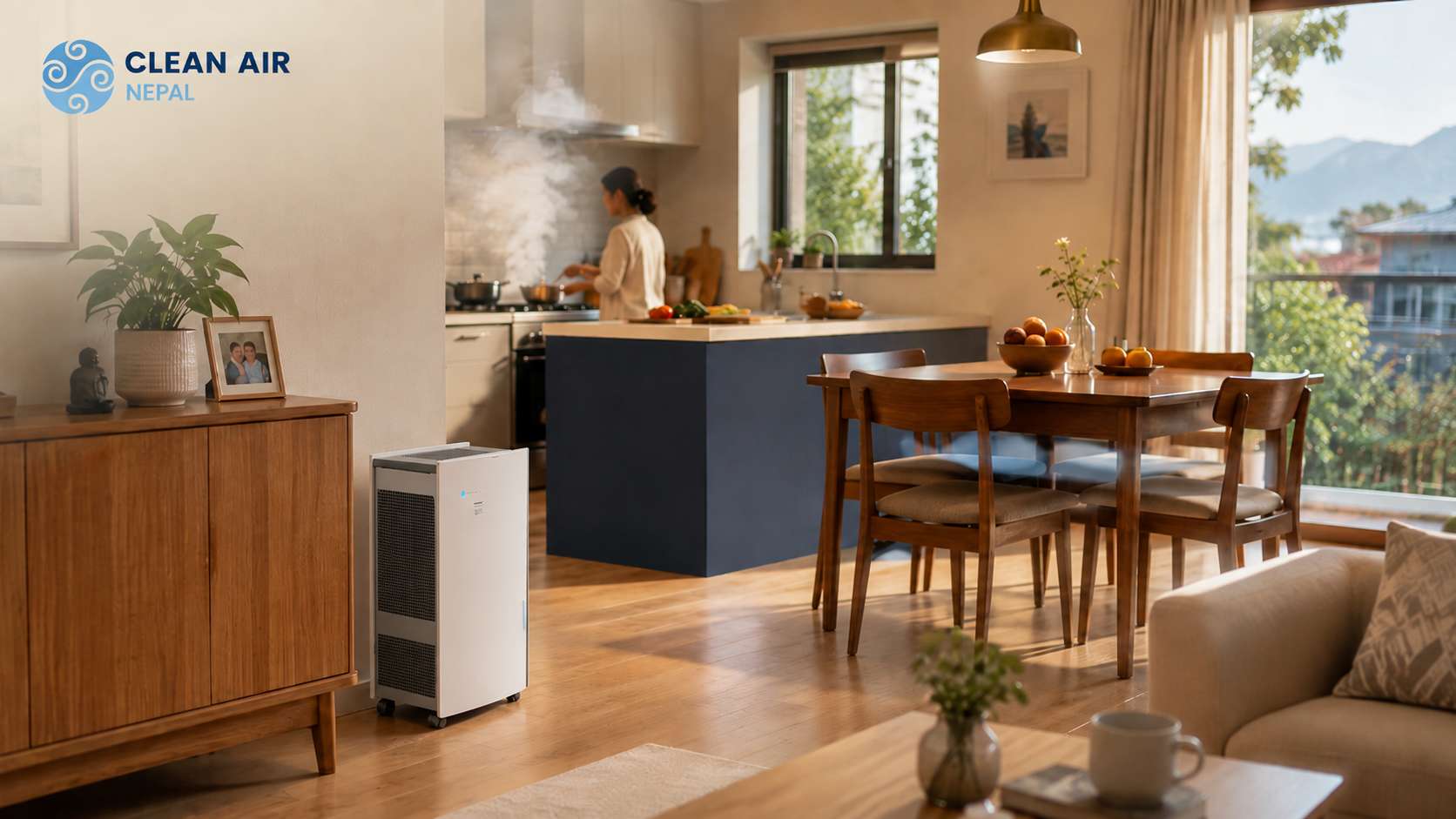
A clean-looking home does not always have clean indoor air. Smoke, cooking fumes, and indoor odours can stay indoors long after they are produced. In many Nepali households, everyday activities such as frying food, preparing traditional meals, burning incense, lighting candles, or simply opening windows near busy roads can affect indoor air quality without being immediately noticeable.
These pollutants often become trapped indoors, especially in apartments, open kitchens, bedrooms, offices, clinics, and other spaces with limited ventilation. Over time, cooking smells, smoke, and stale air can make rooms feel less fresh and comfortable, creating an environment that is not ideal for families, guests, or employees.
For households with children, elderly family members, or pets, maintaining cleaner indoor air is especially important. This becomes even more essential for individuals who are sensitive to smoke, cooking fumes, and strong odours. A well-chosen air purifier designed for smoke, odours, and cooking fumes can help reduce airborne particles and improve indoor freshness.
Smoke and Odour Are Everyday Indoor Air Problems
When air pollution is mentioned, outdoor pollution is often the first thing that comes to mind. But indoor air can also be affected by everyday habits. Cooking, frying, lighting incense, using candles, opening windows near traffic, or keeping rooms closed for long hours can all change the air inside your home.
Smoke and odour do not always disappear as quickly as we think. Fine smoke particles can stay in the air, while smells can settle into curtains, sofas, carpets, bedding, and fabric furniture. This is why a room can still smell like food, smoke, or incense even after cooking is finished or the incense has burned out.
Common indoor sources include:
- Cooking and frying
- Incense and candles
- Traffic smoke is entering from outside
- Pet dander and pet smell
- Damp or closed-room odour
- Smoke from nearby restaurants or burning areas
- Poor ventilation in apartments and closed rooms
In premium homes, offices, clinics, and hotels, indoor freshness matters because it affects comfort, cleanliness, and the overall experience of the space. If these smoke and odour problems are regular in your space, choosing the right air purifier in Nepal can help support cleaner and fresher indoor air.
Can an Air Purifier Help with Cooking Smell and Smoke?
Yes, an air purifier can help with cooking smells and smoke, but it needs the right filter system. In many Nepali homes, cooking fumes and outdoor smoke can stay trapped indoors, especially in apartments, open kitchens, and closed living rooms.
For better results, look for these features:
- Particle filtration: Helps reduce fine particles such as dust, PM2.5, pollen, pet dander, and airborne smoke particles.
- Activated carbon support: Helps reduce cooking smell, incense smoke smell, pet odour, and stale indoor odour.
- Right room coverage: The purifier should match the size of your bedroom, living room, kitchen area, or office.
- Good CADR: A higher CADR helps the purifier clean the room air more effectively.
- Filter availability: Genuine replacement filters should be easy to find for long-term use.
If your main problem is cooking smell, smoke, or stale air, do not choose an air purifier only by design or price. First, understand the filter type, room size, and odour control features. You can read this guide on HEPA, carbon, UV, and smart air purifier types to understand which filter system works for different indoor air concerns. Explore air purifiers designed for smoke, odour, and everyday indoor air concerns to choose a model that best fits your room size and filtration needs.
Why HEPA and Activated Carbon Filters Work Better Together
When choosing an air purifier for smoke, cooking fumes, and odours, it is important to understand that particles and smells are different indoor air problems. HEPA filtration helps with fine airborne particles, while activated carbon support helps with odours and gases. For Nepali homes where cooking fumes, incense smoke, traffic smoke, and stale indoor smells are common, both types of filtration can work better together.
| Filter Type | What It Helps With | Best For | Why It Matters |
| HEPA / Particle Filtration | Dust, PM2.5, smoke particles, pollen, pet dander, and some airborne mould spores | Rooms affected by dust, smoke, allergens, and outdoor pollution | Helps reduce fine particles that can stay suspended in indoor air |
| Activated Carbon Support | Cooking smell, frying odour, incense smell, smoke smell, pet odour, and stale room smell | Homes with open kitchens, incense use, pets, or closed-room odour | Helps reduce odours that regular particle filtration may not handle well |
| HEPA + Activated Carbon Together | Fine particles plus some indoor odours | Bedrooms, living rooms, apartments, offices, clinics, and hotel rooms | Offers more complete support for smoke, cooking fumes, and everyday indoor air discomfort |
Since smoke and cooking fumes can contain both fine particles and odour-causing compounds, the better option is usually an air purifier that supports both particle filtration and carbon-based odour control. Before buying, compare the filter type, room coverage, CADR, noise level, and replacement filter availability so the purifier matches your actual indoor air concern.
When Should You Use an Air Purifier for Smoke and Odour?
An air purifier can be useful when smoke, smell, or stale indoor air becomes a regular problem, not just something that happens once in a while. This is especially common in closed rooms, open kitchens, apartments, and spaces with limited airflow.
You may benefit from using one if:
- Cooking smells stay for hours after meals are prepared.
- Your kitchen opens into the living room or dining area.
- You use incense, candles, or dhoop regularly inside the home.
- Your home is close to traffic, restaurants, or smoke sources.
- Your apartment has limited ventilation, and windows often stay closed.
- You have children, elderly parents, pets, or smoke-sensitive family members.
- Your office, clinic, hotel room, or reception area needs fresher indoor air.
For health-conscious families and premium homeowners, this is not only about removing smell. It is about making the indoor space feel cleaner, fresher, and more comfortable every day.
What Type of Air Purifier Should You Choose?
The right air purifier depends on your room size, indoor air problem, and daily usage. If your main concern is smoke, cooking smell, incense odour, or stale indoor air, look for a model with strong particle filtration, good room coverage, quiet operation, and reliable filter support.
For Cooking Smell and Smoke in Shared Spaces
For living rooms, dining areas, offices, and family spaces, Blueair Classic 480i can be more suitable. These are the spaces where cooking smells, frying fumes, incense smoke, and stale air often spread from one area to another. A stronger purifier can help manage larger shared rooms more effectively.
It can be useful for:
- Dining spaces
- Open kitchen areas
- Spaces where cooking smells or smoke spreads
For Small Bedrooms and Compact Spaces
A compact air purifier designed for smaller bedrooms, personal rooms, study areas, or other limited spaces can be a suitable option for everyday use. It is built for quiet and simple operation, making it ideal for those who want cleaner indoor air without the need for a large unit, such as the Blue Pure 411.
It can be useful for:
- Small bedrooms
- Study rooms
- Personal workspaces
- Light dust and odour concerns
- First-time air purifier users
For Dust-Prone Rooms and Daily Use
A suitable air purifier for rooms where dust, closed-room air, and indoor particles are common can help maintain cleaner and fresher indoor spaces. It is especially useful for homes that collect dust quickly or rooms that need quiet air cleaning throughout the day, such as the DustMagnet 5210i.
It can be useful for:
- Bedrooms
- Apartments
- Dust-prone rooms
- Rooms near roads or open windows
- Homes that need low-noise daily use
For Health-Conscious Homes and Premium Spaces
HealthProtect 7470i is more suitable for families or spaces that need stronger and more premium air purification. It can be a good choice for homes with children, elderly parents, allergy-sensitive members, or rooms where indoor air quality is a serious priority.
It can be useful for:
- Health-conscious homes
- Larger bedrooms
- Premium living spaces
- Clinics or private offices
- Homes with children or elderly family members
The best air purifier is not always the biggest or most expensive one. It is the one that matches your room size, indoor air concerns, usage pattern, and filter availability.
How to Use an Air Purifier for Smoke and Cooking Odour
Using an air purifier the right way can make a big difference, especially when the problem is cooking smell, incense smoke, or stale indoor air. Good placement, proper timing, and regular filter care help the purifier work more effectively.
Follow these simple tips:
- Use it where the smell spreads most, such as the living room, dining area, or bedroom.
- Run it during and after cooking if cooking fumes often move into other rooms.
- Increase the fan speed after cooking or incense use for faster air cleaning.
- Keep it away from walls, curtains, and furniture so airflow is not blocked.
- Do not place it directly beside the stove or in greasy cooking areas.
- Keep doors and windows closed while filtering so the purifier can clean the room air properly.
- Ventilate briefly when outdoor air is fresh, then close the windows and run the purifier again.
- Replace filters on time to maintain good performance.
- Clean curtains, sofas, and kitchen surfaces regularly because smells can settle on fabrics and greasy surfaces.
For open kitchens, living rooms, and dining areas, place the purifier in an open area where air can move freely. Avoid corners or blocked spaces. If the smell is strongest after cooking, running the purifier during and after cooking can help reduce airborne particles and some odours more effectively.
FAQs
Can an air purifier remove cooking smells?
An air purifier with activated carbon support can help reduce some cooking smells. It works best when used with proper ventilation and regular cleaning.
Do air purifiers help with smoke?
Yes, a good air purifier can help reduce airborne smoke particles. For the smell, activated carbon support is also important.
Is HEPA enough for odour?
No. HEPA-style filtration is mainly for particles. For odours, activated carbon support is more useful.
Can an air purifier help with incense smoke?
Yes, it can help reduce incense smoke particles and some smells when it has proper filtration and carbon support.
Where should I place an air purifier for cooking smells?
Place it in the room where the smell spreads, such as the living room or dining area. Avoid placing it directly beside the stove.
Which air purifier is good for smoke and odour in Nepal?
The right model depends on room size, CADR, filter type, carbon support, and filter availability. Clean Air Nepal can recommend a suitable Blueair model for your space.
Do I still need ventilation if I use an air purifier?
Yes. Ventilation helps refresh indoor air, while the air purifier helps filter airborne particles and some odours.
How often should I change filters if I use them for smoke and cooking fumes?
Filter life depends on usage, dust, smoke, odour, and room conditions. If the purifier is used often for cooking fumes, incense, or smoke, filters should be checked more regularly.