This guide explains why polluted air affects children more than adults, which pollutants matter most in Nepal, and what parents can do at home and outside. For what PM2.5 does to the body in general, read health effects of PM2.5.
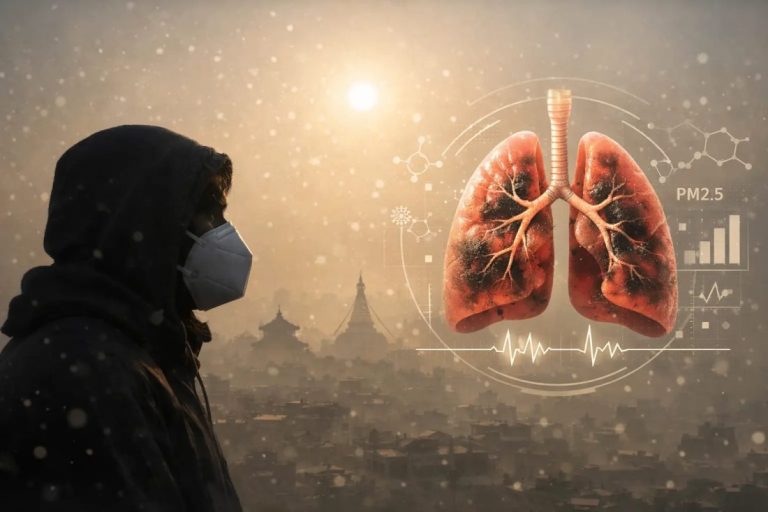
Children’s lungs are still growing. The WHO’s guidance on air pollution and health links polluted air with effects on lung function and with worse breathing conditions. Fine particles called PM2.5, 2.5 microns across or smaller, are the main worry because they travel deep into the lungs.
Why children are more vulnerable
| Factor | Why it matters |
|---|---|
| Developing lungs | Children’s lungs keep growing and developing through childhood. |
| More air for their size | Children breathe more air for their body size than adults do. |
| Active play | Running and playing make them breathe faster and deeper. |
| Asthma and other conditions | Children with asthma can get worse on polluted days. |
Children also cannot decide for themselves when to stay in. Parents, teachers and school staff make those choices for them.
What research in Kathmandu Valley shows
Two studies from the same year, February 2014 to February 2015, show the link in Nepal itself.
- The Nepal Health Research Council looked at 11,300 admissions for breathing illness at 13 hospitals in the valley. Children under 10 made up 25.5% of the patients.
- A study at Siddhi Memorial Hospital in Bhaktapur followed 258 children admitted with acute respiratory infections. Each 10 µg/m³ rise in PM2.5 meant a 16% higher risk of admission that day or the next.
The same NHRC data shows PM2.5 peaks at 8 to 9 am, right when children travel to school.
Which pollutants matter most for children?
The WHO air quality guidelines cover the pollutants with the strongest evidence of harm. These are the ones a parent in Nepal will meet:
| Pollutant | Common sources in Nepal | Why it matters |
|---|---|---|
| PM2.5 | Traffic, kilns, cooking smoke, waste burning, forest fires | Fine particles reach deep into the lungs. |
| PM10 | Road dust, construction, loose soil | Larger particles irritate the nose, throat and airways. |
| Nitrogen dioxide (NO₂) | Vehicle exhaust and other burning | Linked with breathing problems. |
| Ground-level ozone | Forms when exhaust gases react in sunlight | Irritates the airways and lungs. |
| Carbon monoxide (CO) | Generators, stoves and fires with poor air supply | At high levels it cuts the oxygen the blood carries. |
No single fix covers all of them. A particle filter removes particles, not gases such as carbon monoxide.
Common effects on children
The effects depend on the pollutant, how much of it there is, how long the child breathes it and how healthy the child is. Short-term exposure can bring:
- coughing, or more coughing than usual
- a sore nose, throat or eyes
- wheezing or breathing discomfort
- a flare-up of asthma or another breathing condition
Repeated exposure over years matters for how the lungs develop. These symptoms have many other causes too, so focus on cutting exposure rather than guessing the cause.
Where children breathe polluted air in Nepal
Outside, the main sources are vehicles, road and construction dust, industry, waste burning and forest fire smoke from March to May. Festivals add more: read about air pollution during Dashain and Tihar.
Inside, the main sources are cooking smoke, tobacco smoke, incense, stoves and heaters that burn fuel, and outdoor air coming in. PM2.5 gets in through doors, windows and gaps even when the house is mostly closed. Our guide to indoor air pollution in Nepal covers each source.
How parents can cut children’s exposure
- Check the reading before outdoor play. Our live Kathmandu and Nepal AQI shows the nearest station for 12 cities.
- Move play to the cleaner hours. In Kathmandu the early afternoon has the cleanest air of the day. See the best time to go out in Kathmandu.
- Cut hard play on high days. Above an AQI of 100, children are one of the US EPA’s sensitive groups and should keep outdoor activity shorter and lighter.
- Air the house when the outdoor air is better. Opening every window during heavy smoke brings more particles in.
- Keep smoke out of the home and the car. No tobacco smoke near children, a vented kitchen and less indoor burning.
- Clean dust without throwing it back into the air. Wipe with a damp cloth rather than sweeping dry.
- Work with the school. Outdoor sport may need to move on bad days. Schools can read our guide to air purifiers for schools and classrooms in Nepal.
Should parents use an air purifier?
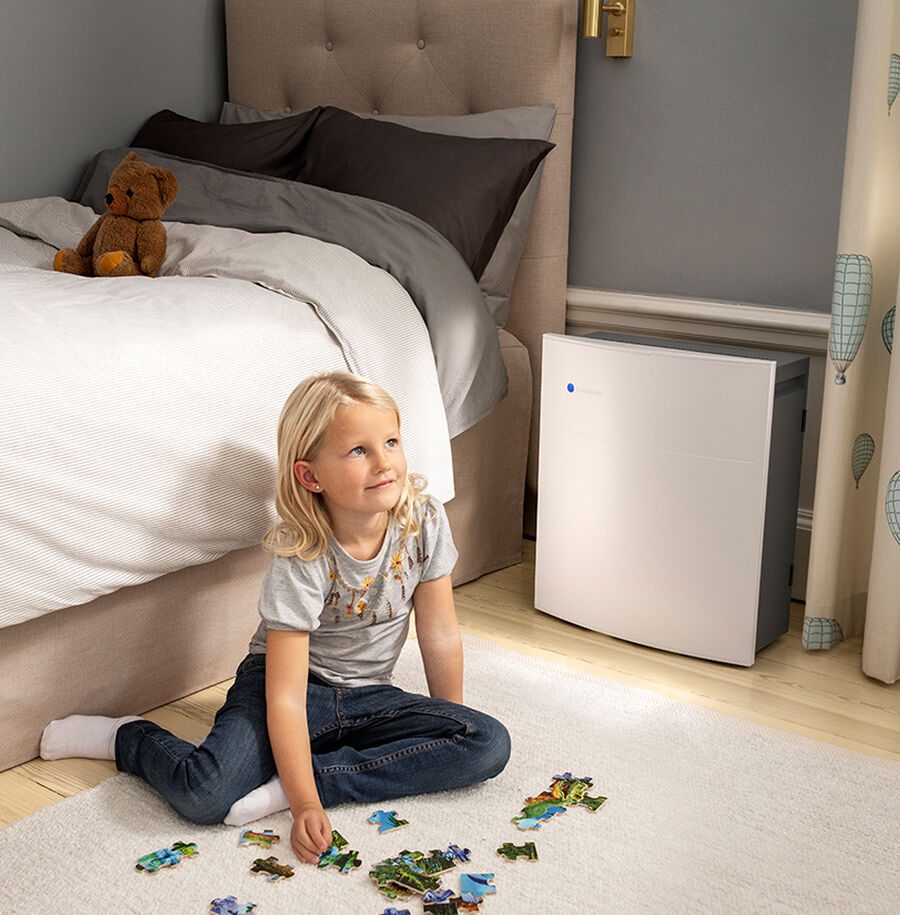
A purifier with a HEPA filter, sized for the room and run with the windows shut, lowers the fine particles in that room’s air. It does not remove every pollutant and it does not treat illness. The US EPA’s guide to air cleaners says to choose by room size and Clean Air Delivery Rate (CADR), the amount of clean air the machine delivers.
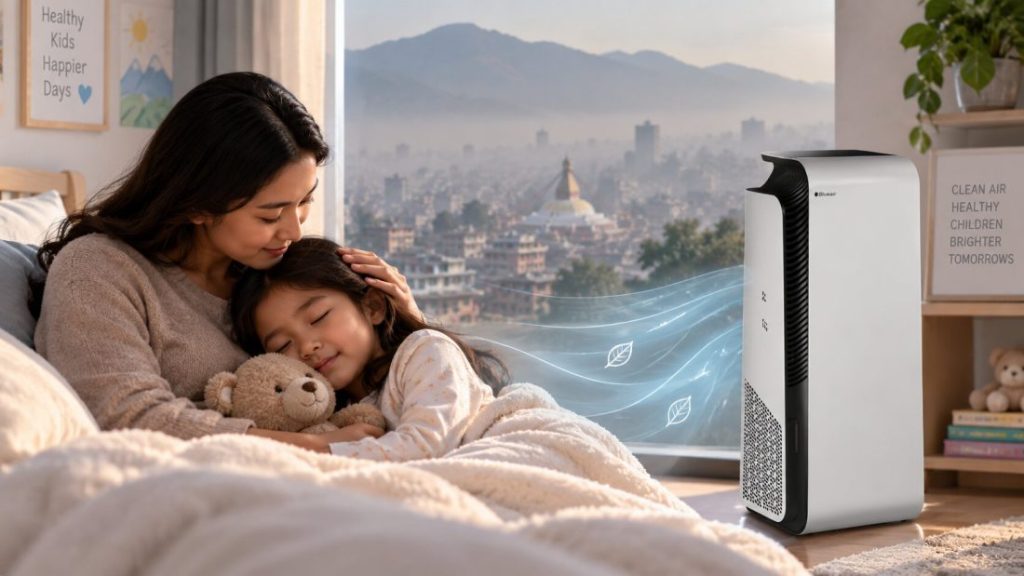
The room that matters most is the one where the child sleeps, for more hours than any adult. Our air purifier for baby and kids room page has quiet models sized for children’s rooms, with genuine filters and local warranty in Nepal.
When to see a doctor
Breathing symptoms that last or get worse need a doctor, especially for a child with asthma. Get help quickly for:
- difficulty breathing or severe shortness of breath
- wheezing that does not settle
- lips or face turning blue or grey
- unusual drowsiness or difficulty waking
Do not treat serious symptoms with ventilation or a purifier alone.
Children and air pollution: FAQs
Is traffic pollution a concern on the way to school in Kathmandu?
Yes. PM2.5 in the valley peaks at 8 to 9 am, the school run hour, and roadside air carries the most exhaust. A route away from main roads helps.
Is keeping children indoors enough on bad air days?
Not on its own. Outdoor particles still get in, and cooking smoke, tobacco and dust add to them. Pair closed windows with a clean indoor room.
Can a child sleep with an air purifier running?
Yes, if it suits the room size, stands where it does not blow straight at the bed and the filter is changed on time. Blueair’s quietest model runs at 17 dB on its lowest speed.
What time of day is best for children to play outside in Kathmandu?
The early afternoon. In the NHRC’s year of readings, 12 to 3 pm had the lowest PM2.5 of the day and the morning rush the highest.
Sources and references
- Air pollution and health, WHO compendium on health and environment, World Health Organization
- What are the WHO air quality guidelines?, World Health Organization
- Situation analysis of ambient air pollution and respiratory health effects in Kathmandu Valley, 2015, Nepal Health Research Council
- Nishikawa and others, Ambient PM2.5 and daily hospital admissions for acute respiratory infections (Bhaktapur), Atmosphere, 2021
- Technical Assistance Document for the Reporting of Daily Air Quality (sensitive groups), US EPA, May 2026
- Guide to Air Cleaners in the Home, US Environmental Protection Agency
- Air quality monitoring portal, Department of Environment, Government of Nepal