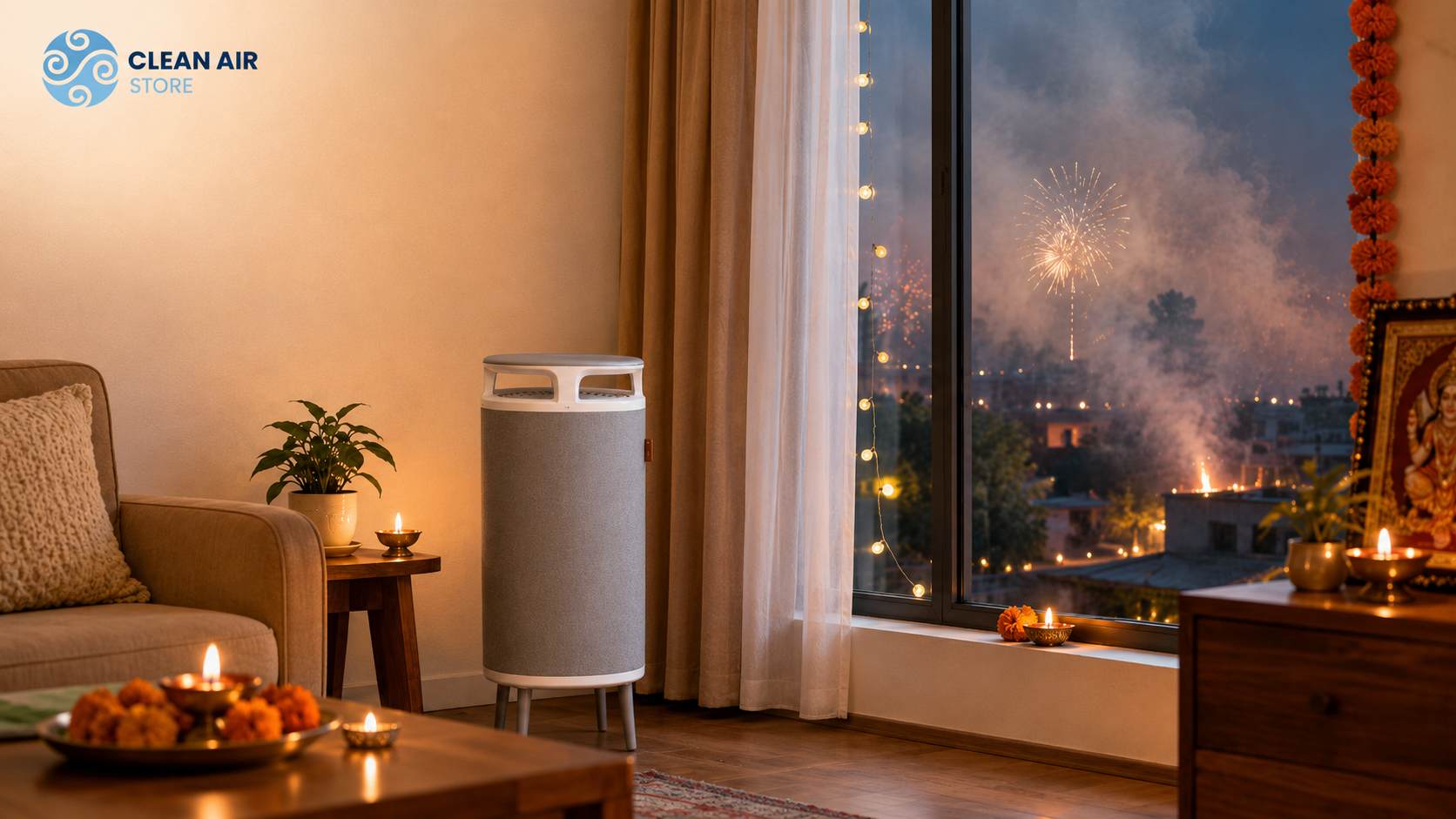
Dashain and Tihar bring family gatherings, home decorations, cooking, oil lamps, candles and, in some areas, firecrackers. These traditions are an important part of the festive season, but Tihar air pollution in Nepal can temporarily raise outdoor PM2.5 and allow smoke to enter nearby homes, apartments and workplaces.
Dashain creates more indoor activity, cooking fumes, incense and frequent door opening, while Tihar adds the possibility of short, concentrated firecracker emissions. Dashain and Tihar firecracker pollution does not mean celebrations must stop. It means households can prepare their indoor spaces before pollution rises and manage ventilation more carefully during peak activity.
Does Festival Pollution Really Affect Indoor Air?
Firecrackers release smoke containing fine airborne particles, including PM2.5. These particles can remain suspended and move through open windows, balcony doors, stairwells and gaps around building openings.
A 2026 study examined PM2.5 and PM10 around Tihar across six major Nepalese cities from 2023 to 2025. It found measurable festival-related changes, although the size and timing varied between cities, years and weather conditions. Festival pollution is often short-lived, but local particle levels can rise sharply where firecracker use is concentrated.
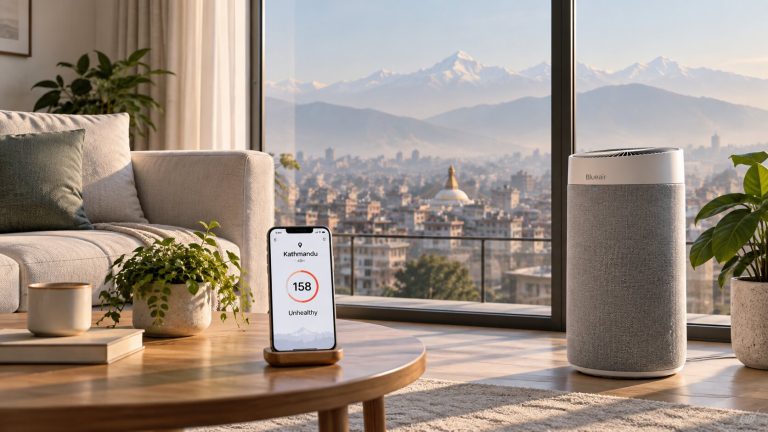
Smoke entering the home may remain trapped after the outdoor activity has ended, particularly when windows are closed without active filtration. The guide to Kathmandu PM2.5 and air pollution explains how local particle readings and AQI categories should be interpreted.
How Does Air Quality Change Before and During Tihar?
Festival air quality does not follow the same pattern every year. The number of firecrackers, wind speed, temperature, rainfall and existing traffic pollution can all change the result.
However, households commonly experience the following pattern:
| Festival stage | Likely pollution sources | Possible indoor effect |
| Before Dashain | Road dust, traffic, cleaning and construction | Dust enters during cleaning, travel and open-window periods |
| During Dashain gatherings | Cooking, incense, candles and frequent door opening | Indoor particles and odours may increase |
| Before Tihar evening | Cleaning, cooking, lamps and outdoor traffic | Indoor pollution may begin rising before fireworks |
| Peak firecracker period | Firecracker smoke and neighbourhood fireworks | Outdoor PM2.5 may rise quickly and enter nearby homes |
| Overnight | Residual smoke with limited dispersion | Smoke may linger outdoors and indoors |
| Following morning | Remaining haze, settled dust and indoor particles | Ventilation should wait until outdoor air improves |
Do not assume that the air is clean as soon as the noise stops. Research from other South Asian festival settings has found that fine particles from fireworks may remain elevated for hours after celebrations end.
How Is Firecracker Smoke Different from Everyday Pollution?
Questions about firecracker smoke and air quality in Kathmandu often focus only on visible smoke. The more important difference is how quickly a concentrated local source can change particle levels within a neighbourhood.
| Pollution source | Typical behaviour | Main indoor concern |
| Traffic emissions | Repeated daily exposure near roads | Fine particles and gases entering through windows and balconies |
| Construction dust | Local and linked to active work | Coarse dust plus smaller airborne particles |
| Cooking smoke | Produced inside the home | Particles, grease aerosols, gases and odours |
| Firecracker smoke | Short, concentrated and neighbourhood-based | Sudden PM2.5 increase, smoke odour and particles entering quickly |
Firecracker smoke can add to pollution that is already present from traffic, road dust and household activities. A Tihar pollution spike may therefore be a temporary addition to an already polluted urban background, rather than a completely separate event.
Particle filtration and activated carbon perform different jobs when smoke is involved. The guide to air purifiers for smoke, odour and cooking fumes explains how fine particles and smoke smells should be managed separately.
Who Needs Extra Care During Festival Smoke?
Festival air quality affects everyone sharing the space, but some households may need to control indoor pollution more carefully.
WHO identifies children, older adults, pregnant women and people living with chronic conditions as groups that can be more susceptible to air pollution. Reducing avoidable indoor smoke is a sensible precaution when a household includes someone with respiratory sensitivities.
Practical priorities include:
- Keep children away from balconies and open windows during firecracker activity.
- Prepare a quieter, cleaner room for older family members.
- Follow an existing asthma or allergy management plan provided by a clinician.
- Avoid adding incense, cigarette smoke or heavy frying to an already smoky indoor environment.
- Keep medicines and relevant contact details available for people with known medical conditions.
Pets should also be brought indoors before fireworks begin. Close windows, draw curtains and provide a familiar quiet area away from balconies and external doors. Animal welfare guidance recommends keeping dogs and cats indoors and moving small-pet enclosures to a quieter protected space while maintaining ventilation.
Can Firecracker Smoke Enter a Closed Home?
Yes. Closing windows reduces smoke entry, but most homes are not airtight. Fine particles can move through small gaps around windows, balcony doors, exhaust openings and shared apartment ventilation.
Smoke may also enter when family members and visitors repeatedly open the main door. In apartment buildings, polluted air from balconies, corridors and stairwells can move between connected spaces.
Closing the room slows outdoor pollution entry but does not remove particles already inside. Active filtration, suitable room sizing and controlled ventilation are still needed.
The wider guide to air purifier benefits in Nepal explains how smoke, PM2.5 and outdoor dust enter homes even when the indoor space appears clean.
How Should You Prepare Your Home Before Dashain and Tihar?
Preparation should begin before the busiest evening, not after the room already smells smoky.
Use this pre-festival checklist:
- Check the filter indicator and inspect the purifier.
- Replace a heavily loaded filter before the festival.
- Clear furniture, curtains and decorations away from the intake and outlet.
- Choose the bedroom or living area that will act as the priority room.
- Check the outdoor AQI before opening windows.
- Close balcony doors before nearby firecracker activity starts.
- Run the purifier for one to two hours before the expected pollution peak.
- Reduce incense, cigarette smoke and smoky cooking indoors.
- Keep pets inside before fireworks begin.
- Explain the room plan to family members and visitors.
Do not cover the purifier with decorative fabric or place flowers, lights or festival items on top of it. A blocked purifier cannot deliver its designed airflow, even when the filter is efficient.
What Are the Best Air Purifier Settings During the Festival?
Auto Mode is useful during ordinary conditions because it adjusts the fan when the sensor detects changing particle levels. However, the sensor only samples air near the unit and may react after smoke has entered from another part of the room.
Use the following settings as a practical guide:
- Before firecrackers begin: Run Auto or medium speed.
- During nearby fireworks: Switch to medium or high.
- After an external door opens: Use high until the reading falls.
- Overnight: Use the highest comfortable setting.
- The following morning: Continue running until indoor readings stabilise.
Continuous operation works better than switching the purifier on only after the room smells smoky. Odour is not a reliable measure of PM2.5, and fine particles may remain after the obvious smell fades.
Choosing the Right Air Purifier for Festival Pollution
The right air purifier for festival pollution must match the full room size and deliver enough filtered air at a fan speed the household can tolerate.
CADR, or Clean Air Delivery Rate, indicates how much filtered air the purifier supplies. A model with too little CADR may keep running without reducing firecracker particles quickly enough.
The CADR and ACH room-size guide provides a practical method for checking room volume, ceiling height and connected areas.
Small Bedrooms
A compact bedroom or study may be suited to the Blue 411, which is listed for small rooms up to 17 m². It is most appropriate for one enclosed room rather than a connected apartment or large family area.
Medium Bedrooms and Apartments
Medium bedrooms, enclosed lounges and apartment living spaces may need more clean-air delivery. The Blue 3410 is listed for rooms up to 36 m² and includes Auto Mode for responding to changing particle readings.
Large Living Rooms and Family Spaces
A large family room, office or shared space needs enough capacity for the complete connected area. The HealthProtect 7470i is listed for larger settings, but room volume, ceiling height and open doorways should still be checked before confirming suitability. The home air purifier buying guide covers room size, CADR, noise, filter type and replacement-filter availability.
What Should You Do After the Fireworks End?
Do not switch the purifier off as soon as the firecracker noise stops. Outdoor and indoor particle levels may remain elevated, especially on a still evening with limited wind.
Continue running the purifier on medium or high until its particle reading shows a steady decline. Wait for outdoor air to improve before opening windows, then ventilate briefly to clear carbon dioxide, cooking gases and stale air.
The following morning:
- Check outdoor AQI before ventilating.
- Wipe hard surfaces with a damp cloth.
- Vacuum or clean floors once settled dust is present.
- Avoid dry sweeping, which can return particles to the air.
- Check the purifier intake and approved pre-filter.
- Continue filtration if indoor PM2.5 remains elevated.
Heavy festival smoke may load filters faster. The Blueair filter replacement guide for Nepal explains when inspection or earlier replacement may be needed.
Festival Air Quality Checklist
Use this checklist to prepare your home before, during and after festival celebrations. A few simple steps can reduce smoke entry, support better filtration and help maintain cleaner indoor air throughout Dashain and Tihar.
Before Dashain
- Clean floors and surfaces without creating unnecessary dust.
- Check the purifier and filter condition.
- Plan for increased cooking and visitor activity.
Before Tihar
- Check the outdoor AQI.
- Position the purifier in the priority room.
- Close balcony doors before firecracker activity increases.
- Bring pets indoors.
During Fireworks
- Keep windows and external doors closed.
- Run the purifier on medium or high.
- Limit incense, smoking and smoky cooking.
- Keep children and pets away from balconies.
Overnight
- Continue purifier operation.
- Use Night Mode only if it provides enough airflow.
- Avoid opening windows based only on smell.
The Following Morning
- Check outdoor conditions before ventilation.
- Ventilate briefly when outside air is cleaner.
- Damp-wipe surfaces and clean floors.
- Inspect the filter if smoke was severe.
Common Myths About Festival Air Pollution
Festival smoke is usually a misunderstood because it may look temporary or disappear quickly. Understanding these common myths helps households make better decisions about windows, ventilation, purifier use and indoor smoke control during Dashain and Tihar.
Smoke Disappears When the Fireworks Stop
Visible smoke may disperse, but fine particles can remain outdoors and indoors for hours. Continue filtration until readings improve rather than relying on visibility or smell.
Closed Windows Keep All Pollution Outside
Closing windows reduces entry, but particles can still move through gaps, doors and shared ventilation. Closed windows also cannot remove smoke already inside.
One Small Purifier Can Clean the Whole House
A portable purifier is designed for one room or connected space. Closed doors, hallways and multiple floors interrupt airflow, so one small unit cannot reliably clean an entire home.
Festival Smoke Is the Same as Normal City Pollution
Both can contain PM2.5, but firecracker pollution is often concentrated within a short evening period and may include particles produced by pyrotechnic materials. Traffic pollution is more continuous and linked to road activity.
The Lowest Fan Speed Is Enough
Low speed may be comfortable, but it delivers less filtered air. During heavy nearby firecracker activity, medium or high speed is more suitable until particle readings improve.
Plan Cleaner Indoor Air for the Festive Season
Every home and apartment has a different layout, room volume and level of outdoor leakage. Get practical guidance on purifier sizing, placement, fan settings and filter care before festival activity begins.
Contact our indoor air team for help planning cleaner indoor air for your bedroom, apartment, living room or shared family space.
FAQs
Does Tihar Increase Air Pollution in Nepal?
Firecracker use, candles, cooking and increased traffic can temporarily raise particle pollution during Tihar. A Nepalese study covering six cities found measurable festival-related changes in PM2.5 and PM10, although results varied by city, weather and year.
Can Firecracker Smoke Enter a Home with Closed Windows?
Yes. Smoke can enter through small window gaps, door openings, balconies, exhaust routes and shared apartment ventilation. Closing windows reduces entry but does not make a room airtight.
Can a HEPA Air Purifier Remove Firecracker Smoke?
A HEPA or high-efficiency particle purifier can reduce fine airborne smoke particles, including PM2.5. Activated carbon may help with some odours, but no portable purifier removes every gas released during combustion.
When Should You Turn on an Air Purifier During Tihar?
Start the purifier before nearby fireworks begin. Run it on medium or high during the main firecracker period and continue overnight or until indoor particle readings return towards their normal level.
Should You Open Windows After Fireworks End?
Wait until outdoor air quality improves. Opening windows too soon may bring more smoke indoors. Once outside air is cleaner, ventilate briefly and then resume filtration.
Which Air Purifier Size Is Best for Festival Smoke?
Choose a purifier according to the complete room volume and CADR, not price or appearance alone. A small bedroom, medium apartment room and open-plan living space require different levels of clean-air delivery.
How Can You Protect Children and Older Family Members During Tihar?
Prepare a closed priority room, run suitable filtration, reduce indoor smoke sources and keep windows closed during peak firecracker activity. Anyone with an existing medical condition should continue following advice from their clinician.
How Can You Help Pets During Fireworks and Smoke?
Bring pets indoors before fireworks start, close windows and curtains, and provide a familiar quiet area. Keep cages and beds away from balconies, open doors and strong smoke odours.