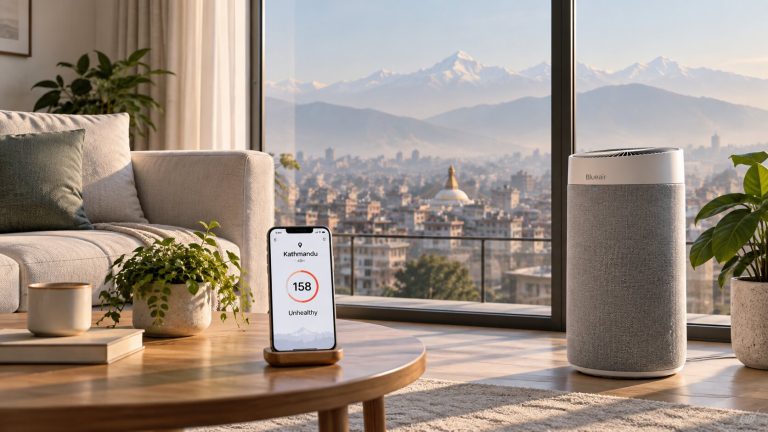
Air pollution has become one of the most serious environmental challenges in the Kathmandu Valley.
Even during months with heavy rainfall, when the atmosphere is naturally cleansed, air pollution levels in Kathmandu often reach unhealthy levels.
Recent monitoring shows that particulate pollution regularly exceeds recommended health guidelines.
This raises important questions: What are air quality standards? What do PM2.5 levels mean? And how does air pollution impact public health in Kathmandu?
I am one of the initiators of Drishti Kathmandu, an air pollution monitoring and advocacy project that works to better understand and communicate air quality conditions in Kathmandu Valley.
Through community-based monitoring and public awareness, the project provides reliable air pollution data and encourages informed discussions on environmental health.
To learn more about the project and follow updates, visit the Drishti Kathmandu Facebook group:
https://www.facebook.com/groups/drishtiKathmandu/
What Are Air Quality Guidelines?
Air quality guidelines help governments understand how much pollution is safe for people to breathe.
The World Health Organization (WHO) sets global air quality guidelines designed to protect public health. These guidelines provide recommendations for acceptable levels of pollutants in the air.
However, each country establishes its own National Ambient Air Quality Standards (NAAQS).
These standards are legally enforceable limits used to manage air pollution within a country’s economic, technological, and environmental capacity.
Some countries also set secondary air quality standards to protect ecosystems, agriculture, and visibility from pollution damage.
Because every country has different economic conditions and environmental policies, air quality standards vary across the world.
Air Quality Standards in Nepal
In Nepal, the Environmental Quality and Clean Air Act (1999) requires the government to set national air quality standards for six common air pollutants.
Among these pollutants, PM2.5 (fine particulate matter) is considered the most dangerous in urban areas like Kathmandu.
PM2.5 particles are extremely small, about 30 times smaller than the width of a human hair, and can easily enter the lungs and bloodstream.
In Kathmandu, PM2.5 pollution contributes to several serious problems, including:
- Air pollution–related deaths
- Around 15% of pneumonia hospitalizations in Kathmandu Valley (Nepal Health Research Council studies)
- Reduced visibility that hides views of the Himalayan mountains
- Damage to crops caused by reduced sunlight
- Changes in cloud formation that may contribute to extreme weather
Nepal’s daily PM2.5 air quality standard is 40 micrograms per cubic meter (µg/m³).
Compared to neighboring countries, Nepal has relatively strict standards:
- India: 60 µg/m³
- China: 75 µg/m³ in urban areas and 35 µg/m³ in national parks
In the United States, the PM2.5 standard was reduced from 65 µg/m³ in 1997 to 35 µg/m³ in 2007 after scientific studies linked pollution exposure to health problems.
However, the WHO guideline is even stricter, recommending an annual PM2.5 exposure level of 10 µg/m³.
Health Effects of PM2.5 Pollution
Scientific research shows that long-term exposure to PM2.5 significantly increases health risks.
These microscopic particles travel deep into the lungs and can even enter the bloodstream, affecting multiple organs.
Studies show that for every 10 µg/m³ increase in PM2.5, the risk of cardiopulmonary mortality increases by 6–13%.
Other health risks associated with PM2.5 exposure include:
- Respiratory infections
- Heart disease
- Stroke
- Lung cancer
Research conducted by the Nepal Health Research Council in 12 hospitals in Kathmandu Valley found that a 10 µg/m³ increase in PM2.5 was linked to:
- 1.3% rise in chronic obstructive pulmonary disease (COPD)
- 3.4% increase in pneumonia cases
- 3.7% rise in overall mortality
However, it is important to understand that pollution slightly above the WHO guidelines does not instantly cause severe health damage.
The real concern is long-term exposure to high pollution levels.
Children, elderly people, individuals with existing illnesses, and economically disadvantaged communities are most vulnerable to the health effects of Kathmandu air pollution.

What Is the Air Quality Index (AQI)?
The Air Quality Index (AQI) is a system used worldwide to communicate air pollution levels to the public.
AQI values are calculated based on the concentration of several pollutants in the air, including:
- Carbon dioxide
- Nitrogen dioxide
- Ground-level ozone
- Sulfur dioxide
- Lead
- Particulate matter (PM2.5 and PM10)
In simple terms:
Higher AQI values mean worse air quality and greater health risks.
AQI helps people understand when air pollution levels are unsafe and when they should limit outdoor activities.
Daily PM2.5 Patterns in Kathmandu Valley
The chart above shows the hourly variation of PM2.5 levels in the Kathmandu Valley over the past month.
The pattern reveals that pollution levels are usually highest in the morning.
This is largely due to increased human activities such as traffic, cooking, and industrial emissions.
As the day progresses, atmospheric conditions improve, and pollution levels generally decrease during the afternoon and evening.
Note: Most of the air quality monitors used in this analysis are located in residential areas across the Kathmandu Valley.
Why Air Pollution Monitoring Matters
Air quality in Kathmandu often worsens dramatically during winter, when pollution levels can reach up to 20 times the WHO guideline.
Regardless of the season, air pollution remains a major public health issue in Kathmandu Valley.
Projects like Drishti Kathmandu aim to improve understanding of pollution by collecting data, analyzing trends, and raising public awareness.
Better monitoring leads to better policies and ultimately better solutions to protect one of our most essential shared resources: clean air.