This guide shows when Kathmandu’s air is cleanest and dirtiest through the day, so you can plan a morning walk, a run or children’s outdoor play around it. It uses a full year of hourly PM2.5 readings from the valley.
The short answer
Walk before 6 am, or move your walk to the early afternoon. Avoid 6 am to noon, and avoid 6 to 9 pm. The air is dirtiest between 8 and 9 in the morning, exactly when most people go out.
| Time | Air in Kathmandu | For a walk or run |
|---|---|---|
| Before 6 am | Low PM2.5, about 36 to 41 µg/m³ | Good |
| 6 am to noon | Highest of the day, peak at 8 to 9 am | Worst |
| Noon to 6 pm | Lowest of the day, about 35 µg/m³ | Best |
| 6 to 9 pm | Second peak of the day | Poor |
| After 9 pm | Falling slowly through the night | Fair |
How Kathmandu’s air changes through the day
The Nepal Health Research Council measured PM2.5 every hour for a year, from February 2014 to February 2015, at Putalisadak in Kathmandu, Mahalaxmisthan in Lalitpur and Bhimsensthan in Bhaktapur. The pattern was the same at all three sites:
Average PM2.5 by time of day, Kathmandu Valley (µg/m³)
Hour by hour, PM2.5 climbed from dawn to a peak of 87 µg/m³ at 8 to 9 am. It then fell steeply to its lowest point, 31 µg/m³, at 2 to 3 pm. It rose again to 59 µg/m³ at 8 to 9 pm and eased off through the night. The NHRC report itself warns that morning walkers are the people most likely to breathe the worst of it.
Researchers at MIT found the same daily cycle in an earlier field study of the valley in the 2004 to 2005 dry season: a peak every morning and every evening, with low values in the afternoon and at night.
Why the morning is the worst time
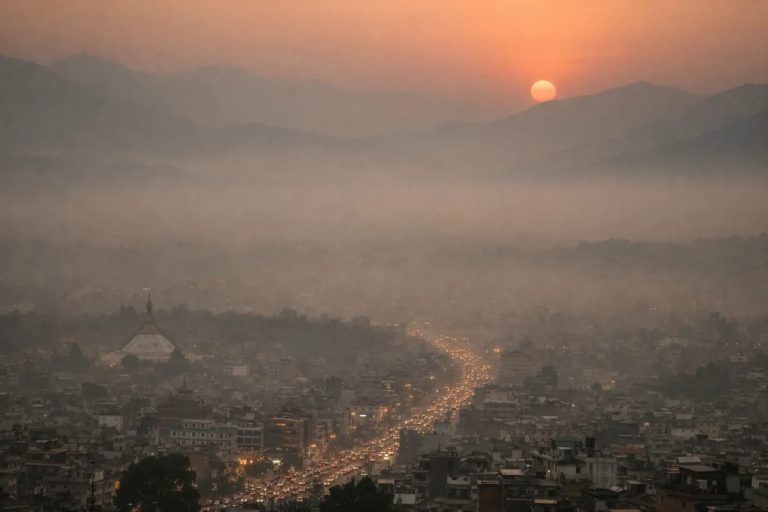
Kathmandu sits in a bowl of hills. On clear nights the ground cools and a layer of cold air settles on the valley floor, with warmer air on top acting like a lid. The smoke and exhaust of the morning rush, cooking fires and kilns have nowhere to go.
Part of the morning peak is also yesterday’s pollution. The MIT study found that pollution from the evening before drifts up above the valley overnight, then mixes back down to the ground in the morning. So the air at 8 am carries two loads at once. For the full story of the valley and its weather, read why Kathmandu is so polluted.
Why the early afternoon is cleanest
By midday the sun has warmed the ground. Warm air rises and mixes the polluted layer into a much deeper column of air, so each breath at street level carries less. In the afternoon, winds also blow through the passes in the hills around the valley. The MIT modelling study found that most of the valley’s pollution is carried out this way in the afternoon.
That is why 12 to 3 pm had the lowest average of the day in the NHRC data, 34.7 µg/m³, even with traffic on the roads.
Why the evening gets worse again
After sunset the ground cools quickly and the lid forms again. Evening traffic and cooking add fresh smoke under it, so PM2.5 climbs to its second peak at 8 to 9 pm. Later at night, with fewer vehicles, readings ease off until the morning rush starts again.
Seasons change the level, not the pattern
The daily cycle holds all year, but the numbers move with the season. The NHRC found winter and spring the most polluted, and the monsoon rains bring readings down. In March to May, forest fire smoke can keep the whole day hazy, so check the reading before you trust the clock. Our forest fire smoke guide covers that season, and the Kathmandu AQI page shows the season-by-season pattern.
Tips for exercising safely in Kathmandu
- Check the live reading first. The live Kathmandu AQI uses the nearest station, such as Ratnapark or Bhaisipati. The government’s own readings are on the Department of Environment portal.
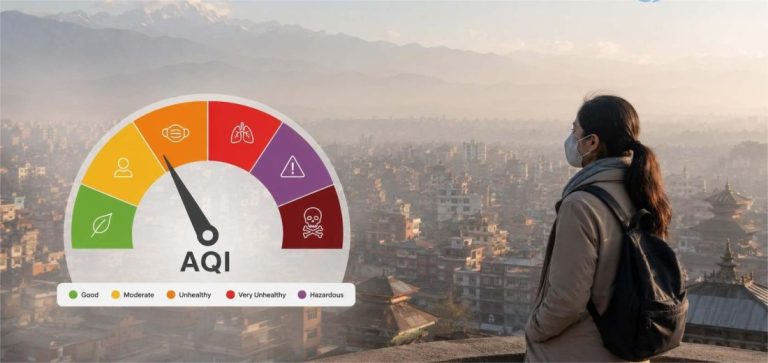
- Go lighter on orange days. When the AQI is 101 to 150, the US EPA advises sensitive people to make outdoor activity shorter and less intense. A walk is fine where a hard run is not. Our guide to what each AQI band means has the full advice.
- Stay away from busy roads. The EPA’s advice on particle pollution singles out exertion near busy roads. A route through a park or a quiet lane is better than Ring Road.
- Exercise indoors on red days. At 151 and above, sensitive groups should move activity inside.
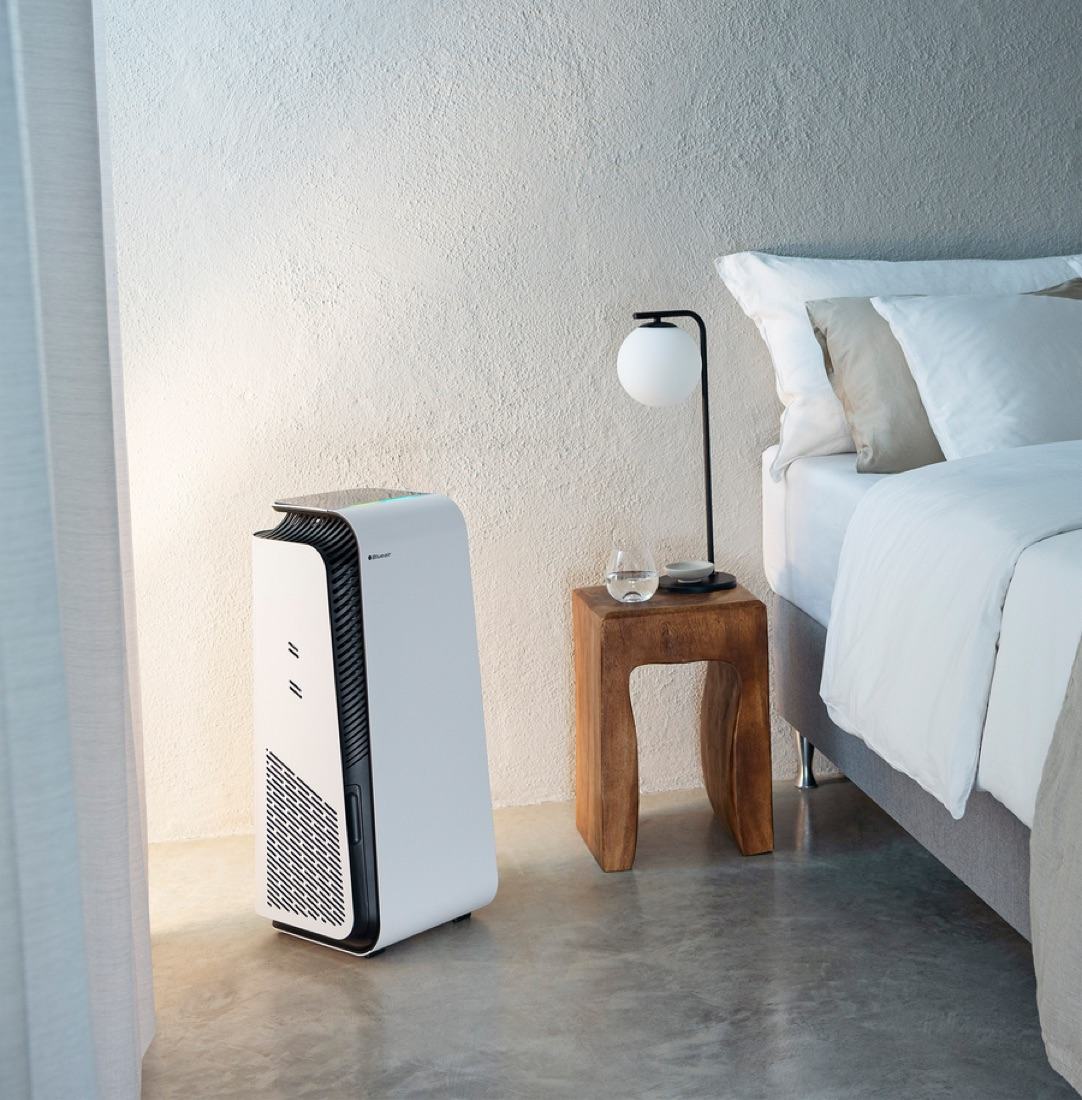
The room you come home to matters too. If the windows stay shut on bad mornings, a HEPA air purifier keeps the fine particles down inside. See our air purifiers for home for the right size for your room.
Morning walk in Kathmandu: FAQs
Is it better to walk in the morning or the evening in Kathmandu?
Before 6 am beats the evening. Once the morning rush starts, the evening is better: the NHRC’s 6 to 9 pm average was 55.7 µg/m³, against 74.0 for 6 to 9 am.
What time is Kathmandu’s air most polluted?
8 to 9 am. In the NHRC’s year of hourly readings, PM2.5 peaked at 87 µg/m³ in that hour, almost three times the afternoon low.
Should I stop my morning walk when the AQI is high?
Not always. At 101 to 150, keep it shorter and easier, or walk in the afternoon. At 151 and above, sensitive groups such as older adults and people with heart or lung disease should exercise indoors.
Why is the afternoon cleaner when there is still traffic?
The sun warms the ground, the air mixes upward and afternoon winds carry pollution out of the valley. The same traffic is spread through far more air.
Sources and references
- Situation analysis of ambient air pollution and respiratory health effects in Kathmandu Valley, 2015 (hourly and 3-hourly PM2.5), Nepal Health Research Council
- Panday and Prinn, Diurnal cycle of air pollution in the Kathmandu Valley, Nepal: Observations, Journal of Geophysical Research, 2009 (MIT)
- Panday, Prinn and Schär, Diurnal cycle of air pollution in the Kathmandu Valley, Nepal: 2. Modeling results, Journal of Geophysical Research, 2009 (MIT)
- Technical Assistance Document for the Reporting of Daily Air Quality (cautionary statements), US EPA, May 2026
- Air quality monitoring portal, Department of Environment, Government of Nepal