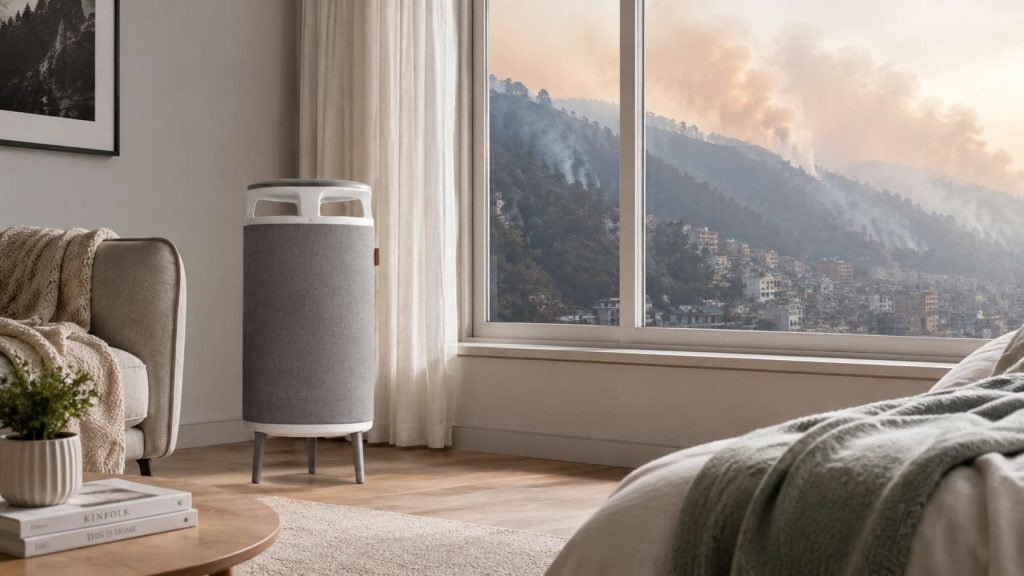
This guide explains how forest fire smoke gets into Nepali homes from March to May, and how to set up and run an air purifier for forest fire smoke so the room you live in stays cleaner until the rain comes.
Smoke does not stay where the fire is. Wind carries it across districts, so a town far from any burning forest can wake up to grey haze. Closed windows slow it down, but fine smoke particles still get in. A purifier sized for smoke, running all day in one closed room, is what brings the indoor level down.
When is forest fire season in Nepal?
The worst months are the dry weeks before the monsoon, from March to May. Leaves and forest litter dry out, fires spread fast, and smoke builds up with every week without rain.
The numbers show how quickly it grows. In 2024, Nepal’s Forest Fire Detection and Monitoring System counted 466 forest fires in March and 1,174 in just the first two weeks of April, according to ICIMOD. In the same period, daily PM2.5 at ICIMOD’s Khumaltar station in Lalitpur ranged from 48 to 131 µg/m³. Regional winds carried the smoke into the Kathmandu Valley on top of the usual traffic and dust.
ICIMOD links the spikes to fires across Nepal, so smoke season is not only a Valley problem. Check the reading for your own city on our live air quality page before you plan the day.
What to do first when heavy smoke arrives
Act on the day the haze rolls in, not after the room smells of smoke.
- Check the government’s air quality monitoring portal and follow local safety notices.
- Bring children, older family members and anyone with heart or lung problems indoors.
- Choose one closed room where the family can spend most of the day and night.
- Close outside doors and windows. Keep trips in and out short.
- Check the filter is fitted, then run the purifier on its highest speed.
- Stop smoking, incense, candles and frying in the house.
- Keep medicines, drinking water and phone chargers in that room.
One closed room is far easier to clean than a whole house. The purifier works on a smaller volume of air, so the reading drops faster.
How does smoke get in when the windows are closed?
Most houses are not airtight. The US EPA lists the ways outdoor smoke comes inside:
- Open windows and doors, even for a minute.
- Kitchen and bathroom exhaust fans that pull outside air in through every gap.
- Air conditioners with a fresh air setting.
- Small cracks and gaps around closed windows, doors and frames.
So closing up the house slows the smoke, but it does not remove what is already inside. That is the purifier’s job.
Smoke is a mix of gases and fine particles. EPA names the fine particles as the biggest health threat in smoke, and those are what a good particle filter catches. Our post on what PM2.5 does to your health explains why these particles matter.
Set up one clean room
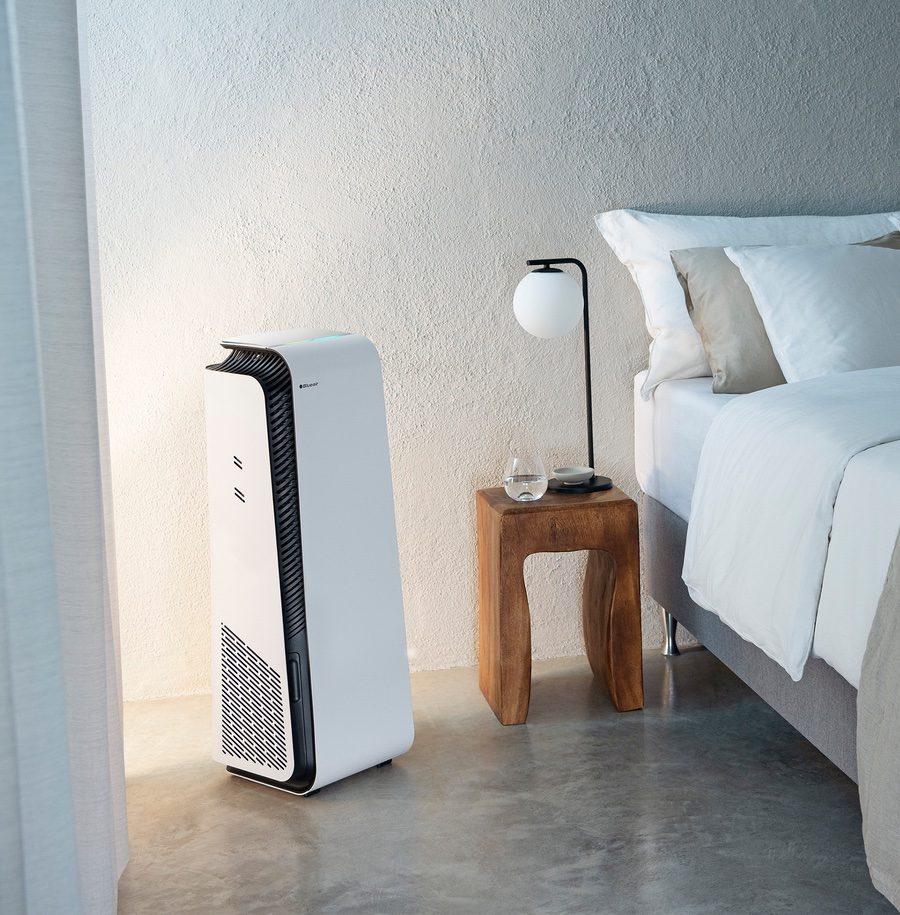
Pick a bedroom or living room that fits the family, has few outside windows and no gas heater or stove. Then follow the clean room steps from the US EPA:
- Close the windows and the room door, but never block your way out.
- Use exhaust fans only for short periods while the air outside is smoky.
- Set any air conditioner to recirculate, not fresh air.
- Run the purifier all the time, with nothing blocking the air going in or out.
- Skip sweeping and vacuuming. Wipe surfaces with a damp cloth so settled dust stays down.
- Watch the temperature. If the room gets too hot, move.
Open the windows for a short time once the outdoor air is cleaner. A purifier does not remove carbon dioxide from breathing, so a room that stays sealed for days is not the goal. Read why in our post on air purifiers and CO2.
How an air purifier helps with forest fire smoke
An air purifier pulls room air through a filter and sends clean air back out, again and again. Smoke particles are tiny, so the filter has to catch very small particles. Blueair’s HEPASilent filtration captures 99.97% of particles down to 0.1 micron. Our Blueair technology page shows how it works, and the HEPA filter guide explains filter grades.
Know what a purifier does not do:
- It does not remove carbon monoxide. If you suspect carbon monoxide, get out of the house.
- Carbon layers can reduce some smoke smell, but a thin carbon layer fills up fast. Particle filtration is what lowers PM2.5. Our post on smoke and odour explains the difference.
- It cannot make a house safe near an active fire. If the fire threatens your area, leave.
EPA also advises choosing a purifier that does not produce ozone. Our post on air purifiers and ozone explains which types do.
How big a purifier do you need for smoke?
For heavy smoke, buy a bigger purifier than you would for everyday dust. AHAM, the body that tests CADR, says that where smoke is heavy you should pick a purifier whose smoke CADR matches the room size. CADR is the Clean Air Delivery Rate, the amount of clean air a purifier delivers. The rule works in US units: smoke CADR in cfm equal to the floor area in sq ft. For everyday use the usual rule is two-thirds of the area.
Here is how it works for a bedroom of 12 ft by 14 ft:
- Floor area: 12 x 14 = 168 sq ft.
- Smoke CADR needed: 168 cfm, which is about 285 m³/h.
- A purifier with a smoke CADR of 180 m³/h would be too small for that room in heavy smoke, even though it is fine for a small bedroom on normal days.
The rule assumes a ceiling of about 8 ft. Higher ceilings, open kitchens and doors left open to a hallway all add air, so size up. You can work through your own room in the CADR and room size guide.
These Blueair models are in stock now. The last column applies AHAM’s smoke rule to each one.
| Blueair model | Smoke CADR | Blueair’s room size | Room size in heavy smoke | Price |
|---|---|---|---|---|
| Blue Pure 411 | 180 m³/h (105 cfm) | 161 sq ft | about 105 sq ft | Rs 22,000 |
| DustMagnet 5440i | 391 m³/h (230 cfm) | 357 sq ft | about 230 sq ft | Rs 60,000 |
| Blue 3610 | 600 m³/h (353 cfm) | 549 sq ft | about 350 sq ft | Rs 50,000 |
| HealthProtect 7770i | 735 m³/h (433 cfm) | 674 sq ft | about 430 sq ft | Rs 1,25,000 |
For a family bedroom, the Blue 3610 gives the most smoke cleaning for the money. See all our picks for sleeping rooms on the bedroom air purifier page, and for halls and living rooms on the large room page.
One purifier cleans one room or one open area. Walls and closed doors stop the airflow, so separate bedrooms each need their own unit, or the family shares one clean room. More on this in can one air purifier clean a whole house.
Fan speed and placement on smoke days
EPA’s advice is simple: run the purifier all the time, on the highest fan speed you can. Auto mode is good for normal days, but its sensor reads the air next to the purifier. Smoke coming in from the far side of the room can take a while to reach it, so on a known smoke day switch to manual high.
- Smoke building outside: medium or high.
- After someone opens an outside door: high until the reading drops.
- At night: the highest speed you can sleep with. Night mode is quieter but cleans less air.
- Thick haze: high, all day, in the clean room.
Put the purifier in the open where people sit or sleep. Keep it away from curtains, sofas and corners, and check the manual for which sides take air in. Keep it running after the reading falls, because smoke builds up again within hours if you switch it off. Our post on how long to run an air purifier covers daily running.
Check the readings and know when to open windows
Write down the indoor reading when you start, then watch it fall. A separate PM2.5 monitor placed where people sit gives a truer picture than the sensor on the purifier, which sits in the cleanest air in the room.
Open windows only when the outdoor PM2.5 is lower than the indoor reading. Open them for a short time, watch the indoor number and close them again if it rises. A clear sky or a lighter smell does not prove the outdoor air is clean, so check the number first.
Filters in smoke season
Heavy smoke fills a filter faster than normal dust. Check the filter more often from March to May instead of waiting for the usual month.
- Look at it when airflow feels weaker or the reading takes longer to fall.
- Follow the filter light and the manual for your model.
- Clean only the parts the manual says are washable, such as the fabric pre-filter. Never wash the main filter.
- Replace it early if a long smoke spell has clogged it.
Keep a spare genuine filter at home before March. We stock genuine Blueair filters in Nepal; find yours on the air purifier filters page. Normal replacement timing is in our Blueair filter replacement guide.
What to do during a power cut
When the power goes, keep doors and windows shut so less smoke gets in while the purifier is off. Avoid cooking smoke, keep movement between rooms low and watch the temperature. When the power comes back, restart the purifier on high until the reading falls.
Run the purifier only from a backup supply that suits it. A fuel generator gives off carbon monoxide, so keep it outdoors and away from doors, windows and air intakes. Never run one inside the house, in a garage or on a covered balcony.
People at higher risk and when to leave
EPA names children, older adults and people with heart or lung disease as the groups most at risk from smoke. The World Health Organization calls fine particles a major health threat during fires. Keep these family members in the clean room, cut outdoor activity and keep their medicines close. Anyone with asthma or a heart condition should ask their doctor what to do on smoke days. For children, read how air pollution affects children in Nepal.
Leave the house, or move to a cleaner place, when:
- Authorities order an evacuation or the fire comes close.
- The indoor reading stays high even with the purifier on high.
- Heat or a long power cut makes the room unsafe.
- You suspect carbon monoxide or an electrical fault.
Get medical help fast if someone has trouble breathing, chest pain, confusion or blue lips. A purifier helps with the air in the room. It does not replace a doctor or an evacuation order.
Get ready before March
The best time to prepare is February, before the first haze. Test the purifier, put a spare filter in the cupboard, choose the room you will use and get a PM2.5 monitor if you want one. When the smoke arrives, you close the windows, switch to high and the room is ready.
Not sure which size fits your room? Send us the room measurements on WhatsApp at +977 9801800596 or through our contact page. We deliver across Nepal, the warranty is handled here, and our team will help you choose.
FAQs
Can a HEPA air purifier remove forest fire smoke?
A HEPA-type purifier catches the fine particles in smoke, which EPA calls the biggest health threat in it. It does not remove every gas or stop smoke coming in, so use it in a closed room on a high speed.
Can an air purifier remove carbon monoxide from smoke?
No. A particle filter cannot catch carbon monoxide. Keep fuel generators and stoves out of closed rooms, and leave the house if you suspect carbon monoxide.
Should windows stay closed all day during forest fire haze?
Keep them closed while the outdoor reading is high. When the outdoor PM2.5 drops below the indoor reading, open them for a short time to let stale air out, then close them and keep the purifier running. Check the number on our air quality page first.
Can I use a ceiling fan with an air purifier on smoke days?
Yes. A ceiling fan on a low speed moves room air towards the purifier. Keep it gentle so it does not blow straight against the purifier’s outlet.
Does one smoke spell mean I need a new filter?
Not always. Check the filter light, the airflow and how fast the reading falls. Replace it if any of those show it is clogged, and keep a spare genuine filter ready for the rest of the season.
Sources and references
- As Nepal's air quality plummets, experts urge a focus on forest fires, ICIMOD (April 2024)
- Air quality monitoring portal, Department of Environment, Government of Nepal
- Wildfires and Indoor Air Quality, US Environmental Protection Agency
- Create a Clean Room to Protect Indoor Air Quality During a Wildfire, US EPA
- Advice for Using Air Cleaners in Areas Affected by Wildfire Smoke, AHAM
- Guide to Air Cleaners in the Home, US Environmental Protection Agency
- Wildfires, World Health Organization