Buying one powerful air purifier for the entire home may sound convenient. However, portable air purifiers work best in the room or connected open space where they are placed. Walls, closed doors, staircases and long hallways can prevent filtered air from circulating evenly throughout the house.
A single unit may be suitable for a studio apartment, a small open-plan flat or one priority room. Larger homes with several bedrooms or multiple floors may need more than one purifier. Room dimensions, layout, airflow and purifier capacity all affect coverage. Our large-room air purifier guide explains these factors in more detail.
This guide will help you understand air purifier coverage, decide whether one unit is enough and choose a practical setup for your home without buying more equipment than you need.
How Do Air Purifiers Work?
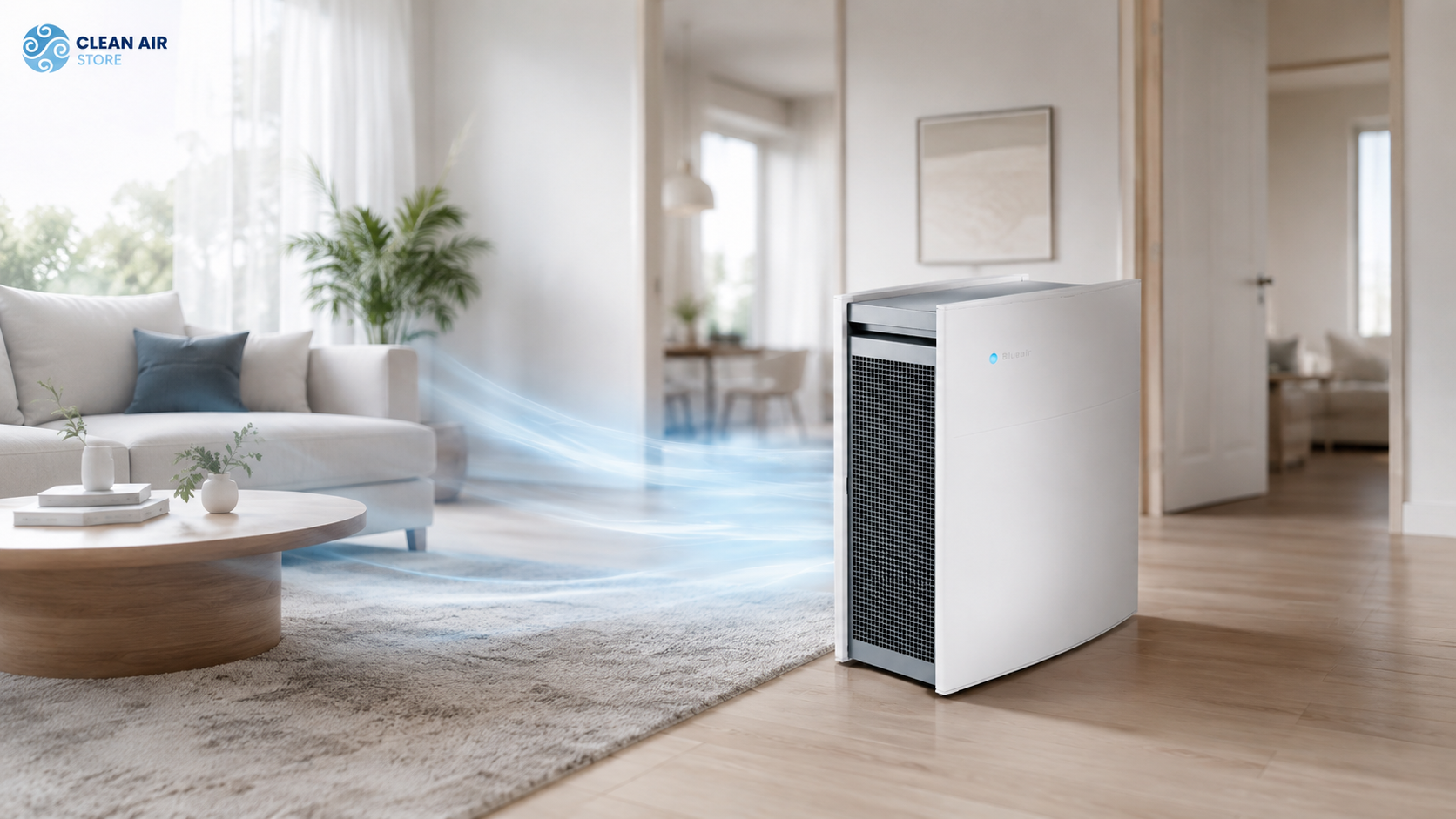
A portable air purifier pulls room air into the machine, passes it through one or more filters, and releases filtered air back into the same space. It repeats this process while it is running. Because the unit depends on air reaching its intake, its effect is strongest in the room where it is placed.
Particle Filtration
A HEPA air purifier or another effective high-efficiency particle filtration system can capture airborne PM2.5, dust, pollen, smoke particles, pet dander and mould spores. It does not remove dust that has already settled on floors, beds or furniture.
Blueair uses HEPASilent technology, which combines mechanical and electrostatic filtration. You can learn more about particle capture in the HEPA filter air purifier guide.
Activated Carbon
Activated carbon helps reduce some cooking odours, smoke smells and gas-based pollutants. It supports particle filtration but does not guarantee that every gas, chemical or odour will disappear.
CADR
Clean Air Delivery Rate, or CADR, shows how much filtered air a purifier delivers. A higher CADR generally means faster cleaning or coverage of a larger room. The AHAM air cleaner guidance recommends comparing CADR with room area and choosing a larger capacity when ceilings are higher than normal.
Can One Air Purifier Clean an Entire House?
One portable air purifier can clean an entire house only when the home is small, open and within the unit’s stated coverage. In most multi-room houses, one unit cannot move enough filtered air through walls, closed doors and separate floors.
Portable purifiers are room-based appliances. The U.S. EPA’s guide to air cleaners advises choosing a CADR large enough for the room or area where the unit will operate. If an area is larger than one purifier can serve, using multiple units may be more effective.
A ducted whole-house air purifier is different. It works with a central heating or cooling system and filters air as it moves through the ducts. However, many homes in Nepal do not use central ducted HVAC systems, so strategically placed portable purifiers are often the more practical option.
Moving one purifier between rooms can help at different times, but it does not clean every room at once. A unit operating in the living room during the day will not maintain the same particle level in a closed bedroom upstairs.
What Affects Air Purifier Coverage?
The room size printed on a product page is useful, but it is not the only factor. Real performance depends on how air moves through the space.
Room Size and Ceiling Height
Measure the length and width of the room to find its floor area. A high ceiling increases the volume of air that must be filtered, so a room may require more capacity than its floor area alone suggests.
Home Layout
One purifier can work well in an open living and dining area because air moves between the connected spaces. A house divided into small rooms creates barriers that reduce coverage.
Walls and Doors
Walls stop direct airflow, while closed doors separate one room from another. Even an air purifier for home use with a high CADR cannot filter air that does not reach the machine.
Natural Airflow
Fans, open internal doors and the position of furniture affect circulation. However, opening outside windows during severe Kathmandu pollution can continuously bring new PM2.5 and dust into the home.
Purifier Capacity
A small purifier may run continuously without cleaning a large room quickly enough. Choose the unit according to the room it will actually serve, not the total floor area of the house.
Placement
Place the purifier where its intake and outlet remain clear. Corners, curtains, sofas and cabinets can block airflow. Central placement may help in an open area, but always follow the clearance instructions for the model.
| One Purifier May Be Enough | More Than One May Be Better |
| Studio apartment | House with several closed bedrooms |
| Small open-plan flat | Multiple floors or staircases |
| One bedroom used as the main clean-air space | Family members using different rooms at the same time |
| Connected living and dining area within the purifier’s coverage | Home with pets, allergies or heavy roadside dust |
| Doors remain open, and air circulates freely | Closed doors and limited airflow between rooms |
When Is One Air Purifier Enough?
One purifier may be enough when the entire occupied space falls within its coverage and air can circulate freely. This is most realistic in a studio apartment, a compact open-plan home or a single room used for sleeping, studying or working.
For example, a family may choose to create one cleaner bedroom for a child, an older adult or someone sensitive to dust. In this situation, the purifier only needs to manage that room, not every part of the house.
A strong unit can also serve as an open living and dining area when the combined area matches its capacity. The guide to choosing a large room air purifier in Nepal explains why room dimensions, airflow and placement should be considered together.
When Might You Need More Than One Air Purifier?
More than one purifier is usually more practical when people use several closed rooms at the same time. Bedrooms, home offices and living rooms may each need separate filtration because walls and doors prevent consistent air exchange.
You may need multiple units when:
- The home has more than one floor
- Bedroom doors remain closed at night
- Family members use different rooms for long periods
- The house is near a busy road or a construction area
- Pets move between bedrooms and living areas
- Someone is sensitive to pollen, dust or pet dander
- Cooking smoke regularly reaches other rooms
You do not necessarily need a purifier in every room. Start with the spaces where people spend the most time. For many households, that means the main bedroom and living room. Additional units can be added only if another frequently used room still has a clear air quality problem.
How Can You Maximise Air Purifier Performance?
Correct use can improve air purifier coverage and prevent the unit from working harder than necessary.
- Match the purifier to the room. Check the actual room dimensions, ceiling height and listed coverage before buying.
- Keep airflow clear. Leave space around the intake and outlet. Do not hide the unit behind furniture or curtains.
- Close outside windows during high pollution. This limits the continuous entry of PM2.5, smoke and dust.
- Run it consistently. Longer operating time filters more air. Use a comfortable continuous setting instead of waiting until dust or smoke becomes obvious
- Use higher speed when needed. Increase the fan after cooking, cleaning or a sudden rise in outdoor pollution.
- Keep internal doors open only when appropriate. This may help one unit serve a connected space, but it also increases the total area the purifier must clean.
- Reduce pollution at its source. Use outdoor venting for kitchen exhaust, avoid smoking indoors and limit unnecessary incense or candle smoke.
- Clean and replace filters correctly. Follow the filter indicator and manufacturer’s instructions. The guide on how often to change Blueair filters in Nepal explains how dust, smoke and long daily use can affect filter life.
How Do You Choose the Right Air Purifier for Your Home?
Choose an air purifier according to the room where it will operate, not the total size of your house. Measure the room, consider its ceiling height and check whether it is open or separated by doors. Then compare coverage, CADR, filtration, noise and replacement-filter availability.
The following Blueair models are designed for different room sizes and air purification needs.
For Small Rooms
The Blueair Blue 411 is listed for rooms up to 15 m². Its compact size may suit a small bedroom, study area or personal workspace. It is a practical option when you want to filter one smaller room rather than an entire home, depending on your room size and indoor air quality needs.
For Medium Rooms
The Blueair Blue 3410 is listed for rooms up to 36 m². It may suit a medium-sized bedroom, family room or home office. It can also work in a compact open-plan area when air can circulate freely, depending on your room size and indoor air quality needs.
For Larger Living Areas
The Blueair Blue 3610 provides listed coverage of up to 51 m². It may be suitable for a larger bedroom, living room or connected living and dining area. However, its coverage does not automatically extend through closed doors or into separate rooms, depending on your room size and indoor air quality needs.
For Large Open Spaces
The Blueair HealthProtect 7770i is listed for rooms up to 62 m². It may suit a large living room, office or open-plan space requiring higher airflow. Even a high-capacity purifier should be selected according to the area it will directly serve, depending on your room size and indoor air quality needs.
The largest model is not automatically the best choice. Consider how the rooms are connected, where people spend the most time, and whether doors remain closed. Also check the cost and availability of genuine replacement filters before making your decision.
Choose Coverage for the Rooms You Actually Use
One air purifier can work for a studio apartment, a small open area, or one priority room. It is unlikely to clean a large house with several closed rooms or multiple floors at the same time.
Measure each important room and match it with suitable filtration and airflow. If one unit cannot serve every occupied space, prioritize the bedroom and living room before adding more. You can explore available air purifiers or ask Clean Air Nepal for help comparing coverage, filters and placement for your home.
FAQs
Can one air purifier clean an entire house?
Usually, no. One portable purifier may serve a studio or small open-plan home, but walls, doors and multiple floors prevent it from cleaning separate rooms effectively.
How many air purifiers does a house need?
The number depends on the layout and the rooms used most often. Many homes benefit from one unit in the main bedroom and another in the living room rather than placing one in every room.
Can I move one air purifier between rooms?
Yes, but it will only filter the room where it is currently operating. Moving it does not maintain cleaner air in every room at the same time.
Will an air purifier work through an open door?
It may provide some filtration across connected spaces, but performance becomes less predictable as the total area increases. Closed doors prevent most air exchange between rooms.
Where should I place an air purifier in a house?
Place it in a frequently used room with clear space around the intake and outlet. Avoid corners, curtains, large furniture and other airflow obstructions.
Is a larger air purifier always better?
No. A higher-capacity unit may clean a room faster, but it can cost more and produce more noise at high speed. Choose capacity according to the room and required airflow.
Do I need an air purifier in every bedroom?
Not always. Separate units are useful when bedroom doors remain closed, and several rooms are occupied for long periods, especially at night.
What is the difference between a portable and a whole-house air purifier?
A portable purifier filters one room or open area. A whole-house air purifier normally connects to a central ducted HVAC system and filters air moving through the ducts.