Air pollution in Kathmandu has become one of the most pressing environmental and health challenges in Nepal.
Many residents ask the same questions: Where does Kathmandu’s pollution come from, and why does it often feel worse during the morning and evening?
The answer lies in a combination of local pollution sources, pollution transported from neighboring regions, and the unique geography of Kathmandu Valley.
Together, these factors create a daily cycle where air pollution rises and falls throughout the day.
Understanding this pattern is essential for designing policies that can effectively improve air quality.
Major Sources of Air Pollution in Kathmandu
Air pollution in Kathmandu originates from both local emissions within the valley and pollution transported from outside Nepal.
Local Pollution Sources
Local pollution depends heavily on where you live within the city. Common sources include:
- Vehicle exhaust from heavy traffic
- Road construction and dust
- Open waste burning
- Brick kilns around the valley
- Diesel generators
Among these, open burning is one of the most harmful pollution sources.
Every kilogram of waste burned releases approximately 100 grams of PM2.5 particles, a dangerous form of fine particulate matter that can penetrate deep into the lungs.
Neighborhoods near highways, construction zones, or industrial activities often experience significantly higher local pollution levels.
Pollution Transported from North India
Kathmandu’s air pollution problem is not only local.
Large amounts of pollution are transported from northern India, where many cities rank among the most polluted in the world.
Prevailing westerly winds carry polluted air masses toward Nepal, bringing additional particulate matter into the region.
In fact, some areas in Nepal’s Terai regions, such as Chitwan and Lumbini, can experience even higher annual pollution levels than Kathmandu, largely because of pollution transported across borders.
By the time this pollution reaches Kathmandu Valley, it mixes with local emissions from vehicles, industries, and burning activities.
Why Kathmandu Valley Traps Pollution
Kathmandu’s geography plays a critical role in worsening air pollution.
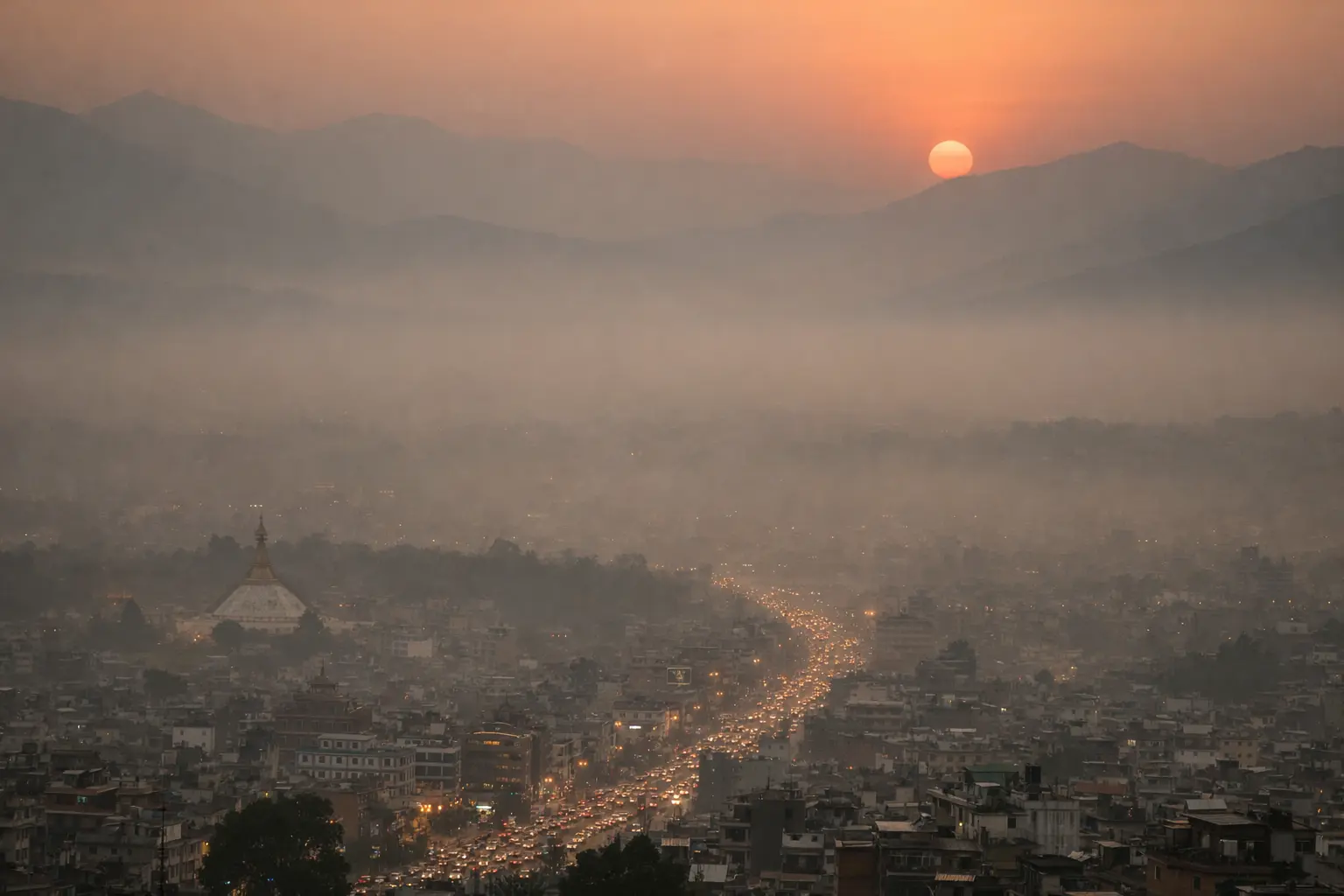
The valley is surrounded by mountains and connected to the outside world through only a few narrow mountain passes.
With no major river flowing into the valley and only a narrow outlet through the Bagmati River, the valley functions like a large bowl that traps air inside.
Because of this natural structure:
- Polluted air often remains trapped inside the valley
- Wind circulation is limited
- Pollution disperses slowly
This effect becomes particularly severe during winter.
The Role of Temperature Inversion
A phenomenon called temperature inversion is one of the main reasons Kathmandu’s pollution becomes so intense during the winter months.
Normally, warm air near the ground rises and disperses pollutants.
During an inversion, however, the situation reverses:
- Cold air settles near the valley floor
- Warmer air forms a layer above it
- Pollutants become trapped below this warm layer
This warm layer acts like a lid, preventing pollution from escaping the valley.
Why Pollution Spikes at Night
Winter inversions in Kathmandu usually begin around sunset.
Unfortunately, this timing coincides with the evening rush hour, when traffic emissions are at their highest.
As vehicles release pollutants into the air, the inversion traps them near the ground.
The result is a nighttime spike in air pollution levels.
Later in the night, cooler air flowing down from the surrounding mountains can lift some of the pollution upward, which is why air quality sometimes improves slightly after 10–11 PM.
Why Mornings Can Be Highly Polluted
Many people assume that mornings have the cleanest air, but this is often a myth.
After sunrise, the sun first heats the mountain slopes around the valley.
Warm air begins rising along these slopes and pulls polluted air from the valley center back toward the ground.
This movement creates a second pollution peak between approximately 8 AM and 11 AM, when pollutants return closer to ground level.
Only when sunlight becomes strong enough to break the inversion does the air begin circulating normally.
Why Afternoons Are Usually Cleaner
By afternoon:
- The valley floor warms up
- The inversion weakens
- Winds become stronger
Cleaner air often enters the valley through western mountain passes, improving air quality.
This is why afternoons in Kathmandu generally feel less polluted compared to mornings and evenings.
Could Changing Work Hours Reduce Pollution?
Understanding the daily pollution cycle may help Kathmandu design better pollution control policies.
One possible approach could be adjusting winter working hours so that evening rush hour occurs before the inversion begins.
Reducing emissions during the period when pollution is trapped could significantly improve air quality.
Testing such strategies using modern monitoring systems could provide valuable evidence for future policy decisions.
Monitoring Kathmandu’s Air Quality
Research on Kathmandu’s pollution cycle was first conducted by Arnico Panday at ICIMOD, whose work highlighted how valley geography and weather patterns influence air quality.
Today, expanded air quality monitoring networks are being developed by research institutions and government agencies.
These monitoring systems will provide better data to help policymakers design more effective solutions for Kathmandu’s air pollution problem.