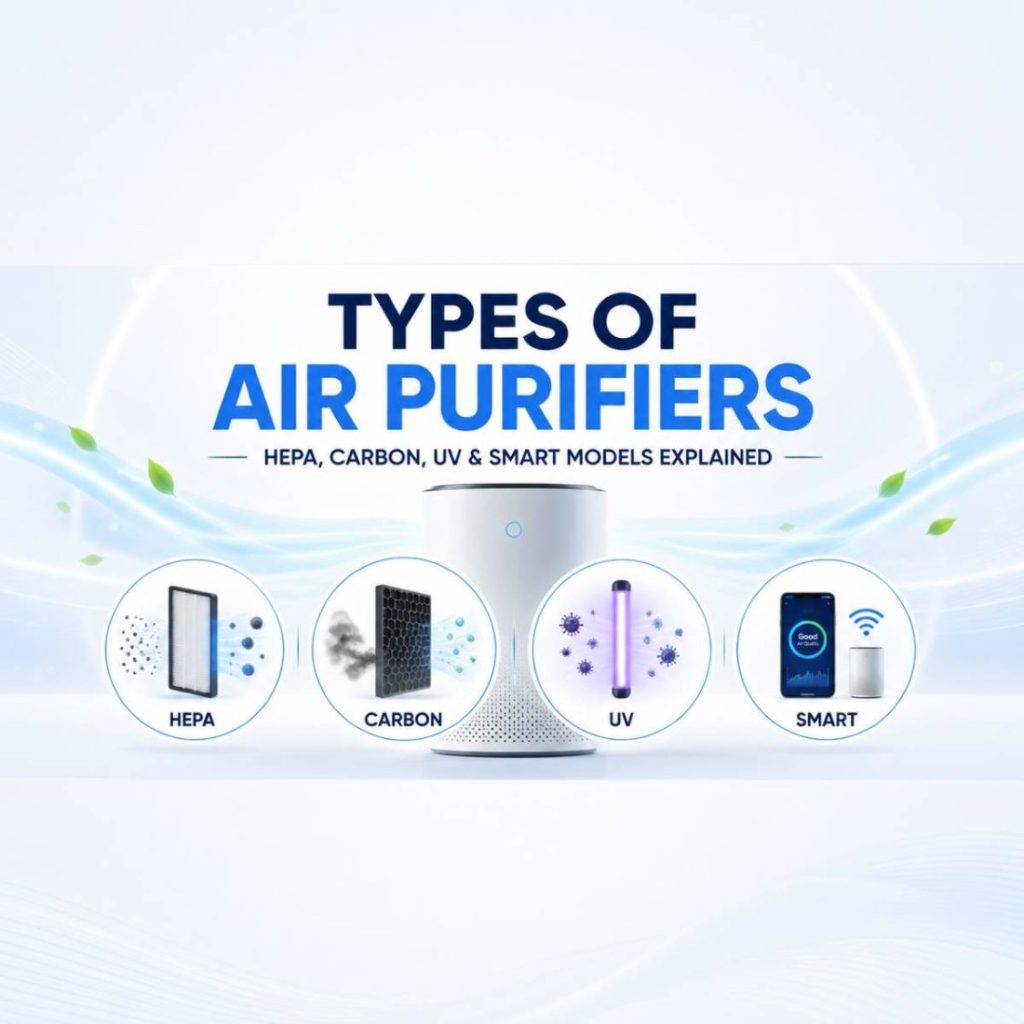
This guide explains the main types of air purifier technology you will see on boxes in Nepal: HEPA, activated carbon, UV-C, ionizers and smart features. For each one you will learn what it targets, what it cannot do, and how much weight to give it when you compare models.
Most purifiers combine two or more of these. The short version: a particle filter does the main work, carbon adds smell and gas control, and the rest are extras.
The types at a glance
| Type | What it targets | What it cannot do | How much it matters |
|---|---|---|---|
| HEPA or HEPASilent filter | Dust, PM2.5, smoke particles, pollen, pet dander | Remove smells or gases | The core of any purifier |
| Activated carbon | Cooking smells, smoke smell, some VOCs | Catch dust or fine particles | Worth having if smells bother you |
| UV-C light | Germs passing the lamp | Catch dust or remove gases | An extra, not a reason to buy |
| Ionizer | Charges particles so they settle or stick | Remove gases; some models make ozone | Only if tested ozone-free |
| Smart features | Sensors, Auto mode, app control | Clean the air on their own | Convenience on top of good filtration |
HEPA filters: the particle filter
A HEPA filter is a dense sheet of fine fibres that catches particles as the fan pushes air through it. It handles the dust, PM2.5 and smoke particles that are the main reason people in Nepal buy a purifier. What the 99.97% figure means, how H13 and “HEPA-type” labels differ, and how Blueair’s HEPASilent compares are all in our HEPA filter guide.
Activated carbon air purifiers
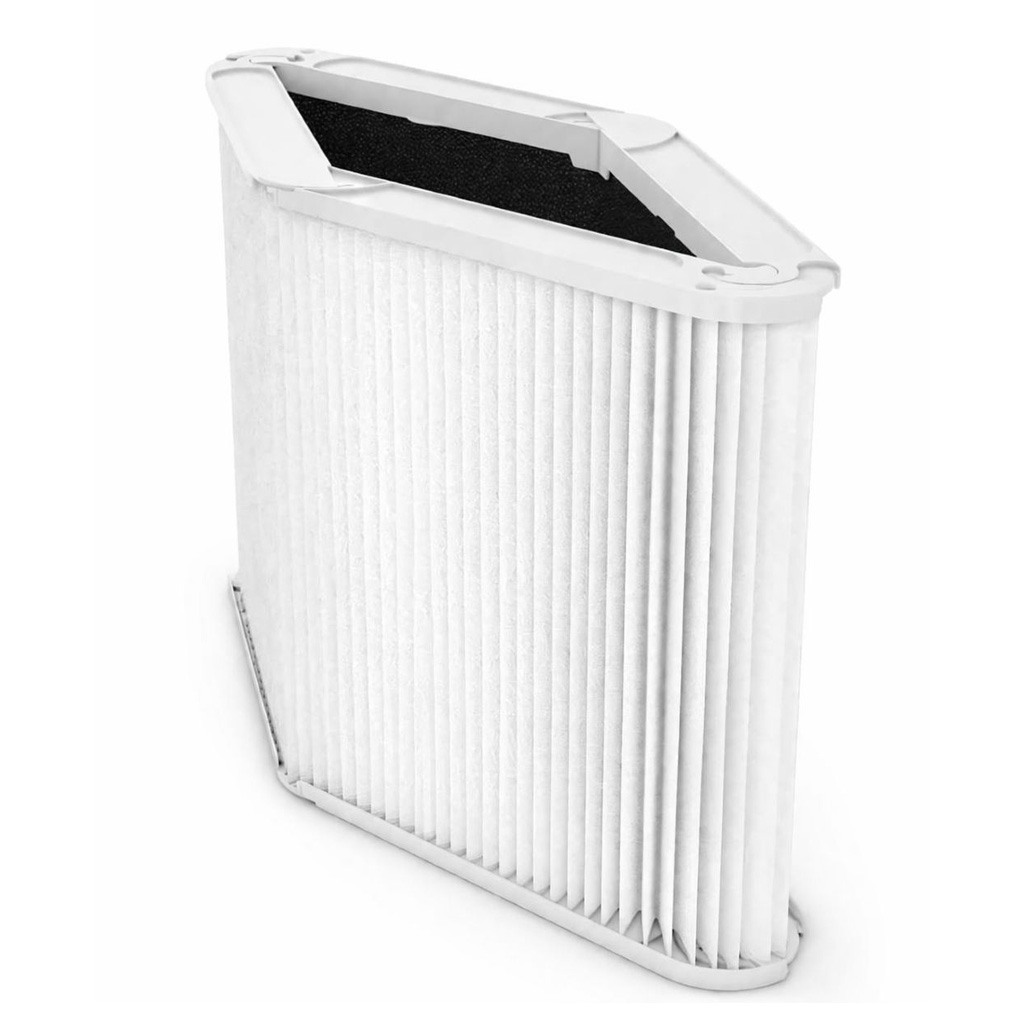
Activated carbon, also sold as a charcoal filter, deals with the part of indoor air pollution a particle filter misses: gases. Carbon is full of tiny pores. Smell and gas molecules stick to the huge inside surface of those pores as air passes through. This is called adsorption.
That makes carbon useful for:
- cooking smells, tadka and frying fumes
- the smell of smoke from dhoop, incense or cigarettes
- traffic smell from a roadside window
- some VOCs from paint, cleaning products and new furniture
The amount of carbon matters. The US EPA says carbon filters can be effective when the filter holds a large amount of material. A thin carbon sheet handles light everyday smells. Heavy fumes need much more. There is also no widely used test for how well a purifier removes gases, unlike CADR for particles.
Carbon does not catch dust, so it always works next to a particle filter. The Blue 3610, for example, takes a HEPASilent particle filter with a layer of activated carbon for light household smells from cooking, pets and smoking. For smells in the kitchen, see our guide to cooking smoke and odours. For paint and furniture, see VOCs at home.
UV air purifiers
A UV air purifier has a UV-C lamp inside. UV-C light can damage bacteria and viruses, so the lamp is meant to make germs passing through the purifier inactive.
It is an extra, not the main cleaner. UV-C does not catch dust, PM2.5 or smoke particles, and the US EPA says research has not shown that UV light removes gases in home air cleaners. The EPA also lists UV lamps without proper coatings as a possible source of ozone. In a home in Nepal, the dust and smoke you can measure are the bigger problem, and a particle filter handles those.
Blueair purifiers do not use UV lamps. Their HealthProtect Series uses GermShield instead, which works on germs caught in the filter. Our post on air purifiers, viruses and bacteria covers what any purifier can and cannot do about germs.
Ionizers and ozone
An ionizer releases charged particles into the air, or charges the particles passing through the purifier. Charged dust either sticks to surfaces in the room or is caught more easily by a filter.
The risk is ozone. The US EPA says purifiers with ionizers or electrostatic parts can emit ozone, a lung irritant, and advises avoiding any purifier that makes ozone on purpose. Look for a purifier tested for low or zero ozone, such as one on the California Air Resources Board (CARB) list.
Blueair’s HEPASilent uses a charge too: it charges the particles so the filter catches them, and the charged dust stays in the filter. Which purifiers make ozone and how to check is the topic of our post do air purifiers produce ozone.
Smart air purifiers
“Smart” describes how a purifier is controlled, not how it filters. Inside there is still a particle filter, often with carbon. The smart part is usually:
- An air quality sensor that reads particles in the room
- Auto mode that raises the fan when the reading goes up and lowers it when the air is clean
- App control for schedules, readings and filter life on your phone
Auto mode is the feature that helps most in a Nepali home. Indoor air changes through the day with cooking, cleaning and traffic, and the purifier reacts without you touching it. The Blue 3610 has a sensor and Auto mode without an app. The DustMagnet 5440i and HealthProtect 7470i add the Blueair app. The simplest model, the Blue Pure 411 at Rs 22,000, has no sensor at all and still cleans small rooms well, because filtration matters more than features.
What the numbers on a purifier screen mean is covered in our guide to purifier readings.
Multi-stage purifiers
A multi-stage purifier stacks several of these in one machine. A common order is:
- a pre-filter for hair and large dust
- a HEPA or HEPASilent filter for fine particles
- an activated carbon layer for smells and gases
- sensors and Auto mode to set the speed
This is the setup that suits most homes in Nepal, where a room often has dust, smoke and cooking smells on the same day. The HealthProtect 7770i is an example: a SmartFilter with HEPASilent Ultra and a carbon layer, plus a screen that shows particles, VOCs, temperature and humidity.
More stages are not automatically better. A purifier with five stages and a weak fan still cleans a room slowly. Check the CADR for your room size first; our guide to choosing an air purifier walks through every check.
FAQs
What are the main types of air purifiers?
HEPA filters for particles, activated carbon for smells and gases, UV-C lamps for germs, ionizers that charge particles, and smart models with sensors and app control. Most purifiers combine a particle filter with one or more of the others.
What does an activated carbon filter do in an air purifier?
It removes smells and some gases. The gas molecules stick to the surface of the carbon’s tiny pores. Carbon does not catch dust, so it is always paired with a particle filter.
Is a UV air purifier better than a HEPA air purifier?
No. UV-C only works on germs passing the lamp and does not catch dust, PM2.5 or smoke particles. A particle filter does the main cleaning in any home. Our HEPA filter guide explains how it works.
Is a smart air purifier worth the extra cost?
Auto mode is worth having, because the purifier speeds up when you cook or the air outside gets worse. An app is a convenience. Neither replaces a good filter and enough CADR for your room.
Which type of air purifier suits most homes in Nepal?
A particle filter with an activated carbon layer, ideally with Auto mode. That handles dust and PM2.5 as well as cooking and smoke smells. Ionizers and UV are optional extras.
Sources and references
- Guide to Air Cleaners in the Home (activated carbon, UV, ionizers and ozone), US Environmental Protection Agency
- Ozone Generators that are Sold as Air Cleaners, US Environmental Protection Agency
- Air cleaners and ozone products (certified low-ozone air cleaners), California Air Resources Board
- What is a HEPA filter?, US Environmental Protection Agency
- HEPASilent removes 99.97% of airborne particles down to 0.1 micron (Blue Pure 211i Max FAQ), Blueair