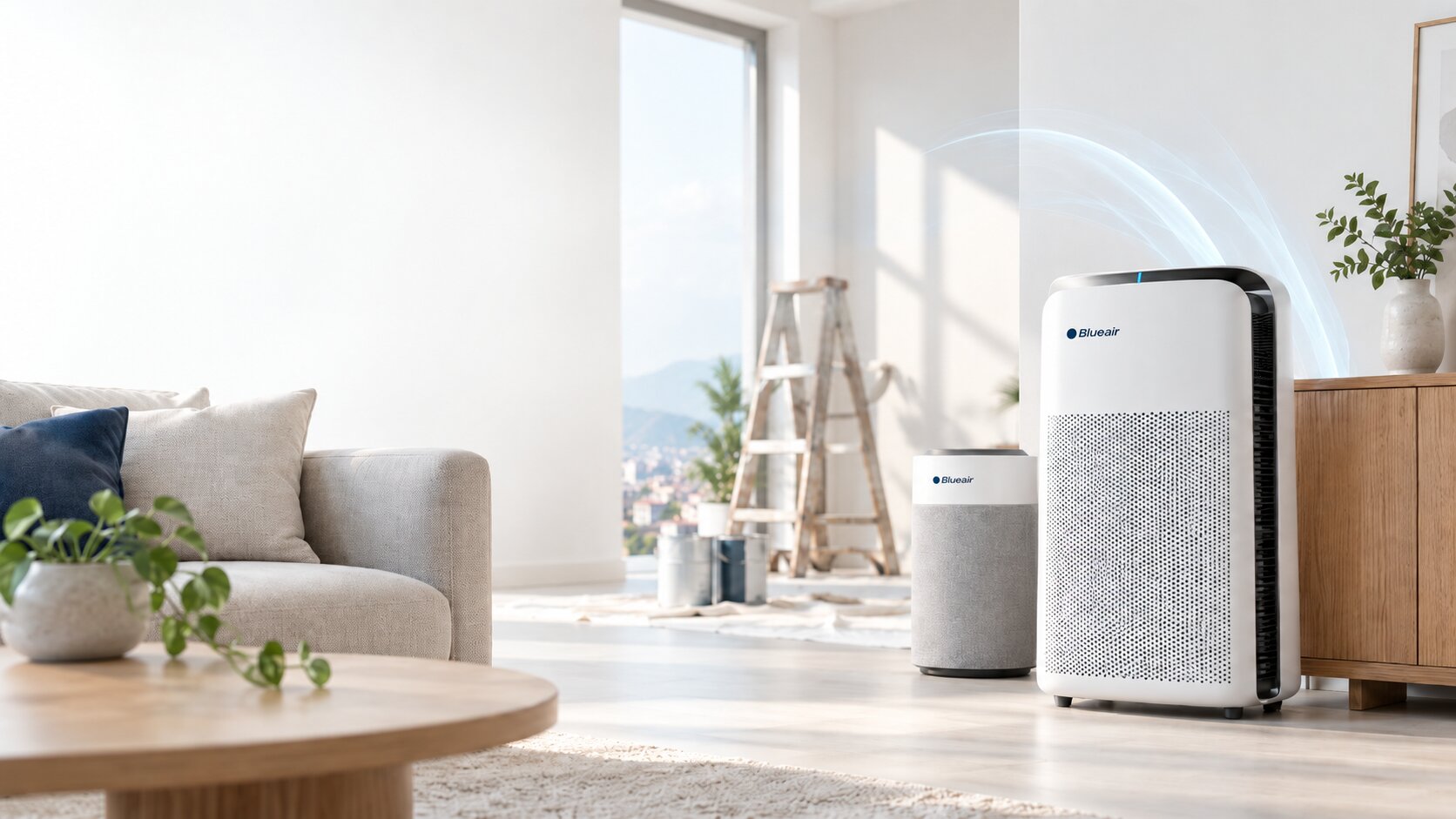
An air purifier for VOCs can help reduce certain gaseous pollutants released by new paint, furniture, and renovation materials, but it shouldn’t be the only solution. VOCs are gases, so effective filtration requires an appropriate gas-phase medium such as activated carbon. HEPA or other high-efficiency mechanical filtration primarily targets particles such as renovation dust and PM2.5.
This distinction matters when renovating or furnishing a home in Nepal. Fresh paint, adhesives, flooring, coatings and new furniture may introduce gaseous pollutants, while drilling, sanding and construction work can produce airborne particles. Source control and appropriate ventilation should come first, with air purification used as an additional layer of indoor air-quality management.
What Are VOCs and Why Do New Paint and Furniture Release Them?
Volatile organic compounds (VOCs) are carbon-containing chemicals that can evaporate into indoor air at normal room temperatures. They may be released while products are being used and, in some cases, continue to be emitted afterwards through a process known as off-gassing.
Common indoor sources include:
- Paints and varnishes used on walls, furniture and other surfaces
- Adhesives and sealants used during flooring, cabinetry and renovation work
- Flooring and coatings, including some finishes and installation products
- Composite or pressed-wood products, which may contain resins and adhesives
- New furniture and cabinetry, particularly products made from multiple materials and finishes
- Cleaning products and solvents used during or after renovation
- Other building materials that may release different VOCs at different rates
Indoor concentrations of some VOCs can become higher when emissions occur in an enclosed or poorly ventilated room. This is why source control and ventilation matter after painting, furnishing, or renovation, even when the room looks clean, and the obvious renovation work is finished.
What Is Furniture Off-Gassing?
Furniture off-gassing is the release of volatile chemicals from materials, adhesives, finishes and coatings into indoor air. The amount varies by product, and a new furniture smell may indicate emissions, but smell alone cannot show which VOCs are present or at what concentration.
Why Pressed Wood Can Release Formaldehyde
Formaldehyde is a VOC that can be released from certain pressed-wood products because of the adhesives and resins used during manufacturing. The amount released can vary depending on the product, materials and manufacturing process.
Common pressed-wood materials include:
- Particleboard used in furniture and cabinetry
- Medium-density fibreboard (MDF) used in cabinets, shelves and panels
- Some hardwood plywood used in furniture and interior fittings
- Composite wood products made using adhesives or resins
Not every pressed-wood product releases the same amount of formaldehyde, so the specific material, adhesive, coating and age of the product all matter.
How Long Does New Furniture Off-Gas?
There is no fixed off-gassing period for new furniture because emissions vary depending on the materials, product design and indoor conditions.
Factors that can affect off-gassing include:
- Material and adhesive composition
- Age of the furniture
- Indoor temperature and humidity
- Ventilation
- Surface coatings and finishes
Formaldehyde emissions from pressed-wood products can decline as the product ages, but the rate varies. Rather than relying on a set number of days, follow the manufacturer’s guidance and keep the room appropriately ventilated.
New Paint Smell vs VOCs: Are They the Same Thing?
No, a new paint smell does not directly indicate how much VOC pollution is present. Some VOCs have noticeable odours, while others may be present without a strong smell.
Key points to remember:
- Strong smell does not always mean high VOC levels
- Weak or no smell does not guarantee VOCs are gone
- Different VOCs have different odour thresholds
- Removing the smell does not prove all VOCs have been removed
Use smell as a sign that more ventilation may be needed, but continue to follow the paint or coating manufacturer’s ventilation and occupancy instructions even after the odour fades.
Renovation Indoor Air Quality: Dust and VOCs Are Different
Renovation can create both airborne particles and gaseous pollutants. Sanding, drilling and demolition produce dust, while paint, adhesives, flooring and new furniture can release VOCs.
| Pollutant type | Examples | Main source during renovation | Suitable filtration/control |
| Particles | Dust, PM2.5, fine particles | Sanding, drilling, demolition | HEPA/mechanical filtration + cleaning |
| Gases/VOCs | Formaldehyde, solvents, other VOCs | Paint, adhesives, coatings, furniture | Source control + ventilation + activated carbon/gas-phase filtration |
| Odours | Paint and furniture smells | Various materials | Ventilation + suitable gas-phase filtration |
HEPA and activated carbon perform different jobs. HEPA and mechanical filters capture airborne particles such as renovation dust, while VOCs are gases and require appropriate gas-phase filtration, such as activated carbon. For renovation-related indoor air quality, a purifier may therefore need both types of filtration.
Does an Air Purifier Remove VOCs?
An appropriately designed air purifier can reduce certain VOCs, but not every purifier is suitable for gaseous pollutants. Particle filters such as HEPA primarily capture airborne particles, while VOCs are gases and require suitable gas-phase filtration.
Activated carbon can help by adsorbing certain gases onto its porous surface, but performance depends on:
- Amount of carbon or sorbent used
- Carbon quality and filter design
- Type and concentration of the VOC
- Airflow and contact time
- Condition and age of the filter
- Remaining adsorption capacity
Activated carbon does not have unlimited capacity. As the filter becomes used or saturated, its effectiveness can decline, so proper maintenance and timely replacement are important.
What Type of Air Purifier Is Best for VOCs?
When renovation creates both dust and chemical emissions, the most useful configuration is one that addresses both particulate and gaseous pollution, alongside ventilation and source control.
Mechanical/HEPA Filtration
HEPA and other high-efficiency mechanical filters are designed to capture airborne particles.
During renovation, these may include:
- Fine construction dust from cutting and building work
- Sanding dust from walls, wood and surfaces
- PM2.5 and other fine particles
- Smoke particles from nearby outdoor pollution or work activities
- Other suspended dust and debris remaining after renovation
HEPA filtration should therefore be viewed as the particle-control component of an air purifier, not as proof that the purifier can remove gaseous VOCs.
Activated Carbon Filtration
An activated carbon air purifier uses porous carbon to adsorb certain gaseous pollutants and odours. Its effectiveness depends on the amount and quality of carbon, filter design, airflow and the specific VOC being targeted.
Key things to check include:
- Amount of activated carbon used
- Type and design of the gas-phase filter
- Manufacturer-supported VOC or odour claims
- Relevant testing or technical documentation
- Filter replacement requirements
A thin carbon layer designed mainly for light odours should not be assumed to perform like a more substantial gas-phase filtration system.
Combined Particle + Activated Carbon Filtration
A purifier that combines particle filtration with activated carbon can address both renovation dust and certain gaseous pollutants.
This combination can help manage:
- Fine renovation dust and PM2.5
- Particles from sanding and drilling
- Certain VOCs from paint and adhesives
- Some furniture and renovation odours
Combined filtration is especially relevant after painting, flooring installation or furnishing. The presence of activated carbon does not mean every VOC will be removed.
Electronic and Other Technologies
Technologies such as ionisation, plasma, UV and other electronic systems should not automatically be treated as effective VOC-removal solutions.
When comparing these systems, check:
- Which pollutants the technology is designed to target
- Whether VOC performance has been specifically tested
- Evidence for the exact purifier model
- Any relevant safety or emissions documentation
For VOC concerns, prioritise documented gas-phase filtration performance rather than broad technology or marketing claims.
How to Reduce VOC Exposure After Painting or Renovation
Imagine a family in Kathmandu that has just repainted a bedroom, installed new flooring and added pressed-wood furniture. The room may still contain both chemical emissions and fine renovation dust, so relying on an air purifier alone is not enough.
A better approach is to:
- Follow product ventilation instructions for paint, adhesives, flooring and coatings.
- Remove unnecessary pollution sources such as leftover paint, solvents and adhesives.
- Ventilate the room appropriately before prolonged occupancy.
- Clean renovation dust from floors, furniture and other surfaces.
- Use suitable air purification for remaining particles and certain gaseous pollutants.
- Maintain and replace filters according to manufacturer guidance.
- Avoid adding extra indoor pollution from smoke, incense or strong chemical products.
- Continue ventilation when outdoor air conditions allow.
For more practical guidance, see air purifier mistakes that reduce performance in Nepal homes. Air purification should support source control and ventilation, not replace them.
How to Choose an Air Purifier for VOCs
Choosing an air purifier for VOCs means checking the actual filtration system, not just the product name or headline claims.
Look for:
- Activated carbon filtration with a clearly documented design
- Mechanical or HEPA filtration for renovation dust and PM2.5
- Appropriate room coverage for the space where it will be used
- CADR to compare particle-cleaning performance
- Specific VOC or gas-filtration claims supported by technical documentation
- Replacement filter availability and recommended replacement intervals
- Independent testing or certification where available
- Practical operating factors such as noise, airflow and maintenance
CADR alone does not prove VOC-removal performance. It is mainly used to measure particle-cleaning performance, so gas-phase filtration should be evaluated separately.
Blueair Air Purifiers for VOCs: Which Models Should You Consider?
Blueair models differ in their particle and gas-filtration setup, so it is important to check the exact filter used with each model rather than assuming all Blueair purifiers perform the same way for VOCs.
| Model | Particle filtration | Gas/VOC filtration | What to check |
| HealthProtect 7470i | HEPASilent Ultra | Activated carbon in Protect 7400 SmartFilter | Current filter configuration and availability |
| HealthProtect 7770i | HEPASilent Ultra | Activated carbon in Protect 7700 SmartFilter | Current filter configuration and availability |
| Classic 405 | HEPASilent | Carbon filter options available | Exact filter supplied with the unit |
| Classic 480i | HEPASilent | Carbon-containing filter options available | Exact current filter type |
The HealthProtect 7470i and 7770i have clearer official documentation showing activated-carbon filtration alongside particle filtration. The Classic 405 and 480i can also use carbon-containing filters, but the exact configuration should be confirmed before choosing them specifically for renovation VOCs.
None of these models should be assumed to remove every VOC. Always verify the current filter specification and any model-specific VOC claims before purchasing.
Can an Air Purifier Remove Formaldehyde From New Furniture?
Some gas-phase filtration systems may reduce airborne formaldehyde, but they should not be assumed to remove it completely.
Formaldehyde from certain composite-wood products and adhesives is a gas, so HEPA filtration alone is not enough. When evaluating a purifier, look for:
- Activated carbon or other gas-phase filtration
- A meaningful amount of sorbent media
- Suitable airflow and contact time
- Model-specific formaldehyde or VOC testing
- Regular filter replacement
- Source control and ventilation
Filtration does not stop furniture from continuing to off-gas. Ventilation and reducing or managing the source remain important alongside air purification.
How Long Should You Run an Air Purifier After Renovation?
No fixed number of hours or days guarantees VOC removal after renovation. The right runtime depends on the room, purifier and pollution source.
Key factors include:
- Room size and purifier airflow
- Type and concentration of VOCs
- Strength of the pollution source
- Activated carbon capacity
- Ventilation rate
- Filter condition
- Whether new materials are still off-gassing
Running the purifier for longer can increase the amount of air passing through the filters, but it does not replace ventilation or manufacturer-recommended waiting periods for paint, adhesives or flooring.
Common Mistakes When Using an Air Purifier for VOCs
Common mistakes include:
- Buying a purifier with strong HEPA filtration but little or no gas-phase filtration when VOCs are the main concern.
- Assuming an “odour removal” claim proves comprehensive VOC removal.
- Ignoring the original source of the pollutant.
- Closing a newly painted room and relying entirely on filtration instead of following ventilation instructions.
- Choosing a purifier solely from its CADR rating.
- Failing to check the quantity or design of the carbon filtration.
- Continuing to use gas-phase filters after their adsorption capacity has declined.
- Assuming every activated-carbon filter performs equally.
- Treating a weaker chemical smell as proof that all VOCs have disappeared.
- Using an air purifier as a substitute for manufacturer-recommended ventilation.
For broader operating problems, see 10 Air Purifier Mistakes That Reduce Performance in Nepal Homes for more practical guidance.
Need Help Choosing the Right Air Purifier?
Not sure which filtration system is suitable for renovation dust, VOCs or new furniture? Get in touch with our air purification team for help comparing models, filters and room-size requirements before you buy.
FAQs
Do HEPA Filters Remove VOCs?
HEPA filters are primarily designed to capture airborne particles. Gaseous VOCs require suitable gas-phase filtration rather than HEPA filtration alone.
Does Activated Carbon Remove Formaldehyde?
Appropriately designed activated-carbon or other sorbent filtration may reduce certain gaseous pollutants, potentially including formaldehyde, but performance depends heavily on the media and conditions. Do not assume every carbon filter has the same capability.
Does an Air Purifier Remove New Paint Smell?
Suitable activated-carbon filtration may reduce some compounds responsible for paint odours. Removing the smell does not prove that every VOC has been removed, so ventilation instructions should still be followed.
How Long Do New Furniture VOCs Last?
There is no universal timeframe. Emissions vary with materials, adhesives, coatings, age, temperature, humidity and ventilation, and can decline at different rates.
Can Air Purifiers Help After Home Renovation?
They can help as part of a wider strategy. Mechanical filtration can reduce airborne renovation dust, while suitable gas-phase filtration can address certain gases and odours.
What Type of Air Purifier Is Best for New Furniture?
If both furniture off-gassing and airborne particles are concerns, look for effective particle filtration combined with documented gas-phase filtration such as activated carbon. Source control and ventilation remain important.
Can an Air Purifier Completely Remove VOCs?
Do not assume so. VOCs include many different chemicals, and gas-phase filters vary in their ability and capacity to adsorb them.
Should I Ventilate a Newly Painted Room Even If I Have an Air Purifier?
Yes, follow the paint manufacturer’s ventilation and occupancy instructions. An air purifier should complement appropriate ventilation rather than replace it.