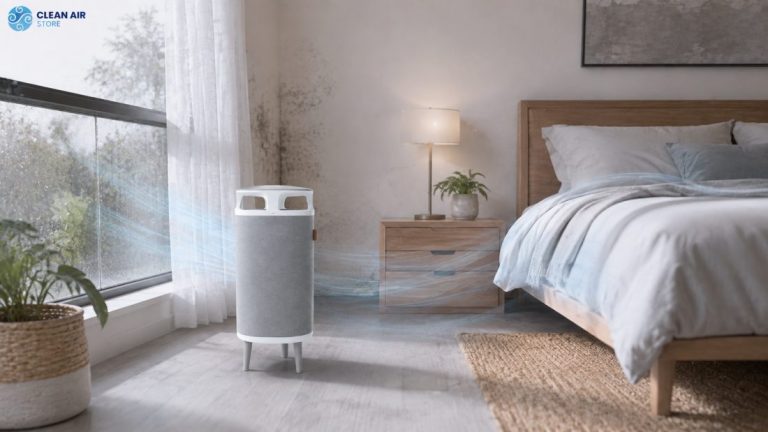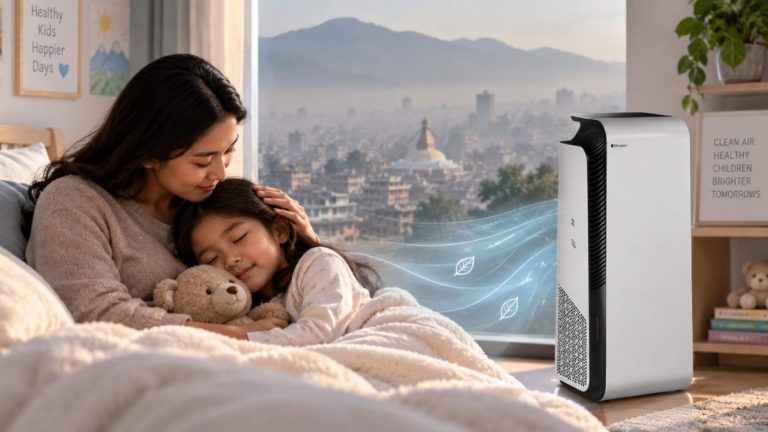
Yes. An air purifier sized for the room pulls dust, pollen, pet dander, mould spores and PM2.5 out of the air, and these are the airborne particles that most often set off asthma and allergy symptoms. Run it in the bedroom and you also get cleaner, quieter air for the hours you sleep. This guide covers what a purifier does for asthma, allergies and sleep, what it cannot do, and how to set one up for the best result.
One point first, because it matters: a purifier cleans the air in the room. It does not replace an inhaler, medicine or your doctor’s advice. Used alongside them, it lowers how much of the trigger you breathe in every day.
How an air purifier cleans the air in a room
A purifier draws room air through its filters and blows cleaner air back out, over and over. How much it helps depends on how much clean air it delivers (its CADR), the size of the room, where you put it and how long it runs.
The particle filter does the main work
A true HEPA filter captures at least 99.97% of particles at 0.3 micron from the air that passes through it. Blueair’s HEPASilent filtration combines a mechanical filter with an electrostatic charge and is rated to capture 99.97% of airborne particles down to 0.1 micron. You can read how it works on our Blueair technology page, and our HEPA filter guide explains the filter grades.
Carbon helps with smells
Activated carbon holds on to some odour and gas molecules from cooking, smoke and pets. It does not remove every gas and it is no substitute for a kitchen exhaust fan. For allergies and asthma, the particle filter is the part that counts.
Which allergy and asthma triggers a purifier removes
A purifier works on anything that floats in the air long enough to reach its filter. Particles that have settled into a mattress, carpet or sofa stay there until you clean them. That is why the best results come from the purifier and a cleaning routine together.
| Trigger | What the purifier does | What you do as well |
|---|---|---|
| Dust and PM2.5 | Captures fine dust and smoke particles from the air | Damp dust, vacuum, keep doors and windows shut on dusty days |
| Pollen | Removes pollen that comes in on air and clothes | Close windows on high pollen days, wash clothes after time outdoors |
| Pet dander | Captures airborne dander from cats and dogs | Keep pets off the bed, wash pet bedding, vacuum furniture |
| Dust mite particles | Captures mite particles when bedding is shaken or the room is cleaned | Wash sheets and blankets in hot water every week |
| Mould spores | Captures spores floating in the room | Fix leaks and damp walls; the purifier cannot remove mould growing on a surface |
| Smoke particles | Captures fine particles from incense, cooking and outdoor smoke | Remove the source, use the kitchen exhaust, do not smoke indoors |
This is the same order the US EPA guide to air cleaners recommends: control the source first, ventilate when the outdoor air is clean, then filter. Mould has its own guide: do air purifiers help with mould.
Air purifier for asthma: what it can do
The CDC lists dust mites, furry pets, mould, secondhand smoke and outdoor air pollution among the common asthma triggers. Every one of these is, at some point, a particle in the air. A purifier that keeps those particles low in the room where the person spends most hours means fewer triggers breathed in, day and night.
The bedroom is the place to start. Most people spend seven or more hours there every night with the door closed, and a purifier running the whole time keeps that air clean while you sleep. During smoky or dusty spells, when the outdoor PM2.5 in Kathmandu and other cities climbs, the purifier keeps the indoor level down. Our post on PM2.5 and your health explains why fine particles matter so much for the lungs.
Keep using the asthma action plan your doctor gave you. Never cut back prescribed treatment because a purifier is running, and get urgent care for severe breathlessness, trouble speaking or blue lips.
Air purifier for allergies: what the research shows
Allergy symptoms at home usually come from pollen, pet dander, dust mite particles and mould spores. A HEPA purifier captures all four while they are in the air.
A six-week trial in Korea gave people with dust mite allergic rhinitis two real purifiers (one in the bedroom, one in the living room) or two dummy units. In homes with the real purifiers, bedroom PM2.5 fell by up to 51.8% and patients needed less allergy medication. Their symptom scores did not change much in six weeks, so the purifier works best as one part of a routine: clean air, clean bedding and the treatment your doctor recommends.
For pet allergies, run the purifier in the room where the pet spends most time and keep the pet out of the bedroom. For dust mites, the purifier catches what gets stirred up, but weekly hot washing of sheets and pillow covers does the rest.
Clean air and a better night’s sleep
Sleep is where a purifier earns its place. Adults need at least seven hours of sleep a night, so you spend about a third of every day breathing bedroom air. The US EPA reports that indoor levels of some pollutants can be 2 to 5 times higher than outdoors. With the door and window shut, dust, dander and fine particles stay in the room unless something removes them.
When airborne irritants are the reason you cough, sneeze or wake up with a blocked nose, cleaner bedroom air helps you rest. A purifier will not fix insomnia or sleep apnoea. If you snore loudly with pauses in breathing, or wake up breathless, see a doctor.
Quiet enough to sleep beside
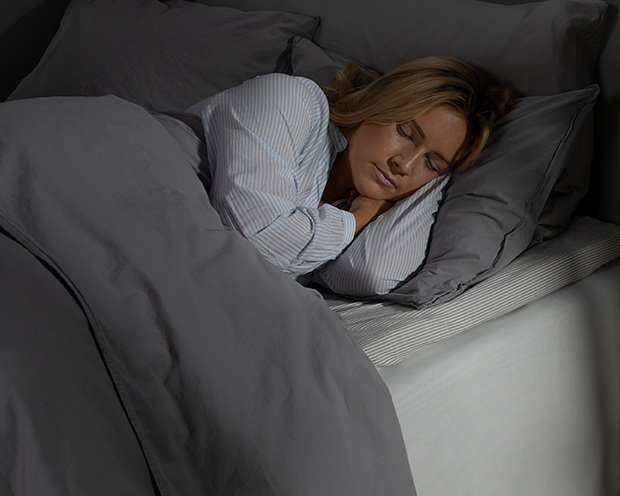
Noise decides whether people keep a purifier running at night. The WHO recommends keeping bedroom noise under 30 dB(A) at night for good-quality sleep. Blueair’s lowest speeds sit well under that:
- Blue Pure 411: 17 dB on the lowest speed, for bedrooms up to 161 sq ft. Hold the button for 5 seconds to dim the lights.
- Blue 3610: 23 dB on the lowest speed, for rooms up to 549 sq ft, with auto mode.
- HealthProtect 7470i: 25 dB on the lowest speed, for rooms up to 418 sq ft, with a night mode schedule and adjustable display brightness.
Our air purifier for bedroom page compares these models side by side, and for a child’s room see the baby and kids room page.
What an air purifier can and cannot do
| It can | It cannot |
|---|---|
| Cut airborne dust, pollen and pet dander | Cure asthma, allergies or a sleep disorder |
| Lower PM2.5 and smoke particles indoors | Replace inhalers, medicine or medical advice |
| Capture mould spores floating in the air | Remove mould growing on walls or furniture |
| Keep one room or open area clean | Clean a whole house through closed doors |
| Run quietly all night in a bedroom | Remove carbon dioxide (open a window when the outdoor air is clean) |
On the last point, see do air purifiers remove CO2.
What to look for when allergies or asthma are the reason
The full buying checklist is in our guide on how to choose an air purifier. For allergy and asthma rooms, four points matter most:
- A proven particle filter. HEPA or HEPASilent, tested for fine particles. A carbon layer is a bonus for smells, not the main feature.
- Enough clean air for the room. Measure the room in sq ft and pick a model rated for at least that size. Our CADR and room size guide shows the maths.
- Low noise at the speed you will use. Check the dB figure on low and medium, not only the quietest setting.
- Filters you can buy locally. A purifier with a clogged filter cleans less air. We stock genuine Blueair replacement filters in Nepal.
The HealthProtect Series adds GermShield, which kills viruses and bacteria on the filter, even on standby, and shows live PM readings on the display. The Blue Series covers the same particles at a lower price.
Set it up for the best result
- Put it in the bedroom or the room where symptoms are worst, with space around the intake and outlet as the manual says. Our placement guide covers every room.
- Do not point strong airflow straight at the pillow.
- Switch it on before bed if the room has been open or just cleaned, then leave it running through the night. See how long to run an air purifier.
- Use a higher speed after cooking, cleaning or burning incense, and when the outdoor reading is high. Check the live AQI for Kathmandu and other cities.
- Keep windows closed when the outdoor air is dusty or smoky, and open them for a short time when it is clean.
- Clean the pre-filter and change the main filter on time.
- Never use an ozone generator in a room where people sleep. Ozone irritates the lungs. More in do air purifiers produce ozone.
Not sure which model fits your room? Message us with the room size and who sleeps there, and we will suggest the right Blueair for you.
FAQs
Will an air purifier help me sleep better?
It helps when dust, pollen, pet dander or smoke in the bedroom make you cough, sneeze or wake up blocked. Run it all night on a low speed under 30 dB, with the display dimmed.
Can an air purifier stop an asthma attack?
No. A purifier lowers the triggers in the air before symptoms start, but during an attack follow the asthma action plan and get medical help if symptoms are severe or do not improve.
Do doctors recommend air purifiers for asthma?
Doctors often advise people with asthma to reduce triggers at home, and air filtration is one way to do that. Use it alongside your prescribed treatment, never instead of it.
Can an air purifier remove dust mites?
It captures dust mite particles that get into the air, but the mites themselves live in bedding, mattresses and carpets. Wash bedding in hot water every week and vacuum often.
Does an air purifier help with pet allergies?
Yes, it captures pet dander floating in the room. Run it where the pet spends most time, keep the pet out of the bedroom and vacuum furniture regularly.
Which filter is best for allergies?
A HEPA or HEPASilent particle filter, because pollen, dander, mite particles and mould spores are all particles. Carbon only helps with smells.
Sources and references
- Guide to Air Cleaners in the Home, US Environmental Protection Agency
- The Inside Story: A Guide to Indoor Air Quality (indoor levels 2 to 5 times higher), US EPA
- Asthma Triggers: Gain Control (dust mites, pets, mould), US EPA
- Controlling Asthma: common triggers, Centers for Disease Control and Prevention
- Park et al. 2020, air purification for house dust mite allergic rhinitis, Yonsei Medical Journal
- Noise fact sheet (under 30 dB(A) in bedrooms at night), WHO Europe
- About Sleep and Your Heart Health (adults need at least 7 hours), CDC