Indoor air pollution can come from both outdoor sources and everyday activities inside the home. Outdoor PM2.5, dust and smoke can enter through doors, vents and small gaps, while cooking, incense, cleaning products, dampness and household dust can add pollutants inside.
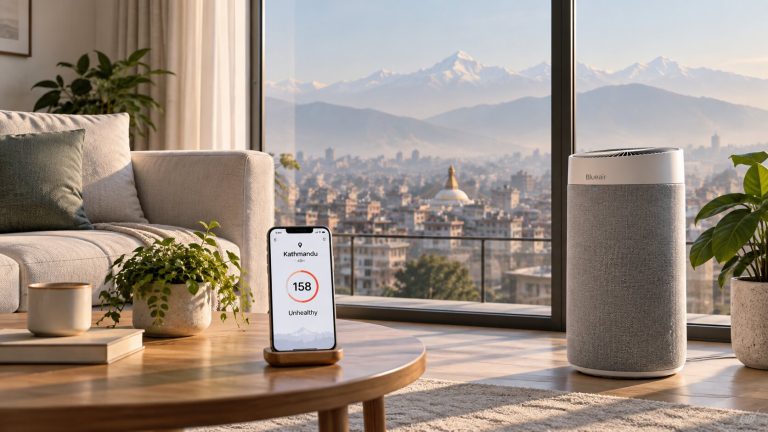
For a home in Kathmandu near a busy road, closing the windows during a polluted afternoon can reduce direct outdoor air entry, but it cannot block every particle. Cooking fumes, incense, or dust stirred up by cleaning and movement can affect the air at the same time.
Indoor air can be cleaner or more polluted than outdoor air depending on the home, the activities taking place and outdoor conditions. What matters is identifying where the pollution is coming from and choosing the right way to control it.
What Is Indoor Air Pollution?
Indoor air pollution is the presence of unwanted particles, gases or biological contaminants in the air inside a building. It can include PM2.5, airborne dust, smoke particles, volatile organic compounds (VOCs), combustion gases, pollen and mould spores.
These pollutants need different forms of control. Particle filtration can help with airborne PM2.5 and dust, while gases, excess moisture and CO₂ require different approaches such as source control or appropriate ventilation.
Identifying the type of pollutant is therefore the first step in improving indoor air quality. A method that helps reduce PM2.5 may not address CO₂, dampness or certain gaseous pollutants.
Where Does Indoor Air Pollution Come From?
Indoor air pollution usually comes from two places: outdoor pollution entering the building and sources generated inside the home. Outdoor PM2.5, road dust, traffic emissions and smoke can move indoors, while cooking, incense, cleaning products, paint, furniture, dust and dampness can add pollutants from inside. In many homes, both sources can affect the air at the same time.
| Source | Common Examples |
| Outdoor pollution entering indoors | PM2.5, road dust, traffic emissions, smoke, haze, pollen |
| Indoor sources | Cooking, smoking, incense, candles, cleaning products, paint, furniture, dust and dampness |
Outdoor particles can enter through open windows and doors, but also through vents, gaps and normal building leakage. EPA guidance also identifies outdoor air, cooking, combustion and indoor dust as important sources of indoor particulate matter.
Indoor sources can also change air quality quickly during activities such as frying food, burning incense or disturbing settled dust. This is why both outdoor entry and indoor sources need to be considered.
Can Outdoor Air Pollution Get Inside Your Home?
Outdoor air pollution can enter a home even when you are not deliberately ventilating it. Doors, windows, vents, cracks and other small openings allow some exchange between indoor and outdoor air, so closing the windows does not completely block PM2.5 or other outdoor particles.
This is especially relevant for homes near busy roads, construction areas or other sources of dust and smoke. During winter pollution or seasonal haze, outdoor particles may still make their way indoors, although the amount varies with the building, wind, ventilation and how often doors and windows are opened.
During severe pollution or smoke episodes, reducing unnecessary outdoor-air entry can help limit particle intrusion. Homes affected by seasonal haze and wildfire smoke may need extra attention because outdoor particle levels can remain high for longer periods.
How Much Does Cooking Affect Indoor Air?
Cooking can be a significant source of indoor particles and gases, particularly during frying, grilling, sautéing, charring and other high-temperature methods. The amount released depends on the food, cooking temperature, fuel, appliance and how well the kitchen is ventilated.
The most effective control is to remove pollution close to where it is produced. A range hood or exhaust system that vents outdoors can carry fumes and particles out of the kitchen, while a recirculating hood filters the air and sends it back into the room instead.
An air purifier can help reduce some airborne particles that remain after cooking or spread into nearby spaces, but it should not replace proper kitchen exhaust. It also helps to understand the difference between particles and the gases involved in smoke, odours and cooking fumes.
Can Incense, Smoking, Candles or Mosquito Coils Pollute Indoor Air?
Burning materials indoors can release both particles and gases into the air. Cigarette smoke, incense, candles, mosquito coils and other combustion sources do not produce exactly the same emissions, but each can add pollutants to an enclosed room.
The U.S. EPA identifies smoking products, candles and other combustion activities as sources of indoor particulate matter.
Where indoor burning is optional, reducing how often it occurs can lower the amount of pollution generated inside the home. If incense, candles or similar products are used, ventilation can help when outdoor air quality is suitable.
Can Cleaning Products, Paint and New Furniture Pollute Indoor Air?
Some household products and materials can release volatile organic compounds (VOCs), which are gases rather than particles. Common sources include paints, solvents, adhesives, fragrances, some cleaning products and certain types of furniture or pressed-wood materials.
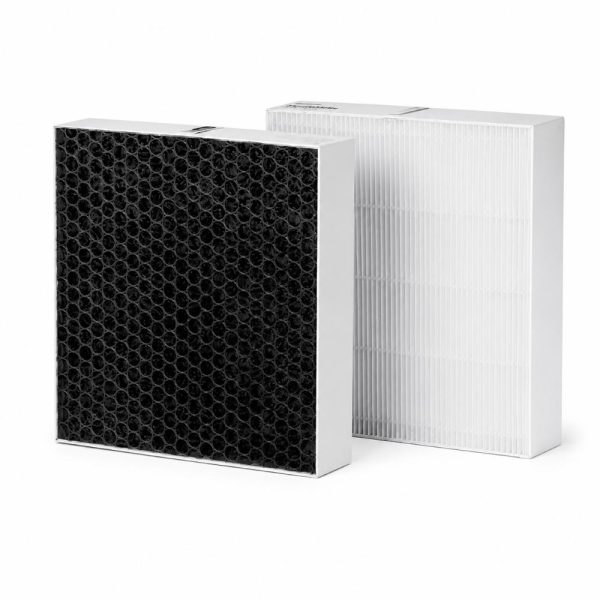
Because VOCs are gases, a particle filter alone is not designed to remove them. Activated-carbon or other gas-phase filtration may help reduce certain gases and odours, but effectiveness depends on the pollutant, the filter design and how much gas-filtering material is used.
Purifiers that display VOC readings can help show changes in the air they sample, but the number does not identify every chemical present. PM2.5, VOC and AQI readings are better used to track changes in the air than to identify every pollutant present.
Can Indoor Dust Affect Air Quality?
Indoor dust can affect air quality when settled particles are stirred back into the air. Walking, sweeping, vacuuming, making a bed or moving fabrics can resuspend dust from floors, furniture and other surfaces.
That dust may include particles brought in from outdoors, along with pollen, fibres, skin flakes and material produced by normal household activity. Regular cleaning, including damp dusting where appropriate, can help reduce how much settled dust is lifted back into the room.
An air purifier can help capture airborne particles that reach its filter, but it does not remove dust already settled on floors or furniture. Surface cleaning, reducing dust entry and filtration work best as separate parts of the same approach.
Do Dampness and Mould Affect Indoor Air?
Dampness and water damage can affect indoor air by creating conditions that support mould growth and other moisture-related problems. An air purifier cannot fix the moisture source, so leaks, wet materials and persistent dampness still need to be dealt with directly.
The priority is to find out why the area is damp and fix that problem first. Leaks should be repaired, wet materials dried properly and damaged materials addressed where necessary. Moisture control is a more direct solution than relying on filtration alone.
Particle filtration may capture some airborne material, including some mould spores that reach the filter, but it should be treated as a supporting measure. The underlying moisture problem still needs to be controlled.
Does Keeping Windows Closed Protect You From Indoor Air Pollution?
Closing windows can help reduce outdoor particle entry when PM2.5 levels are high, but it does not prevent all indoor pollution. Particles can still enter through doors, vents and small gaps, while cooking, combustion, dust, VOC sources and moisture can continue to affect the air inside.
Keeping a room closed for long periods can also reduce air exchange, allowing CO₂ and some indoor-generated pollutants to build up. This is why permanently sealing a room is not a complete indoor-air strategy.
During periods of high outdoor particle pollution, limit unnecessary outdoor-air entry. When outdoor conditions improve, ventilation can help replace stale indoor air and reduce pollutants that particle filtration alone does not address.
Why Does Ventilation Still Matter?
Ventilation helps replace indoor air with outdoor air, which can reduce occupant-generated CO₂ and dilute some indoor gases, moisture and odours. It addresses air exchange, which particle filtration does not.
A particle-filter air purifier cleans the air already circulating inside the room rather than replacing it with outdoor air. It can help with airborne particles, but normal particle filtration does not remove CO₂.
In Nepal, ventilation also needs to account for outdoor pollution. Opening windows when outdoor PM2.5 is high can bring more particles indoors, so it is better to limit unnecessary opening during the worst periods and ventilate when outdoor conditions improve.
What Can an Air Purifier Actually Help With?
A properly sized air purifier can reduce airborne pollutants that its filtration system is designed to capture. For a particle-focused purifier, this can include PM2.5, airborne dust, smoke particles, pollen and other suspended particles.
Air purification works best alongside source control and appropriate ventilation rather than as a solution to every indoor-air problem. It does not remove occupant-generated CO₂ through normal particle filtration, fix dampness, replace kitchen exhaust or stop pollutants from being produced. Where suitable carbon filtration is present, it may also help reduce certain gases and odours, depending on the pollutant and filter design.
Performance also depends on choosing a purifier with enough clean-air delivery for the space. Factors such as CADR, air changes and room size are more useful than choosing a unit simply because it is marketed for a bedroom or living room.
For larger household spaces within its stated coverage, the Blue 3610 is one option, with coverage listed up to 51 m². Room size, ceiling height and layout should still be considered before choosing a purifier.
How Can You Reduce Indoor Air Pollution at Home?
Improving indoor air works best when you deal with the source first, then use ventilation, cleaning and filtration where they are actually needed. A simple order of priority is:
1. Control the source
Reduce avoidable indoor smoke and combustion, use outdoor-vented kitchen exhaust where available, and deal with leaks or dampness promptly. Strong chemical products should also be used and stored according to their instructions.
2. Keep indoor surfaces cleaner
Regular cleaning helps reduce settled dust that can be stirred back into the air. Damp dusting can limit resuspension, while vacuum filters should be kept clean and in good condition.
3. Ventilate when outdoor air is suitable
Use windows, doors or suitable ventilation systems when outdoor conditions allow. Ventilation is especially useful for CO₂, moisture, odours and some indoor gases that particle filtration does not remove.
4. Limit outdoor particle entry during severe pollution
When outdoor PM2.5 is high, avoid leaving windows and doors open unnecessarily. This should be treated as a temporary measure until outdoor conditions improve.
5. Use filtration where particle pollution remains a problem
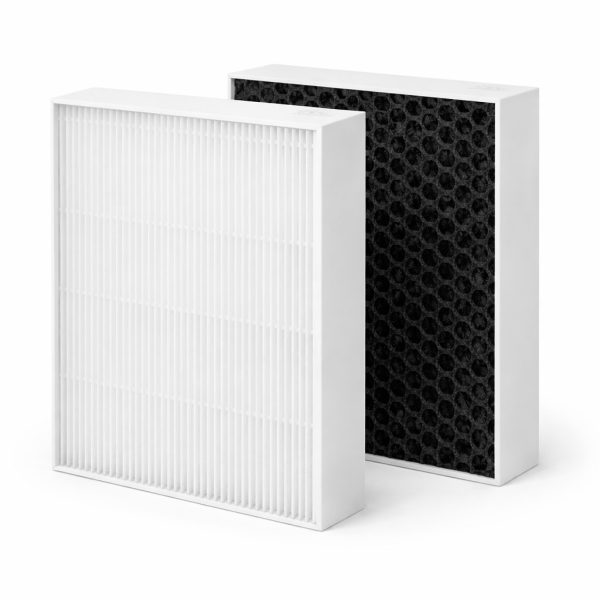
An appropriately sized air purifier can help reduce airborne particles that remain indoors or continue entering from outside. Keep the filter in good condition and follow the manufacturer’s replacement guidance.
What Should a Kathmandu Household Do on a Polluted Day?
During a high-PM2.5 period, a Kathmandu household can reduce unnecessary outdoor-air entry by keeping windows closed during the worst hours and limiting indoor sources such as smoke, incense and other burning. This can be especially useful for homes near busy roads, construction areas or other dust sources.
Use outdoor-vented kitchen exhaust while cooking, and run an appropriately sized air purifier if particle pollution remains a concern indoors. If the purifier has a sensor, its readings can help show how conditions are changing, but they should not be treated as a complete measure of indoor air quality.
When outdoor pollution improves, ventilate the room instead of keeping it closed indefinitely. The goal is to reduce particle entry during the worst periods while also controlling pollution produced inside the home.
Common Indoor Air Quality Mistakes
Indoor-air problems are easier to manage when each pollutant is matched with the right control method. These are some of the most common mistakes:
- Assuming indoor air is always clean. Outdoor pollution can enter the home, while cooking, smoke, dust and other indoor sources can add pollutants inside.
- Opening windows without checking outdoor conditions. Ventilation can bring additional particles indoors when outdoor PM2.5 is high.
- Keeping windows closed all the time. CO₂, moisture, odours and some indoor gases still need appropriate air exchange.
- Using a purifier while strong pollution sources continue. Reducing the source should come first where practical.
- Expecting an air purifier to remove CO₂. Standard particle filtration does not replace ventilation or air exchange.
- Expecting particle filtration to remove every gas. VOCs and particles require different filtration or control methods.
- Relying on a purifier instead of kitchen exhaust. Cooking pollution is better captured close to where it is produced.
- Ignoring dampness and leaks. Filtration cannot fix the moisture source behind a mould or dampness problem.
- Neglecting filter maintenance. An overdue or heavily loaded filter can reduce purifier performance.
- Choosing a purifier without checking room size. Clean-air delivery should be matched to the size and use of the space.
A Simple Indoor-Air Checklist for Your Home
Before deciding what your home needs, first identify where the pollution is coming from and what type of problem you are dealing with:
- Is dust, smoke or PM2.5 entering from outdoors?
- Does cooking regularly create smoke, fumes or lingering odours?
- Are incense, candles or other materials burned indoors?
- Is settled dust frequently being stirred back into the air?
- Are there leaks, damp areas or visible mould?
- Does the room get enough air exchange?
- Is outdoor air currently suitable for opening windows?
- Is the main concern particles, gases, moisture or CO₂?
- If you use an air purifier, is it correctly sized and is the filter still in good condition?
Once you know the main source, it becomes much easier to decide what to do next. A kitchen problem may need better exhaust, a damp room may need repairs and drying, while a room affected by PM2.5 may need better particle control.
Improve Indoor Air by Fixing the Right Problem First
Indoor air problems rarely come from one source alone. Outdoor particles, cooking, dust, moisture and household products can all affect indoor air differently, while ventilation influences how those pollutants build up or disperse.
From there, the response becomes much clearer. Some issues need source control or ventilation, while airborne dust and PM2.5 may need stronger particle filtration. The right solution depends on the pollutant, not on using more devices.
If airborne dust or PM2.5 is still a concern in your home, contact Clean Air Nepal for help choosing an air purifier that suits your room size and how the space is used.
FAQs
Is indoor air more polluted than outdoor air?
Indoor air can be cleaner or more polluted depending on outdoor conditions, ventilation and indoor sources such as cooking, smoke, VOCs and dust.
Can PM2.5 get inside a closed house?
PM2.5 can enter through doors, vents, cracks and normal building leakage even when windows are closed. Closing windows reduces direct entry but does not make a home airtight.
Does cooking cause indoor air pollution?
Frying, grilling and other high-temperature cooking can release fine particles and gases. Outdoor-vented kitchen exhaust helps remove them close to the source.
Does an air purifier remove indoor air pollution?
An air purifier can reduce airborne pollutants its filtration system is designed to capture. It does not replace source control, ventilation or kitchen exhaust.
Should I keep my windows closed when air pollution is high?
Keeping windows closed during high outdoor PM2.5 can reduce particle entry. Ventilate again when outdoor conditions improve rather than keeping the room sealed continuously.
Does an air purifier remove CO₂?
Standard particle filtration does not remove occupant-generated CO₂. Ventilation or another system designed for air exchange is needed.