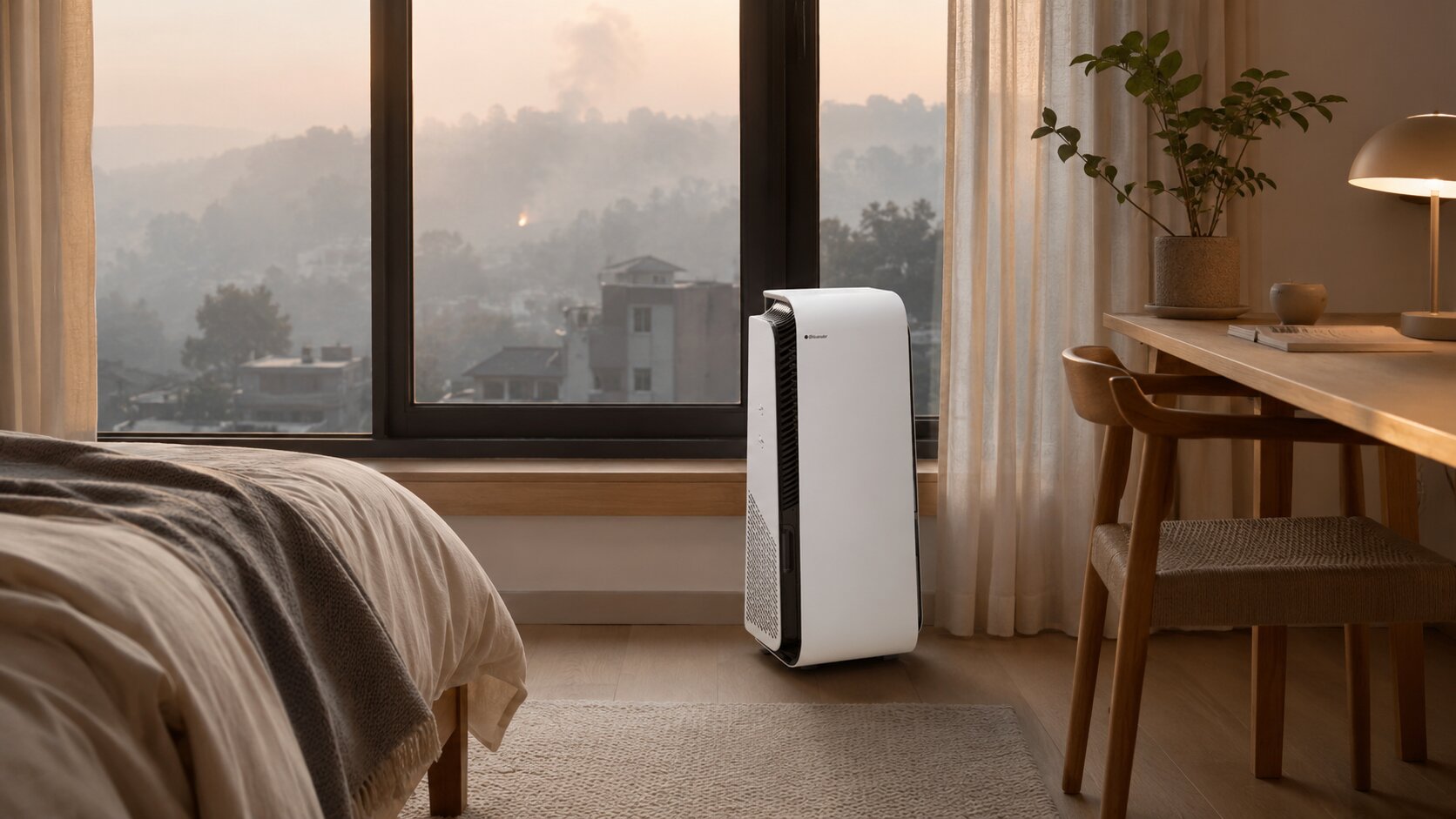
Wildfire smoke and seasonal haze can raise indoor PM2.5 even when doors and windows are closed. Limit outdoor air entering your home and run a correctly sized air purifier continuously in the room where your household spends the most time, starting at the highest practical fan speed.
An air purifier can reduce airborne smoke particles, but it cannot remove every harmful gas or make a building safe during a nearby fire. If fire threatens your property, serious symptoms develop or authorities advise evacuation, leave immediately and follow official instructions.
This guide explains how to create a cleaner-air room, use your purifier effectively, monitor PM2.5, manage filter loading and power cuts, and decide when to ventilate your home again.
What Should You Do First When Heavy Smoke Reaches Your Area?
When heavy smoke reaches your area, immediately reduce outdoor-air entry and prepare one enclosed room for continuous filtration.
- Check Nepal’s official air-quality monitoring portal and follow local safety announcements.
- Bring children, older adults and other at-risk household members indoors.
- Choose one enclosed room where your household can spend most of its time.
- Close external doors and windows, and keep necessary entry and exit brief.
- Make sure the purifier filter is fitted correctly, then run the unit at its highest practical fan speed.
- Avoid smoking, burning incense, frying, vacuuming and other particle-producing activities.
- Monitor indoor PM2.5 if a suitable device is available.
- Keep essential medicines, drinking water and charging equipment in the selected room.
Focusing on one enclosed room gives the purifier a smaller volume of air to clean, making it easier to reduce indoor smoke particles than when filtering the entire home.
What Is in Forest-Fire Smoke and How Does It Enter Your Home?
Forest-fire smoke contains PM2.5, larger particles and gases that can travel far beyond the burning area. Fine PM2.5 particles remain airborne and enter homes through doors, windows, ventilation systems and building gaps, while exhaust fans can draw more polluted air inside.
A high-efficiency filter can reduce airborne smoke particles, while activated carbon may reduce some gases and odours. However, air purifiers cannot remove carbon monoxide, and the US EPA’s wildfire smoke and indoor air guidance recommends combining filtration with source control and reduced outdoor-air entry.
How Do You Create and Maintain a Cleaner-Air Room?
Choose an enclosed bedroom or living room that is large enough for your household, comfortable to occupy and easy to keep closed. Select a room with few external openings and no fireplace or fuel-burning appliance. The US EPA’s cleaner-air room guidance recommends combining continuous filtration, reduced outdoor-air entry and control of indoor particle sources.
- Close external doors and windows without blocking an exit.
- Keep the internal door closed and make necessary entry and exit brief.
- Use air conditioning on recirculation mode when safely supported.
- Limit kitchen and bathroom exhaust-fan use while outdoor air is smoky.
- Run the purifier continuously with its inlet and outlet unobstructed.
- Avoid smoking, incense, candles, frying, aerosols, sweeping and unnecessary vacuuming.
- Use a damp cloth or mop when cleaning cannot wait.
- Monitor the room temperature and leave if it becomes unsafe.
Keep medicines, drinking water and essential chargers in the room to reduce unnecessary movement. Never block ventilation required by a fuel-burning appliance or remain in a room that becomes dangerously hot.
How Should You Run and Position the Air Purifier?
Start the purifier at the highest practical fan speed and keep it running throughout the smoke episode. Increase the speed after doors open, indoor PM2.5 rises or power returns following an outage. Once readings remain stable, use a quieter setting if needed, but avoid switching the unit off. Keeping an air purifier running continuously helps prevent smoke particles from building up again.
Place the purifier in the occupied room with the clearance specified in its manual. Keep the inlet and outlet away from curtains, furniture, cramped corners, heat, cooking grease and direct steam so air can circulate freely. Keep cables out of walkways and the controls easily accessible.
Which Air Purifier Is Suitable for Wildfire Smoke?
You should choose an air purifier with high-efficiency particle filtration and enough clean-air delivery for the complete room. Measure the room’s length, width and ceiling height, including any connected space. Comparing CADR and ACH with room size helps determine whether a purifier can filter the room’s air volume frequently enough during a smoke episode.
The following Blueair models cover different room sizes. Published capacity is a useful starting point, but actual performance depends on smoke entry, room layout, filter condition and operating speed.
| Blueair model | Published room capacity | Suitable space to consider |
| Blue 3610 | Up to 51 m² | Living room, large bedroom or open space |
| HealthProtect 7470i | Up to 38 m² | Bedroom, home office or study room |
| HealthProtect 7770i | Up to 62 m² | Large living room, office or open-plan area |
| Classic 480i | Up to 40 m² | Medium-to-large bedroom, living room or workspace |
| Classic 680i | Up to 72 m² | Large room, office or open space |
The right fit depends on room volume, desired ACH, smoke entering the space, filter condition and the fan speed you can use comfortably. Activated carbon may help with some smoke odours and gases, but particle filtration and adequate CADR remain the main priorities for PM2.5.
How Do You Monitor PM2.5 and Know When to Ventilate?
Place an indoor PM2.5 monitor in the occupied area, away from the purifier outlet, doors, windows and cooking sources. Record the initial level, run the purifier on high and monitor whether the reading falls consistently. A separate monitor can better represent the air where people sit or sleep than a built-in sensor near the purifier.
Ventilate only when verified outdoor PM2.5 remains lower than the indoor level. Open the windows briefly, watch the indoor reading and close them if it begins to rise, while keeping the purifier running afterwards. During periods of winter air pollution in Kathmandu, clearer skies, rainfall or reduced smoke smell alone do not confirm that outdoor air is clean enough for ventilation.
Can Heavy Smoke Fill an Air Purifier Filter Faster?
Heavy smoke can fill an air purifier filter faster, restrict airflow and slow PM2.5 reduction. Check the filter indicator and look for weaker airflow, visible pre-filter buildup, persistent odour or unusual operating sounds. Replacement timing depends on smoke concentration, operating hours, filter size and condition.
Unplug the purifier before maintenance and clean only the washable parts identified in the manual. Do not wash, shake or vacuum a non-washable main filter unless the manufacturer allows it. Blueair filter replacement timing in Nepal varies with pollution exposure and daily use, so keep a compatible genuine filter available during smoke season.
What Should You Do During a Power Cut?
During a power cut, you should keep doors and windows closed to slow smoke entry while the purifier is not operating. Avoid particle-producing activities, limit movement between rooms and monitor the indoor temperature. When power returns, restart the purifier at high speed until the PM2.5 level begins to fall.
Use only a backup power supply approved for the purifier. Keep fuel-powered generators outdoors and away from doors, windows and air intakes because they release carbon monoxide. Never operate one inside a home, garage, hallway or partly enclosed balcony.
How Can At-Risk People Stay Safe During Wildfire Smoke?
Children, older adults, pregnant people and those with heart or lung conditions may face greater health risks from wildfire smoke. Limit outdoor activity, keep essential medicines nearby and follow any healthcare action plan provided by a doctor. The World Health Organization’s wildfire guidance identifies fine particulate matter as a major health threat during wildfires.
When Should You Move to a Safer Location?
You should leave the building or move to a safer cleaner-air location when:
- Authorities issue an evacuation order or the fire threatens your area.
- Indoor PM2.5 remains high despite continuous filtration.
- Excessive heat or a prolonged power cut makes the room unsafe.
- You suspect carbon monoxide, structural damage or an electrical hazard.
- Someone develops new or worsening symptoms.
- A safer building with effective filtration is available.
Seek urgent medical care if someone experiences breathing difficulty, chest pain, confusion, fainting, blue lips or rapidly worsening symptoms. An air purifier can reduce airborne smoke particles, but it cannot replace evacuation instructions or medical treatment.
What Should You Prepare for the Next Smoke Episode?
You should prepare essential supplies before the next smoke episode begins. Keep a compatible replacement filter, indoor PM2.5 monitor, essential medicines, drinking water, charging equipment and an approved backup power supply readily available.
Test the purifier, replace a heavily loaded filter when necessary and choose the room you will use as your cleaner-air space. Preparing in advance helps your household respond quickly and limit smoke exposure when outdoor PM2.5 rises again.
Find the Right Air Purifier for Wildfire Smoke
During severe smoke, the right air purifier can help reduce indoor PM2.5 when combined with a protected room and limited outdoor-air entry. Room size, clean-air delivery and filter condition all affect how effectively the purifier controls airborne smoke particles.
Clean Air Nepal offers Blueair air purifiers for different room sizes and genuine replacement filters. Contact our team with your room measurements for help finding the right fit for your bedroom, living room, office or larger shared space.
FAQs
Can One Air Purifier Clean an Entire House During Wildfire Smoke?
One purifier works within a defined room or connected open space. Separate closed rooms need individual filtration or access to a shared cleaner-air room.
Can Two Smaller Air Purifiers Be Used in One Large Room?
Two smaller purifiers can work together when their combined CADR suits the room size. Position them apart and keep all inlets and outlets clear.
Can You Use a Ceiling Fan With an Air Purifier?
A ceiling fan can improve air circulation while the purifier removes particles. Use a comfortable speed and avoid disrupting the purifier’s airflow.
Should an Air Purifier Run Overnight During Severe Haze?
An air purifier should run overnight to prevent smoke particles from building up indoors. Use the highest fan speed that remains comfortable for sleeping.
Can an Air Purifier Remove Carbon Monoxide From Wildfire Smoke?
A particle air purifier cannot remove carbon monoxide. Keep a working carbon monoxide alarm and leave immediately if exposure is suspected.
Should You Replace the Filter After One Severe Smoke Episode?
A filter does not always require replacement after one smoke episode. Check its indicator, airflow and PM2.5 removal rate, then follow the manufacturer’s guidance.