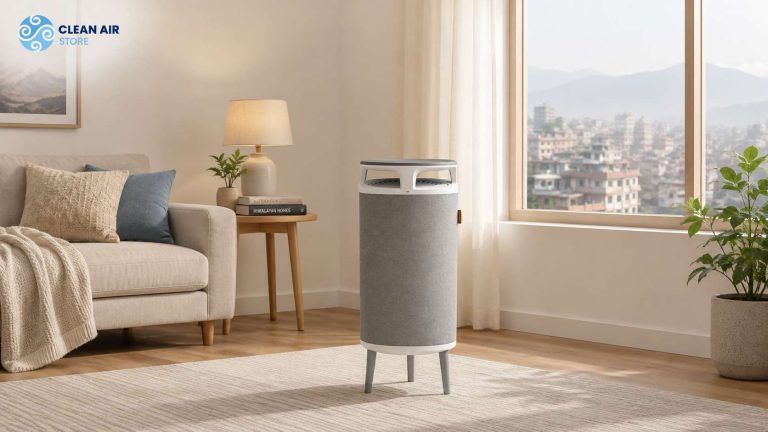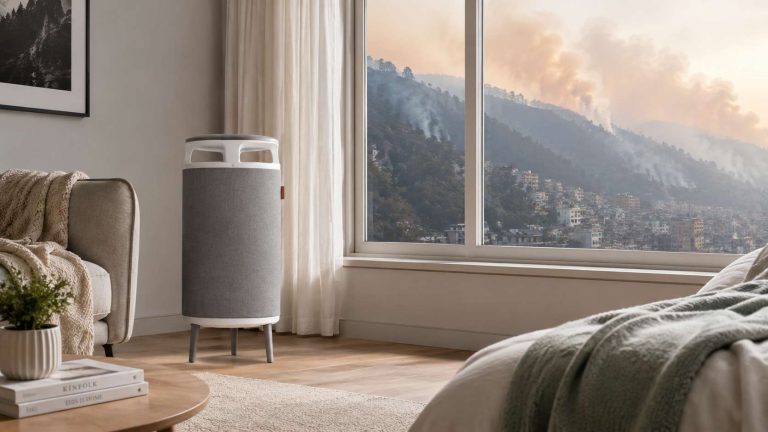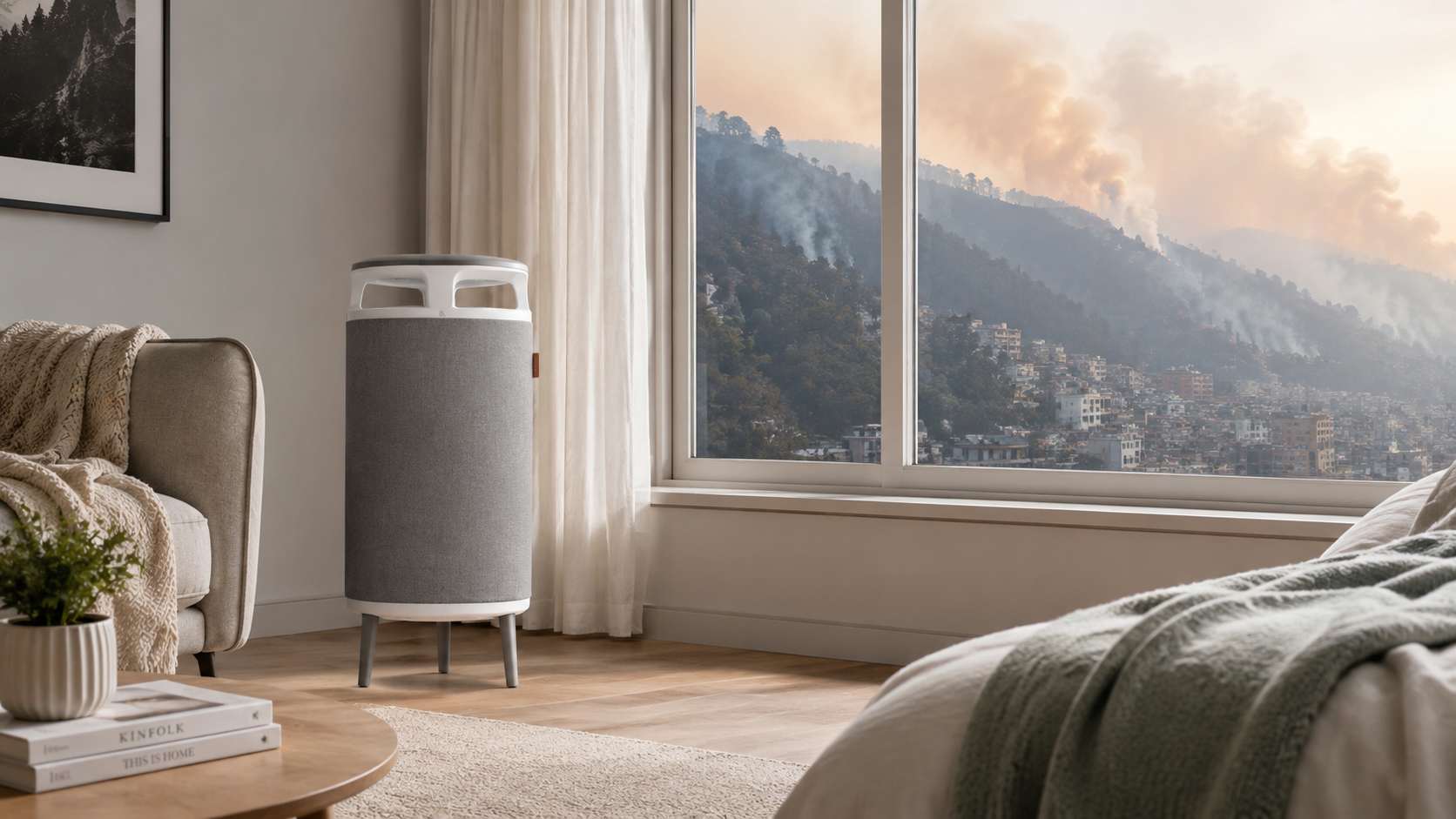
Nepal’s pre-monsoon months bring a distinct air pollution challenge. From March to May, dry conditions and widespread forest fires can send smoke across districts. For anyone searching for an air purifier for forest fire smoke in Nepal, the concern is not limited to visible outdoor haze. Fine smoke particles can also enter bedrooms, offices, classrooms and shops located far from an active fire.
Many households underestimate indoor smoke because their doors and windows are closed. However, smoke can still enter through ventilation systems, door openings and gaps around windows. A correctly sized air purifier can reduce indoor smoke particles when used alongside closed windows, source control and carefully timed ventilation.
What Causes Poor Air Quality During Nepal’s Forest Fire Season?
Forest fire activity increases during the dry pre-monsoon period as vegetation, leaves and forest litter lose moisture. Wind can then carry smoke far beyond the original fire area, allowing it to mix with traffic exhaust, construction dust, road dust and household emissions in Kathmandu Valley.
Clear streets nearby do not always mean the air is clean, because smoke from fires in other districts or neighbouring regions can still reach populated areas when wind conditions favour its movement. The guide to Kathmandu PM2.5 and air pollution explains local particle readings, AQI categories and seasonal pollution patterns in more detail.
How Is Wildfire Smoke Different from Other Air Pollution?
Wildfire smoke contains fine particles and gases released as vegetation and other materials burn. Fine smoke particles can remain suspended in the air, move across large areas and enter buildings through small openings.
| Pollution source | Typical pattern | Main indoor concern | Practical response |
| Traffic emissions | Daily, especially near busy roads | Fine particles, gases and road dust | Close openings during peak traffic and filter occupied rooms |
| Construction dust | Local and linked to active work | Visible dust and smaller airborne particles | Control the source, clean surfaces and use particle filtration |
| Winter inversion | Pollution becomes trapped near ground level | Prolonged exposure to mixed urban pollution | Monitor air quality and maintain continuous filtration |
| Wildfire smoke | Regional, episodic and affected by wind | PM2.5, haze, smoke particles and odours | Create a cleaner-air room and run suitable filtration continuously |
Forest fire pollution in Kathmandu can rise rapidly when regional smoke reaches the Valley. Winter inversion, by comparison, is a weather condition that traps existing emissions. Smoke season therefore requires regular outdoor monitoring and faster changes to indoor air routines.
Can Wildfire Smoke Enter Your Home with Windows Closed?
Wildfire smoke can enter a home even when the windows appear fully closed. Most buildings are not airtight, and outdoor air can move through small gaps around window frames, doors, exhaust openings and ventilation systems.
Opening the main door repeatedly can also allow polluted outdoor air to enter. Buildings with older windows, visible gaps or uncontrolled outdoor-air intakes may experience faster smoke infiltration.
Closing windows slows smoke entry, but it does not remove PM2.5 that has already entered the room. EPA guidance reports that indoor particle levels during wildfire events vary considerably between buildings, even when doors and windows remain closed.
Is Closing the Windows Enough During Heavy Smoke?
Closing external doors and windows is an important first step when outdoor PM2.5 or smoke levels rise. It reduces the amount of polluted air entering and gives an air purifier a more controlled space to clean.
However, closing the room does not actively remove particles. A wildfire smoke air purifier repeatedly draws indoor air through a suitable filter, helping reduce smoke particles that have already entered.
During a severe smoke episode:
- Choose one priority room with fewer external openings.
- Close external doors and windows.
- Reduce unnecessary movement through the door.
- Stop incense, smoking and other indoor combustion.
- Limit frying or other cooking methods that produce smoke.
- Run a correctly sized purifier continuously.
Ventilate briefly when outdoor air becomes cleaner. Filtration does not remove carbon dioxide produced by occupants, so a permanently sealed room without planned ventilation is not the goal.
How Do Air Purifiers Help During Forest Fire Season?
A HEPA air purifier or another high-efficiency particle purifier circulates room air through a filter that captures fine airborne particles. This makes particle filtration particularly relevant for PM2.5 in wildfire smoke.
An activated carbon filter can also reduce some smoke odours and gases. However, carbon capacity varies between products, and it should not be treated as complete gas removal. Particle filtration remains the main requirement when reducing indoor smoke PM2.5.
Four factors determine how well an air purifier performs during smoke season:
- Filter efficiency: The filter must be suitable for fine particles.
- Clean-air delivery: The purifier must move enough filtered air for the room.
- Fan speed: Higher speeds deliver more filtered air per hour.
- Room conditions: Open windows, indoor smoke and blocked airflow reduce performance.
The HEPA air purifier guide for Nepal explains the difference between particle filtration and activated carbon. A purifier can reduce indoor smoke particles, but it cannot stop the outdoor fire or remove every combustion gas.
How Much CADR Do You Need for Wildfire Smoke?
CADR, or Clean Air Delivery Rate, shows how much filtered air a purifier can supply within a set period. A higher CADR helps the purifier clean a larger room or reduce smoke particles more quickly. Start by calculating the room volume using length × width × ceiling height, then multiply that figure by the desired air changes per hour.
For example, a 4 m × 5 m room with a 2.7 m ceiling has a volume of 54 m³ and would need about 270 m³/h at five air changes per hour. High ceilings, open kitchens and connected hallways increase the required capacity, so avoid choosing a purifier that only meets the minimum. The CADR and ACH room-size guide provides practical calculations and sizing advice.
Choosing the Right Blueair Air Purifier for Smoke Season
The right air purifier for smoke season depends on room volume, layout, outdoor leakage, preferred noise level and the fan speed that will be used. Product coverage figures should be treated as a starting point rather than the only sizing method.
Small Bedrooms and Studies
DustMagnet 5210i can suit compact bedrooms, studies and individual work areas where floor space is limited. Its compact format makes it easier to position close to the occupied area without placing it behind furniture.
Medium Bedrooms and Home Offices
Larger bedrooms, family rooms and enclosed home offices often need more airflow than a compact purifier can provide. For these spaces, the Blue 3610 offers higher capacity and can be a practical option where room volume or outdoor smoke entry is greater.
Living Rooms and Larger Shared Spaces
Larger living rooms, offices and shared areas need sustained filtration and enough capacity for the full connected space. The HealthProtect 7470i can suit these settings, especially where connected monitoring is useful. For open-plan living and dining areas, measure the entire area as one room before confirming the required capacity.
The home air purifier buying guide can help compare room size, filtration, noise, controls and replacement-filter requirements.
Where Should You Place an Air Purifier During Smoke Season?
Correct placement helps the purifier draw in smoke particles and circulate filtered air throughout the room. Choose an open position in the room where people spend the most time, without blocking the intake or outlet.
- Keep enough open space around every air intake and outlet.
- Avoid placing the unit behind a sofa, under a desk, inside a cabinet or against heavy curtains.
- Check all sides of the purifier because different models draw air from different directions.
- Keep the room door closed during heavy smoke if the purifier is sized for that room.
- Do not expect one purifier in a hallway to clean several closed bedrooms.
- Measure the complete connected area if doors remain open, as the purifier will need to handle a larger volume of air.
Which Fan Setting Is Best on Heavy Smoke Days?
Auto Mode is useful for everyday operation, but the sensor only measures the air near the purifier. It may not respond immediately when smoke begins entering from another part of the room.
During a known smoke event, increase the fan speed before indoor air becomes visibly hazy or strongly smoky. EPA guidance recommends running portable air cleaners as often as possible and using higher fan speeds during wildfire-smoke periods.
- Normal conditions: Use Auto or medium.
- Outdoor smoke increasing: Switch to medium or high.
- After opening an external door: Use high until readings fall.
- At night: Use the highest setting that remains comfortable.
- Severe haze: Run continuously on high in the priority room.
Night Mode may be quieter, but it also provides less clean-air delivery. In heavy smoke, a higher comfortable setting may be more suitable.
How Often Should Filters Be Checked During Forest Fire Season?
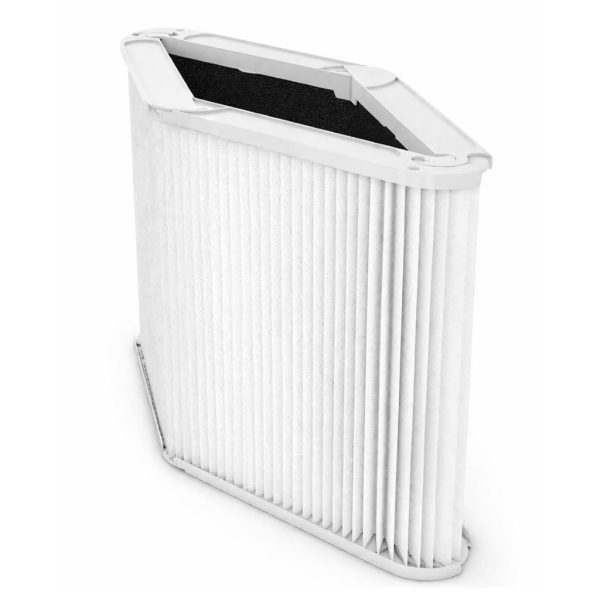
Wildfire smoke can load filters faster than normal household dust, especially during prolonged haze. Check the filter regularly instead of waiting for a fixed replacement month.
- Inspect the filter if airflow becomes weaker or fan noise changes.
- Check it when indoor PM2.5 takes longer than usual to fall.
- Follow the filter indicator and the instructions in the model manual.
- Clean only the approved pre-filter parts.
- Do not wash the main particle filter unless the manufacturer confirms it is washable.
- Replace the filter earlier if heavy smoke has caused faster loading.
Use the Blueair filter replacement guide for Nepal for local replacement timing and warning signs.
Common Myths About Wildfire Smoke and Air Purifiers
Misunderstandings about wildfire smoke can lead to poor indoor air decisions during Nepal’s dry season. Knowing what an air purifier can and cannot do helps homeowners use filtration more effectively and avoid relying on incomplete protection.
Closing Windows Is Enough
Closing windows reduces the amount of outdoor smoke entering, but it does not remove particles already inside. A closed room still needs active particle filtration during a prolonged smoke event.
One Purifier Can Clean the Whole House
A portable purifier is designed for one room or connected area. Walls, closed doors and hallways interrupt airflow, so one unit cannot reliably clean several separate rooms.
Smoke Only Affects Outdoor Air
Smoke enters through gaps, doors, ventilation systems and normal building leakage. Indoor PM2.5 can rise even when no window has been deliberately opened.
Any Air Purifier Works Equally Well
Performance depends on filter type, CADR, fan speed, placement, room volume and filter condition. An undersized or blocked purifier may remove smoke too slowly during a serious pollution episode.
Activated Carbon Removes All Smoke Pollution
Activated carbon can reduce some odours and gases, but capacity matters. Fine smoke particles still require suitable particle filtration. The article on air purifiers for smoke, odour and cooking fumes explains how the two filter types perform different jobs.
Prepare Your Indoor Air Plan Before Smoke Arrives
Nepal’s March-May forest fire season requires a different indoor air plan from ordinary dust or winter pollution. Smoke can travel from distant fires, change rapidly with the wind and raise indoor PM2.5 even when windows remain closed.
The most practical response combines outdoor air monitoring, a controlled priority room, suitable CADR, continuous filtration and timely filter inspection. An air purifier for forest fire smoke in Nepal cannot eliminate every pollutant, but correct sizing and operation can improve particle control in the rooms people use most.
Plan Cleaner Indoor Air for Forest Fire Season
Every home, office and classroom has a different layout, room volume and level of outdoor leakage. Contact our indoor air team for practical help comparing suitable Blueair models, checking room measurements and planning purifier placement before the smoke season begins.
FAQs
Do You Need an Air Purifier During Nepal’s Forest Fire Season?
An air purifier can help reduce indoor PM2.5 when wildfire smoke affects outdoor air quality. It works best in a closed priority room with suitable CADR, unrestricted airflow and continuous operation during heavy smoke.
Can a HEPA Air Purifier Remove Wildfire Smoke?
A HEPA or high-efficiency particle purifier can capture fine airborne particles found in wildfire smoke. It cannot stop the outdoor source, remove every gas or guarantee that no smoke will enter the room.
Can Forest Fire Smoke Enter a Home with Closed Windows?
Forest fire smoke can enter through gaps around windows, door openings, ventilation systems and other leakage points. Closing windows slows smoke entry, but filtration is needed to reduce particles already inside.
Should Windows Stay Closed All Day During Wildfire Haze?
Keep external doors and windows closed while outdoor smoke or PM2.5 remains high. When outdoor air improves, ventilate briefly to release accumulated carbon dioxide, cooking gases and stale air, then resume filtration.
What Fan Speed Should You Use for Wildfire Smoke?
Use medium or high when outdoor smoke is rising, or indoor readings begin increasing. Auto Mode suits routine operation, but manual high speed can provide faster filtration during a clear smoke event.
How Do You Choose the Right Air Purifier Size for Smoke?
Measure the room’s length, width and ceiling height, then compare its volume with the purifier’s CADR. Include connected areas and open doorways because they increase the amount of air the purifier must clean.
Do Blueair Filters Need More Frequent Replacement During Smoke Season?
Heavy or prolonged smoke can load filters more quickly than ordinary household use. Inspect the filter regularly and replace it when the indicator, airflow or manufacturer guidance shows that replacement is due.