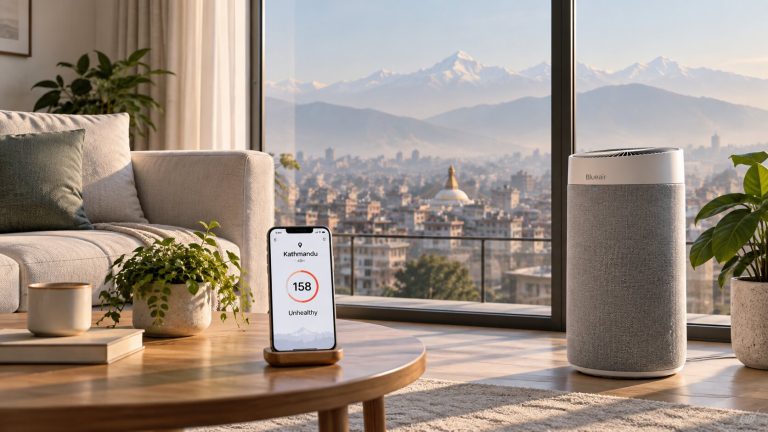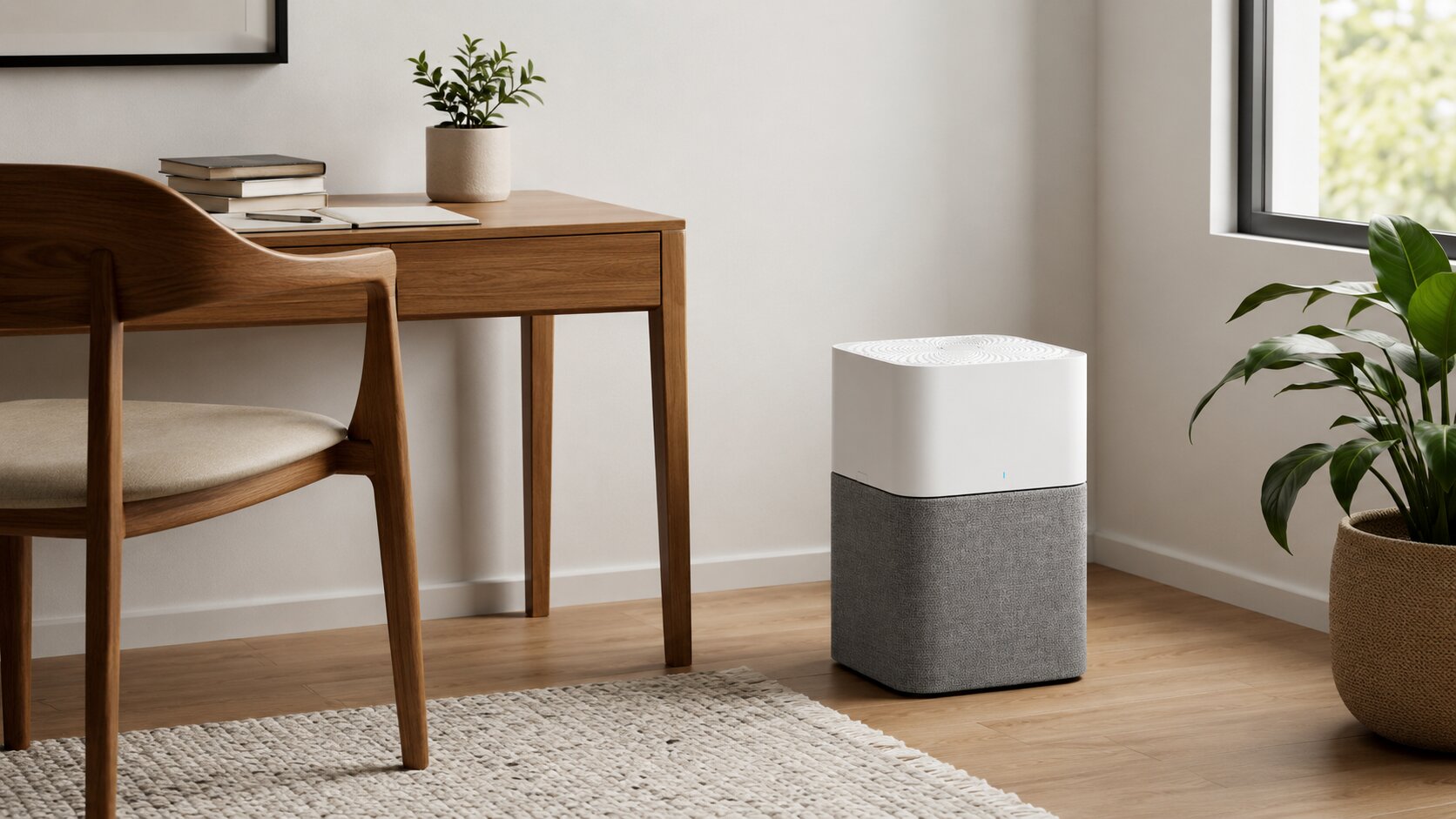
Smart air purifiers may display PM1, PM2.5 or PM10 concentrations, VOC levels, an AQI value or a coloured air-quality indicator. These readings offer a quick view of the air being sampled near the purifier and help you track how indoor conditions change throughout the day.
These readings do not all measure the same pollutant or use the same scale. Particle readings may show concentrations in micrograms per cubic metre (µg/m³), while AQI converts pollution data into an index. Coloured lights often represent air-quality categories defined by the manufacturer.
Understanding what PM1, PM2.5 and PM10 mean is only the beginning. This guide explains each reading, what purifier sensors can and cannot detect, why indoor readings may differ from outdoor AQI and how to interpret sudden changes. Most importantly, it explains why trends over time are more useful than one isolated number.
What Do Air Purifier Sensor Readings Tell You?
Air purifier sensor readings provide a snapshot of the air being sampled near the unit. They can show changes in the pollutants the sensor is designed to measure, but they do not represent every pollutant or every part of the room.
A concentration shows how much of a particular pollutant is present in the air. AQI converts pollution data into an index, while colour indicators simplify the result into an easy-to-understand air-quality status.
| Reading | Simple meaning | Usually shown as |
| PM1 | Very fine particles measuring 1 micrometre or smaller | Number or concentration |
| PM2.5 | Fine particles commonly produced by smoke, traffic and cooking | Concentration, index or colour |
| PM10 | Larger inhalable particles, including airborne dust and pollen | Number or concentration |
| VOC or tVOC | A combined reading for certain airborne gases | Level, graph or colour |
| AQI | An index that converts pollution data into an air-quality category | Number and colour |
Readings can change because of the purifier’s position, nearby activities and airflow. Treat them as a guide to the air reaching the sensor, as the pollutants measured vary by model.
What Do PM1, PM2.5 and PM10 Mean?
PM stands for particulate matter, a mixture of solid particles and liquid droplets suspended in the air. The number indicates the largest particle diameter included in that category, measured in micrometres (µm). It does not refer to the number of particles detected.
| Reading | Particle size included | Common contributors |
| PM1 | Up to 1 µm | Smoke and combustion emissions |
| PM2.5 | Up to 2.5 µm | Traffic pollution, haze and cooking fumes |
| PM10 | Up to 10 µm | Road dust, construction dust and pollen fragments |
PM1
PM1 represents the smallest particle range commonly shown by smart air purifiers. These particles are often associated with smoke and combustion, although a consumer sensor cannot identify their exact source or chemical composition.
PM2.5
PM2.5 is widely used in air-quality monitoring because it covers fine inhalable particles commonly found in traffic emissions, haze, smoke and cooking fumes. The US EPA definition of particulate matter places PM2.5 within the broader PM10 category.
PM10
PM10 covers the broadest of these three ranges and includes coarser airborne material stirred up by road traffic, construction, sweeping and other dusty activities.
These categories overlap, so their readings should never be added together. PM10 includes PM2.5, while PM2.5 includes PM1. For example, readings of 8 for PM1, 14 for PM2.5 and 25 for PM10 describe nested particle ranges, not a combined concentration of 47 µg/m³.
What Does a VOC Reading Mean?
VOC stands for volatile organic compounds, a broad group of gases released by sources such as paint, new furniture, cleaning products, perfume, air fresheners, adhesives and cooking. A tVOC sensor responds to a mixture of these gases and reports an overall level rather than identifying each compound individually.
A high VOC reading indicates a change in the gaseous mixture near the sensor, but it cannot reveal the exact chemical, its concentration or its health significance. EPA guidance on indoor VOCs also explains that no single limit applies broadly to the many VOCs found in non-industrial indoor spaces.
VOC readings are therefore most useful when viewed alongside indoor activities. A spike after spraying cleaner, applying perfume or unpacking new furniture provides more practical insight than an isolated “high” reading.
How to Read AQI Numbers and Colour Indicators on an Air Purifier
AQI numbers and colour indicators provide a simplified view of how clean or polluted the air near the purifier appears to be. AQI stands for Air Quality Index, and the purifier may convert sensor data, often PM2.5 levels, into an easy-to-understand number, colour or air-quality category.
An air purifier’s AQI reading may not use the same calculation as official outdoor AQI. Public systems may consider several pollutants and report the one producing the highest index value, while a purifier measures air near its sensor using thresholds defined by the manufacturer.
On supported Blueair models, blue and green indicate cleaner air, while yellow, orange and red show increasing particle levels. These colours provide quick guidance, but they should not be directly compared with WHO particulate-matter guidelines, which are based on 24-hour and annual averages.
Why Is Indoor AQI Different From Outdoor AQI?
Indoor AQI can differ from outdoor AQI because the readings are taken in different locations and may use different sensors, averaging periods and calculation methods. An outdoor station represents conditions in its surrounding area, while an air purifier samples the air near its sensor inside one room.
Outdoor pollution can enter through windows, doors and gaps in the building. At the same time, indoor activities such as frying, burning incense or candles, cleaning and vacuuming can temporarily make the room more polluted than the air outside.
A purifier may react immediately to a nearby source, whereas an outdoor AQI reading may use averaged station data. During winter air pollution in Kathmandu, keeping external openings closed and using effective filtration can lower indoor particle readings even while outdoor AQI remains high.
What Can Air Purifier Sensors Detect?
Air purifier sensors commonly measure airborne particles and, on supported models, VOC levels, temperature and humidity. They only report what they are designed to detect, so they do not provide a complete picture of indoor air quality.
The US EPA’s indoor monitor guidance recommends using consumer readings as information about specific pollutants rather than a full assessment of the room.
| Pollutant or condition | Can it be detected? | What the reading cannot tell you |
| Airborne particles | Yes, with a particle sensor | What the particles are made of |
| VOCs | Yes, with a VOC or tVOC sensor | Which individual gases are present |
| Temperature and humidity | On supported models | These are room conditions, not pollutants |
| Carbon dioxide (CO₂) | Only with a dedicated CO₂ sensor | PM and VOC sensors cannot measure CO₂ |
| Carbon monoxide (CO) | Only with a dedicated sensor | A purifier display does not replace a certified CO alarm |
| Radon | Only with a specific radon sensor | A separate radon-testing device is normally required |
| Dust or mould on surfaces | No | Sensors only sample material suspended in the air |
A low PM reading simply means that little airborne particulate matter is reaching the sensor at that moment. It does not confirm that VOCs, CO₂ or other unmeasured pollutants are also low.
Why Do Air Purifier Readings Suddenly Increase?
Air purifier readings can rise suddenly because of a nearby activity or a change in outdoor air, not necessarily because the sensor is faulty. The source often determines which reading increases:
- Frying, grilling, smoking, candles and incense can raise PM1 and PM2.5.
- Sweeping, dusting, making a bed or using an unfiltered vacuum can stir up PM10 and smaller particles.
- Perfume, cleaning sprays, paint, air fresheners and new furniture can increase VOC readings.
- Open windows can allow traffic emissions, smoke, road dust and pollen to enter.
- Steam and fine droplets from showers or humidifiers may temporarily affect optical particle sensors.
Because smoke, odours and cooking fumes affect indoor air differently, check whether the change appears in the particle or VOC reading. After the source stops, observe how quickly the reading returns to its usual level. This recovery time can indicate how effectively filtration, ventilation and room airflow are clearing the air.
Why Are Trends More Useful Than One Reading?
A trend shows how indoor air changes over time, while a single reading only captures one moment. Reviewing several hours or days of data makes it easier to recognise normal conditions, identify recurring pollution sources and see how quickly the room improves.
Focus on three parts of the pattern:
- Baseline: The normal reading when the room is settled and no clear pollution source is active.
- Spikes: Sudden increases linked to activities such as cooking, cleaning, burning incense or opening a window.
- Recovery: The time taken for the reading to return to its baseline after the source stops and the purifier runs.
Recurring spikes can reveal everyday sources that need better control. If the baseline remains elevated or recovery becomes slower, check for continued outdoor pollution entry, blocked airflow, poor purifier placement, an overdue filter or insufficient filtration capacity.
How Should You Use Air Quality Readings?
Use air quality readings to understand what is affecting the room and decide how to respond, rather than treating them as a score to chase. When a reading changes:
- Identify whether particles, VOCs or both have increased.
- Look for a likely source, such as cooking, smoke, dusting, perfume or an open window.
- Stop or remove the source where practical.
- Ventilate gaseous pollutants when the outdoor air is cleaner, but keep windows closed when outdoor particle pollution is high.
- Increase the purifier speed during a particle spike and observe whether the reading begins to fall.
- Review the app history later to see whether the increase was brief, recurring or persistent.
Proper air purifier placement also supports more reliable readings, as blocked inlets, curtains, kitchen steam and strong draughts can affect the air reaching the sensor. Auto Mode is convenient for maintaining a steady baseline, while manual high speed may provide a faster response during obvious particle events such as smoke or cooking.
Air Quality Readings by Blueair Model
Blueair models do not all monitor the same information. Some track PM2.5 only, while others also measure different particle sizes, VOCs, temperature and humidity.
| Blueair models | Readings available | Where they appear |
| DustMagnet 5210i, 5240i and 5440i | PM2.5 | Colour indicator and app |
| HealthProtect 7470i and 7770i | PM1, PM2.5, PM10, tVOC, temperature and humidity | Display, colour bars and app |
| Classic 480i and 680i | PM2.5, tVOC, temperature and humidity | Air-quality indicator and app |
On HealthProtect models, the particle colour bar reflects whichever PM category has the highest reading. Check the display or app to identify whether PM1, PM2.5 or PM10 caused the colour to change.
These readings show what each model can monitor, but they do not determine whether the purifier is suitable for your room size. Check the exact model specifications and user manual before comparing models.
How to Check an Air Purifier Reading That Seems Incorrect
Place the purifier in a stable position and monitor the reading for a while. If it remains unusually high or does not change with the room conditions, check the following:
- Look for ongoing sources such as cooking, perfume, cleaning products, steam or outdoor pollution.
- Make sure the air intake and sensor area are not blocked.
- Clean the sensor inlet only as instructed in the user manual, as dust buildup may affect the reading.
- Check that the filter is installed correctly and does not need replacement.
- Restart the purifier or reconnect the app if the display and app appear out of sync.
It is normal for two devices in the same room to show slightly different readings. Sensor design, placement, airflow, calibration and update frequency can all affect the result. Focus on whether both devices respond to the same activities and show a similar overall trend.
Find the Right Air Purifier for Your Room
PM1, PM2.5, PM10, VOC and AQI readings are most useful when viewed over time. Follow the usual baseline, identify what causes sudden increases and observe how quickly the air improves after the source is controlled.
Sensor features are only one part of choosing a purifier. For personalised recommendations, get help comparing suitable models based on your room size, main pollution concerns and preferred smart features.
FAQs
What PM2.5 Reading Should You Aim for Indoors?
Keep PM2.5 as low and stable as practical. A reading that remains high is more concerning than a brief spike.
Why Does PM2.5 Rise During Cooking?
Frying and grilling can release fine particles. Use an exhaust fan and increase the purifier speed while cooking.
Why Is the VOC Reading High After Cleaning?
Cleaning sprays and fragrances can release VOCs. Ventilate when outdoor air quality is suitable and check whether the reading falls.
Why Is the Indicator Green When I Can Still Smell an Odour?
The indicator may respond to particles rather than odour-causing gases. A green light does not always mean the odour has cleared.
Can Indoor and Outdoor AQI Be Compared?
Indoor and outdoor AQI can be compared only when both use the same pollutant, averaging period and calculation method. Otherwise, the readings may differ.
Do Air Purifier Sensors Detect CO₂ or Carbon Monoxide?
Only purifiers with dedicated CO₂ or carbon monoxide sensors can detect them. Use a separate CO₂ monitor and certified carbon monoxide alarm when needed.
Why Do Two Air Purifiers Show Different Readings?
Sensor design, placement, airflow and update frequency can affect readings. Compare their overall trends rather than expecting identical numbers.
Should I Use Auto Mode?
Auto Mode is useful for everyday operation. Use manual high speed during cooking, smoke or a sudden particle spike.