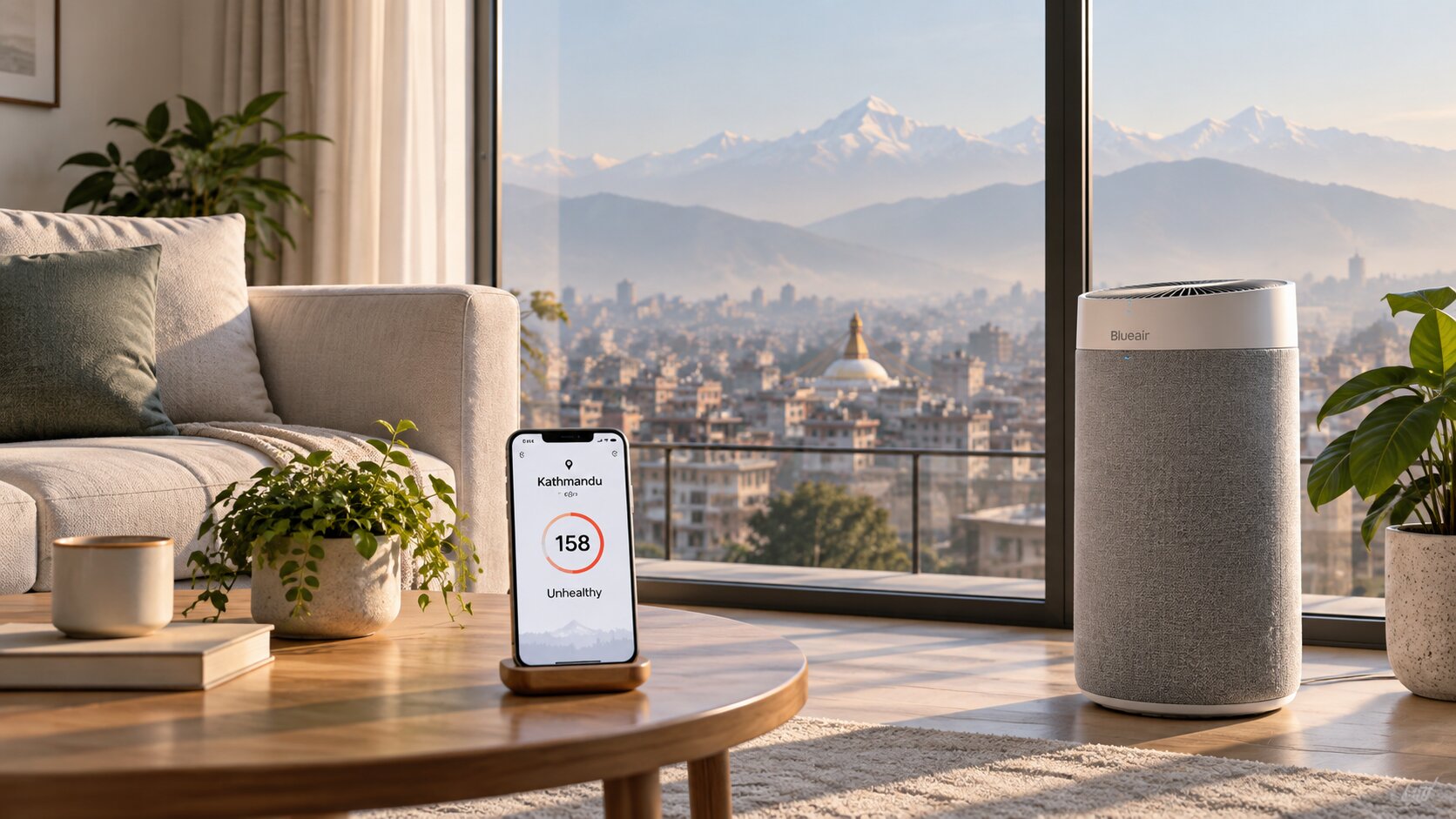
Air Quality Index (AQI) is a simple way of showing how polluted the outdoor air is and how much concern that level may pose. The higher the AQI, the poorer the air quality and the more carefully people may need to plan prolonged outdoor activity.
For someone checking AQI in Nepal, the number alone is not enough. A useful reading should be viewed together with its category, monitoring location, dominant pollutant where available, timestamp and recent trend. This matters because air quality can change considerably between different parts of the Kathmandu Valley, between cities, and even across different times of the same day.
AQI is therefore most useful as a decision-making tool. It can help you judge whether to exercise outdoors, plan children’s outdoor activities, open windows for ventilation, or reduce the amount of polluted outdoor air entering your home.
How to Check AQI in Nepal
The most reliable way to check AQI in Nepal is to use a recognised air-quality monitoring source and focus on the monitoring location closest to where you actually are. A city-wide AQI can be useful for a broad picture, but it may not reflect the exact conditions around your home, school, workplace or route.
Use this process:
- Open a reliable source. The Department of Environment air-quality statistics and AQMS pages provide official government air-quality data, reports and monitoring updates.
- Select the monitoring station or area nearest to your location.
- Check the AQI value together with its colour or category.
- Look for the pollutant driving the reading, especially PM2.5 where that information is available.
- Check the timestamp so you know how recent the reading is.
- Review the recent trend instead of relying on one isolated value.
Location and timing can make a noticeable difference. A reading for “Kathmandu” may not reflect the exact AQI in Lalitpur, Bhaktapur or another part of the Valley. For practical decisions such as exercising outdoors or opening windows, prioritise the nearest recent reading and its trend rather than a broad city average.
What Does AQI Actually Measure?
Air Quality Index (AQI) converts measured levels of outdoor air pollutants into a standardised index that is easier to interpret. Instead of showing only raw pollutant concentrations, AQI groups air quality into categories that indicate how polluted the air is and the level of potential health concern.
AQI is not the same as a pollutant concentration. For example, PM2.5 may be measured in micrograms per cubic metre (µg/m³). That concentration is then converted into an AQI value using pollutant-specific breakpoints and averaging rules. The two numbers are related, but they are not interchangeable.
AQI calculations can include pollutants such as PM2.5, PM10, ground-level ozone and certain gases. The reported AQI is typically determined by the pollutant producing the highest index value for that monitoring period.
An AQI of 100 does not mean 100 µg/m³ of PM2.5. On the U.S. EPA scale, AQI 100 marks the upper end of the Moderate category. It is an index value, not a universal pollution-concentration limit, so it should not be interpreted as a direct PM2.5 measurement in Nepal.
What Do Different AQI Levels Mean?
AQI levels are grouped into six categories so you can quickly judge how polluted the outdoor air is and how cautious you may need to be. The U.S. EPA AQI guidance uses the following scale, with higher AQI values indicating poorer air quality and greater potential health concern.
| AQI Range | Category | What It Means | What You Should Do |
| 0–50 | Good | Air quality is satisfactory and pollution levels are low. | Normal outdoor activities are suitable for most people. |
| 51–100 | Moderate | Air quality is acceptable, but a small number of unusually sensitive people may notice effects from some pollutants. | Most people can continue normal activities. Sensitive individuals can monitor how they feel during prolonged outdoor activity. |
| 101–150 | Unhealthy for Sensitive Groups | Children, older adults and people with heart or lung conditions may be more affected by prolonged exposure. | Sensitive groups should reduce prolonged or strenuous outdoor activity. |
| 151–200 | Unhealthy | Pollution levels may affect more people, while sensitive groups face greater concern. | Limit prolonged or strenuous outdoor activity and consider rescheduling exercise or other extended outdoor plans. |
| 201–300 | Very Unhealthy | The risk of health effects increases for everyone. | Reduce time spent outdoors, avoid strenuous outdoor activity and follow any official public-health guidance. |
| 301–500 | Hazardous | Air pollution has reached the highest AQI category and represents a serious public-health concern. | Avoid unnecessary outdoor activity and follow official health or emergency guidance. |
For example, AQI 40 is Good, 90 is Moderate, 130 is Unhealthy for Sensitive Groups, 180 is Unhealthy, 250 is Very Unhealthy, and 350 is Hazardous. These are examples only, and category labels may vary between AQI systems.
Why PM2.5 Matters When Checking AQI in Nepal
PM2.5 refers to fine particulate matter measuring 2.5 micrometres or smaller. These particles can come from vehicle exhaust, combustion, industrial activity, biomass and waste burning, smoke, and other processes that produce or form fine airborne particles.
PM2.5 often becomes especially relevant during poor air-quality periods in Nepal because several local and regional sources can contribute at the same time. In Kathmandu Valley, traffic, brick kilns, burning, dust and pollution transported from outside the immediate area can all influence particle levels, with the mix changing by season and location.
Smoke from dry-season fires and regional haze can also push PM2.5 higher across a wider area. When AQI rises, check which pollutant is driving the reading and whether the trend is improving or worsening. During periods of wildfire smoke and seasonal haze, reducing outdoor particle entry can become especially important indoors.
Why Kathmandu AQI Can Change So Quickly
Kathmandu AQI can change quickly because both pollution sources and weather conditions vary throughout the day. Traffic, road and construction dust, local combustion and smoke can raise pollution levels, while wind and rainfall can help disperse or remove airborne particles.
Weather can also cause pollution to build up. During cooler, stable conditions, temperature inversions can limit the upward movement of air and trap pollutants closer to the ground. Kathmandu Valley’s surrounding terrain can make this buildup more noticeable when winds are weak.
Time of day also affects readings. Morning traffic and low wind may produce different conditions from the afternoon, while seasonal forest-fire smoke and regional haze can raise particle levels across a much wider area.
For this reason, one AQI reading should not be treated as a fixed measure of air quality across Kathmandu. Check the location, timestamp and recent trend before deciding what the number means for you.
Why Two AQI Apps Can Show Different Numbers
Two AQI apps can show different numbers because they may use different monitoring locations, data sources, update times or calculation methods. One service might use a nearby monitoring station, while another may combine several stations, forecasts or modelled data for a wider area.
For example, someone in Lalitpur may check two apps at the same time before opening their windows. One app could be showing a recent reading from a nearby monitor, while the other is estimating conditions across a larger part of the Kathmandu Valley. Both can be valid without showing exactly the same AQI.
When readings differ, check:
- the monitoring station or area used;
- when the reading was last updated;
- which pollutant is driving the AQI;
- whether the value is measured, modelled or forecast; and
- which AQI scale the service follows.
If the readings are close, focus on the category and recent trend rather than the exact number alone. A reading of 145 and another of 155 may look similar, but they fall into different AQI categories, so the source and timing still matter.
What Should You Do When AQI Is High in Nepal?
When AQI rises, adjust your plans based on the category, how long you expect to be outdoors and whether anyone in your household is more sensitive to air pollution. As readings move above 100, sensitive groups should be more cautious, while higher categories call for reducing prolonged or strenuous outdoor activity.
Check conditions before exercise, school sports, long commutes or other extended outdoor plans. Children, older adults and people with heart or lung conditions should follow public-health guidance for sensitive groups when pollution levels worsen.
Indoors, reduce avoidable particle sources such as smoking, incense, candles and smoky cooking. If outdoor particle pollution is clearly worse than indoor air, keeping windows closed temporarily and using suitable particle filtration can help reduce particle entry and buildup. For larger rooms, the Blue 3610 is one option designed for spaces where particle filtration is needed.
An air purifier can reduce airborne particles in the room it serves, but it does not replace source control or ventilation. Check conditions again later and ventilate when outdoor air improves, especially if heat, moisture, CO₂ or other indoor pollutants have built up.
Should You Keep Windows Open or Closed When AQI Is High?
Keep windows closed when outdoor particle pollution is clearly worse than the air indoors, especially during periods of high PM2.5. Open them again for ventilation once outdoor conditions improve rather than keeping the room sealed for long periods.
Open windows can bring outdoor particles indoors, but keeping a room closed continuously can allow CO₂, moisture and other indoor pollutants to build up. Particle filters can reduce airborne particles, but they do not remove CO₂ or every indoor gas.
For Kathmandu households, check the nearest AQI reading and recent trend before ventilating. If AQI is high and still rising, delay opening windows. If conditions improve later in the day, use that cleaner period to ventilate the room.
Why Is Outdoor AQI Different From Your Air Purifier Reading?
Outdoor AQI and the reading on your air purifier measure different environments. Public AQI represents outdoor conditions using monitoring-station or other public air-quality data, while a purifier measures the air around its sensor inside your room.
That means the two readings can differ considerably. Closed windows and filtration may keep indoor particle levels lower than outside, while cooking, incense, cleaning or outdoor air entering through doors and windows can temporarily raise the indoor reading.
Purifiers may also use their own colour thresholds or calculation methods, so the displayed value may not follow the same AQI scale as an outdoor monitoring service. This is why PM2.5 and AQI readings on air purifiers should be interpreted as indoor sensor readings rather than assumed to match public outdoor AQI.
If the purifier continues showing red or unusually high readings after outdoor conditions improve, factors such as indoor pollution sources, airflow, placement or filter condition may be involved. There are several reasons an air purifier can continue showing a high AQI even when outdoor conditions appear to have improved.
How Often Should You Check AQI?
Check AQI at the times when it could affect a decision, such as before outdoor exercise, children’s activities, a long commute or opening windows during a polluted period.
More frequent checks make sense during winter pollution episodes, forest-fire smoke, seasonal haze or rapidly changing weather. If conditions are stable, refreshing an app every few minutes is rarely useful because many monitoring services update at set intervals or use averaged data.
For most household decisions, the trend matters more than a single reading. If AQI has been falling for several hours, for example, it may make more sense to ventilate later than to react to an earlier peak.
Common Mistakes When Reading AQI
AQI is easy to misread if you focus only on the number. These are some of the most common mistakes to avoid:
- Confusing AQI with PM2.5 concentration: AQI is an index, while PM2.5 is measured in µg/m³. They are related but not the same number.
- Treating one city reading as local conditions everywhere: Air quality can vary between neighbourhoods, so the nearest monitoring location is more useful.
- Ignoring the timestamp: An old reading may no longer reflect current conditions.
- Comparing different AQI systems directly: Apps may use different breakpoints, averaging methods or data sources.
- Assuming clear skies mean clean air: Fine-particle pollution can still be elevated even when visibility looks good.
- Comparing indoor and outdoor readings as if they are identical: Air purifier sensors measure indoor air around the device, not official outdoor AQI.
- Reacting to one short-lived spike: Check the recent trend before changing plans based on a single reading.
Use AQI to Make Better Air-Quality Decisions
Checking AQI in Nepal is most useful when you look beyond the number and consider the location, pollutant, timestamp and recent trend. Higher AQI values indicate poorer outdoor air quality, but conditions can still vary between neighbourhoods and throughout the day.
Use AQI to guide decisions about outdoor activity, ventilation and reducing outdoor particle pollution indoors. Source control, timely ventilation and suitable particle filtration can all play a role in keeping indoor air cleaner.
If outdoor pollution is regularly affecting the air inside your home or office, contact Clean Air Nepal for help choosing an air purifier suited to your room size, usage and indoor air-quality needs.
FAQs
What is a good AQI level in Nepal?
AQI 0–50 is Good on the EPA scale, while 51–100 is Moderate. Lower values indicate cleaner air for the pollutant driving the index.
At what AQI level should I close my windows?
Close windows temporarily when outdoor particle pollution is clearly worse than indoor air, especially in unhealthy AQI ranges. Reopen them when outdoor conditions improve.
Why is Kathmandu AQI often high?
Kathmandu AQI can rise because of traffic, road and construction dust, combustion, brick kilns, burning, seasonal smoke and weather conditions that trap pollution in the Valley.
Is AQI 150 dangerous?
AQI 150 is the top of the Unhealthy for Sensitive Groups category on the EPA scale. Sensitive groups should reduce prolonged or strenuous outdoor activity.
Is PM2.5 the same as AQI?
PM2.5 is a pollutant concentration measured in µg/m³. AQI converts pollutant concentrations into an index and category, so the two are related but not the same.
Why does my air purifier show a different AQI from my phone?
Your phone usually shows outdoor AQI, while the purifier measures indoor air near its sensor. They may also use different calculation methods and update intervals.