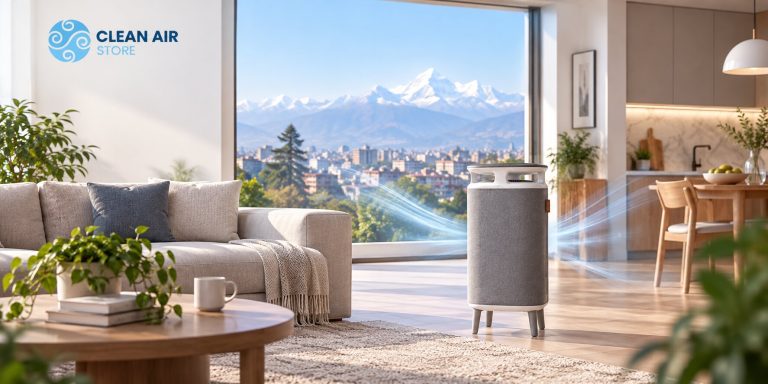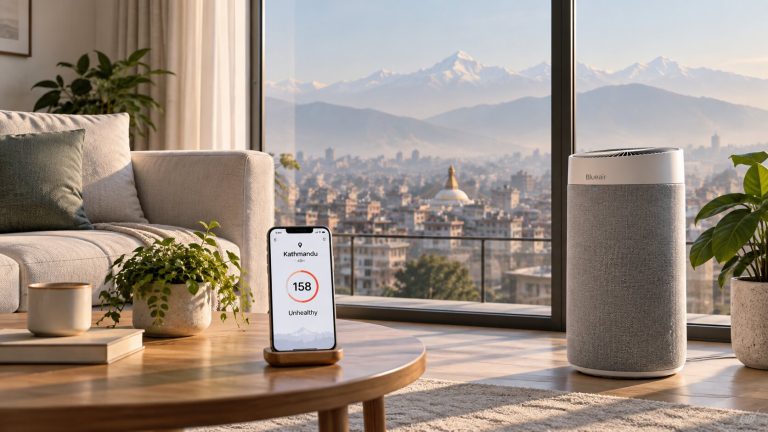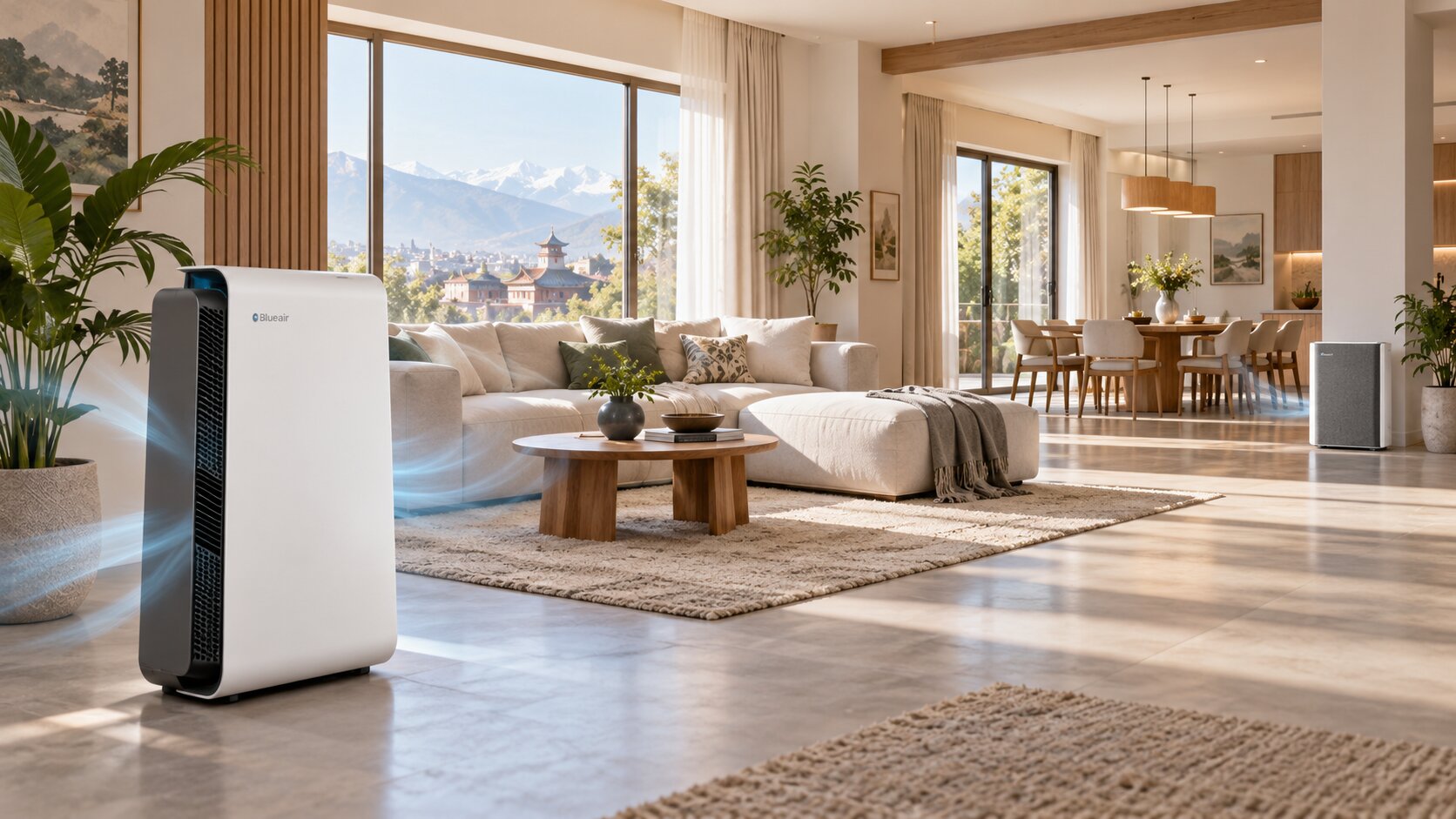
Choosing an open plan home air purifier requires more than simply matching a purifier to the room’s floor area. A large living room may connect directly to a dining space, kitchen, hallway or staircase, allowing air to move freely between several areas.
That means a purifier may effectively be working across a much larger space than the living room measurements suggest. Ceiling height, CADR, room shape, airflow and purifier placement all influence how well filtered air reaches the areas where your family spends time.
For some homes, one high-capacity purifier can be the most practical choice. In longer, divided or multi-zone layouts, two correctly sized units placed in separate areas may provide more even filtration.
Why Do Open-Plan Homes Need Different Air Purifier Sizing?
Open-plan homes need different air purifier sizing because the purifier may be cleaning air across several connected areas rather than one clearly enclosed room.
A 35 m² bedroom with a closed door has a defined air volume. A 35 m² living room that opens into a dining area, hallway or staircase does not. Air can move freely between these spaces, carrying dust, PM2.5, smoke particles and other airborne pollutants beyond the main living area.
Open kitchens, partial walls and higher ceilings can increase the effective space the purifier has to serve. Manufacturer room-size ratings are still useful, but the actual layout of your home influences how evenly and quickly filtered air reaches different parts of the space.
Is Room Size Enough to Choose an Air Purifier for a Large Room?
Floor area alone is not enough to choose the right air purifier for a large room. Room volume, ceiling height and layout also affect how much air the purifier needs to process.
Consider two living rooms that both measure 50 m². One has a standard ceiling and is fully enclosed. The other has a double-height ceiling, an open staircase and a connected dining area. Although the floor area is the same, the second space contains more air and allows that air to move through a much larger zone.
The U.S. EPA’s guidance for portable air cleaners recommends considering the entire area an air cleaner is expected to serve in an open floor plan. It also notes that rooms with higher ceilings may require a purifier with greater capacity.
For large or connected spaces, look beyond length × width. Consider the ceiling height, adjoining areas and how freely air moves between them.
What CADR Do You Need for a Large or Open-Plan Room?
The CADR you need depends on the size and volume of the space the purifier is expected to serve. CADR, or Clean Air Delivery Rate, measures how much filtered air a purifier can deliver, so a higher CADR generally allows the unit to process airborne particles more quickly in a larger room.
Room-coverage figures are useful, but they do not always show how quickly the air is being cleaned. AHAM’s air filtration standards use CADR to relate purifier performance to suggested room size and recommend allowing more capacity where ceilings are higher than eight feet.
Air changes per hour, or ACH, adds another useful measure by estimating how often the purifier can process the room’s air volume within an hour. Comparing CADR and air changes per hour gives a clearer picture of whether a purifier has enough clean-air delivery for a large or open-plan space.
Does Ceiling Height Change the Air Purifier Size You Need?
A higher ceiling can increase the air purifier capacity you need because it increases the total volume of air in the room. Two rooms can have the same floor area but require different levels of filtration if one has a much higher ceiling.
For example, a purifier that is well matched to a 40 m² living room with a standard ceiling may have a heavier workload in a 40 m² double-height room. The floor area has not changed, but the purifier now has substantially more air to process before it can achieve the same number of air changes per hour.
This is especially relevant in larger family homes with high-ceiling living rooms, entrance foyers, mezzanine-style spaces or staircases that open upward into another level. In these layouts, it is better to consider both floor area and ceiling height rather than relying on square metres alone.
Can One Air Purifier Cover a Large Open-Plan Living Room?
One air purifier can cover a large open-plan living room if it has enough clean-air delivery for the entire connected space and filtered air can circulate freely throughout the layout.
A single high-capacity unit works best in relatively simple spaces, such as a large rectangular living and dining area with few partitions, a standard ceiling height and no major barriers between zones.
Placement also has a major effect on performance. A purifier positioned in an open area where air can move freely through the room will usually serve the space more effectively than the same unit placed behind furniture, in a tight corner or at one end of a long room.
One purifier may be less practical when the space is L-shaped, divided by partial walls or spread across several distinct zones. In those cases, the issue is not only total purifier capacity, but whether filtered air can reach each part of the room evenly.
When Are Two Air Purifiers Better Than One?
Two air purifiers can work better than one when a large room is difficult to cover evenly from a single location. This is more common in long, L-shaped or partly divided spaces, where filtered air has to travel farther or move around corners to reach every occupied area.
For example, one purifier in an L-shaped living and dining room may have enough capacity for the total floor area, but that does not mean air will circulate equally well into both sections. Placing two correctly sized units in separate zones can help provide more even filtration across the space.
Two purifiers can be useful when:
- the room is unusually long
- partial walls separate living and dining areas
- the purifier can only be placed at one end of the room
- one area is close to frequently opened balcony or entrance doors
- a staircase opens directly into the living space
- family members regularly use different parts of the room
- airborne particles enter from more than one direction
Using two units also means managing two filters, two power sources and two maintenance schedules. Compare their combined CADR, noise, electricity use and filter costs with what one larger purifier can provide before deciding.
Is One Large Air Purifier Better Than Two Smaller Purifiers?
One large air purifier is often the simpler choice for an open, uncomplicated room, while two smaller units can suit long, divided or multi-zone spaces better. The better setup depends on how easily filtered air can reach the areas people actually use.
| Factor | One Large Purifier | Two Smaller Purifiers |
| Best suited to | Simple, open layouts | Long, divided or multi-zone layouts |
| Placement | Depends on one well-chosen position | Can serve separate parts of the room |
| Air distribution | Works best where airflow is open | Can provide more even coverage across zones |
| Noise | One unit may need to run at a higher speed | Each unit may be able to run at a lower speed |
| Maintenance | One filter system to maintain | Two filter systems to maintain |
| Cost | Depends on the model selected | Depends on the two models selected |
| Flexibility | Stays focused on one main area | Units can be moved or used separately |
The decision should be based on more than the number of purifiers. Compare the combined CADR, room layout, placement, noise, filter costs and electricity use to see which setup makes more sense for the space.
Where Should You Place an Air Purifier in a Large Open-Plan Room?
Place the air purifier where air can move freely into and out of the unit, with enough open space for filtered air to circulate through the room. A central or open position is often more useful than placing the purifier against a wall or at the far edge of a large living area.
Avoid positioning it tightly in a corner, behind a sofa or between large pieces of furniture, as these can restrict the intake or clean-air outlet. It also helps to consider where people spend the most time and where outdoor particles are most likely to enter, such as near balcony doors, entrance doors or frequently opened windows.
In long or divided open-plan rooms, one placement point may not serve every area equally well. If filtered air has to travel a long distance or around partial walls to reach another occupied zone, a second purifier may be more practical than relying on one unit at the opposite end of the space.
Can an Air Purifier Clean a Living Room Connected to a Kitchen?
An air purifier can help reduce airborne cooking particles that spread into a connected living room, but it should not replace kitchen exhaust. Where possible, cooking pollution should first be captured close to the source with an outdoor-vented range hood, while the purifier handles particles that move into the wider living space.
Different pollutants also need different types of filtration. Cooking smoke, airborne particles and odours are not all treated in the same way. Particle filtration can reduce suspended smoke and fine particles, while gases and odours require suitable gas-filtration media such as activated carbon.
Ventilation has a separate role because it brings in outdoor air and removes indoor air. This is especially relevant for occupant-generated CO₂, which standard particle filtration does not remove. In an open kitchen and living area, kitchen exhaust, ventilation and air purification work best as separate but complementary measures.
Can One Air Purifier Clean a Living Room With an Open Staircase?
One air purifier should not be expected to clean both floors consistently just because the living room is connected to an open staircase. Air can move freely between levels, which makes the total space harder to define and increases the volume the purifier may influence.
Filtered air from downstairs may travel upward, while dust, smoke particles and other airborne pollutants from the upper floor can also move back into the living area. This means the purifier is no longer working within a clearly enclosed room, and its performance across both levels can vary with the layout and natural airflow of the home.
If both floors are used regularly, placing separate purifiers on each level is often more practical than relying on one extra large room air purifier downstairs. This gives each occupied area its own source of filtered air instead of depending on air movement through the staircase.
How Much Extra Purifier Capacity Should You Allow for a Large Room?
It can be useful to choose more purifier capacity than the bare minimum when the room is large, open or exposed to changing pollution levels. Extra clean-air delivery gives the purifier more headroom when outdoor PM2.5 is high, doors open frequently, ceilings are taller than standard, or the living area connects to other spaces.
Additional capacity can be useful when:
- outdoor PM2.5 is frequently high
- doors open many times during the day
- ceilings are unusually high
- the living room connects to other areas
- faster particle reduction is preferred
- you want to avoid relying on the highest fan speed all the time
There is no fixed rule that every homeowner should choose a purifier 20% or 50% larger. A better approach is to compare CADR with the actual room volume, layout, ceiling height and expected conditions, then choose enough capacity for the purifier to perform comfortably in that space.
Which Blueair Air Purifiers Suit Large or Open-Plan Homes?
For a large or open-plan room, compare Blueair models by CADR, room size and how well one unit can serve the layout, rather than looking at coverage figures alone.
Blueair HealthProtect 7770i
The HealthProtect 7770i is rated for rooms up to 62 m², with CADR of 435 cfm for smoke, over 400 cfm for dust and 435 cfm for pollen. It also includes Wi-Fi, Auto mode and built-in air-quality monitoring.
It is best suited to larger family living spaces where one high-capacity purifier can be positioned in an open area with good airflow.
Blueair Classic 680i
The Classic 680i is rated for rooms up to 72 m², with CADR of 450 cfm for smoke, 400 cfm for dust and 450 cfm for pollen. It also includes PM2.5 and VOC sensing with Auto mode.
Its higher airflow makes it suitable for large living rooms, halls and relatively open family spaces.
Blue 3610
The Blue 3610 is rated for 51 m², with CADR of 353 cfm for smoke, 347 cfm for dust and 380 cfm for pollen.
It suits moderately large rooms and simpler open-plan layouts, and can also be considered where two separate purifier locations make more sense than one very large unit.
What Are the Most Common Air Purifier Sizing Mistakes in Large Homes?
Most sizing mistakes happen when the purifier is chosen by room coverage alone, without considering how the space is actually used.
Common mistakes include:
- choosing by floor area alone
- ignoring high ceilings and total room volume
- treating connected spaces as separate rooms when there are no doors
- placing the purifier in a corner or behind large furniture
- expecting one downstairs purifier to clean another floor
- choosing a model that only just meets the room-size requirement
- overlooking CADR and the fan speed needed to maintain useful airflow
- forgetting ongoing filter replacement costs
- assuming the largest purifier is always the best option
- assuming two smaller units will always perform better than one larger unit
A better setup matches purifier capacity to the actual room volume, layout and airflow, then places the unit where filtered air can reach the parts of the home that are used most.
What Should You Check Before Buying an Air Purifier for a Large Home?
Before choosing an air purifier for a large space, check both the room itself and the purifier’s real operating capacity.
- What is the total connected floor area?
- What is the ceiling height and overall room volume?
- Is the space rectangular, long, L-shaped or divided?
- Does it connect to a kitchen, staircase or other open area?
- Are adjoining rooms separated by doors?
- Where are dust and outdoor pollution most likely to enter?
- Where can the purifier be placed without restricting airflow?
- What CADR does the purifier provide?
- How many air changes can it realistically deliver in the space?
- Would two purifier locations provide more even coverage?
- What are the replacement-filter costs?
- How noisy is the purifier at the fan speed you are likely to use?
- What is its power consumption?
Looking at these factors together gives a much clearer picture than relying on the room-coverage figure alone. The best choice is one that can deliver enough filtered air for the actual volume and layout of the space without being difficult to run or maintain.
Need Help Choosing an Air Purifier for a Large Home?
Large and open-plan spaces are not always easy to size from floor area alone. Ceiling height, room shape, connected areas and purifier placement can all change what will work best in your home.
If you are unsure whether you need one high-capacity purifier or two smaller units, contact Clean Air Nepal with your room dimensions, ceiling height and a simple description of the layout. We can help you narrow down the most suitable setup for your space.
FAQs
What Size Air Purifier Do I Need for an Open-Plan Living Room?
Choose a purifier based on the total connected space, ceiling height and CADR. Open areas and higher ceilings increase the amount of air the unit needs to process.
Can One Air Purifier Cover a Large Open-Plan Home?
One purifier can work if its CADR is suitable for the full connected area and air can circulate freely. Long or divided layouts may need more than one unit.
Is One Large Air Purifier Better Than Two Smaller Purifiers?
One large purifier often suits a simple open layout, while two smaller units can provide more even coverage in long or divided spaces.
Where Should I Place an Air Purifier in an Open-Plan Room?
Place it where the intake and outlet remain unobstructed and filtered air can move freely through the main occupied area.
Can One Air Purifier Clean a Living Room and Kitchen Together?
It can reduce airborne cooking particles that spread into the living room, but it should not replace kitchen exhaust or ventilation.
Can One Air Purifier Clean Two Floors?
One purifier should not be expected to clean two floors consistently. Open staircases connect the air between levels, so separate filtration is often more practical.
Does a Higher Ceiling Require a Larger Air Purifier?
A higher ceiling increases the total room volume, so a purifier with greater clean-air delivery may be needed even when the floor area is unchanged.