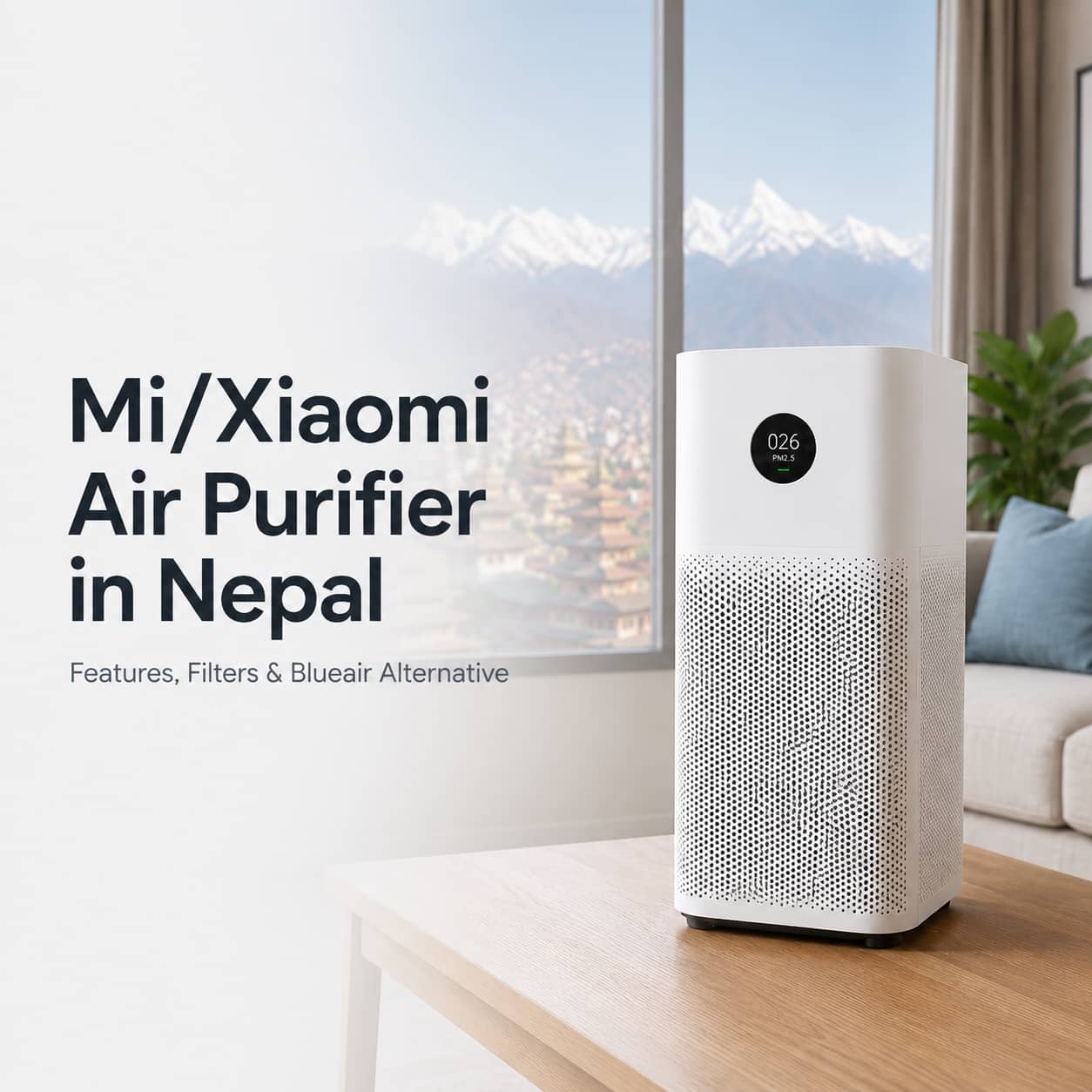
Mi air purifier in Nepal is a popular search because many Nepali buyers want a smart, modern, and budget-friendly air purifier for dust, smoke, PM2.5, odours, and indoor air pollution. Xiaomi air purifiers are known for features such as app control, air quality display, auto mode, HEPA filtration, activated carbon filtration, and a compact design.
The Mi air purifier in Nepal is a good choice for buyers who want a smart air purifier with HEPA filtration, app control, air quality monitoring, and a modern design. However, you should confirm the exact model, room coverage, filter availability, and the cost of a replacement filter before purchasing.
Why People Search for Mi Air Purifier in Nepal
People search for the Mi air purifier because Xiaomi is already a familiar smart device brand. Many buyers know Mi for phones, routers, TVs, cameras, and home gadgets, so its air purifiers naturally attract people looking for a smart, modern, and value-focused option.
In Nepal, the search usually stems from two needs: indoor air pollution and smart-home convenience.
Common indoor air problems buyers want to reduce
Mi air purifier buyers are often dealing with:
- Road dust and construction dust
- Traffic pollution and PM2.5
- Smoke from outside, incense, or cooking
- Pet dander, pollen, and fabric dust
- Stale air in closed rooms or apartments
- Odours from kitchens, pets, and indoor activities
These problems are common in Kathmandu, Lalitpur, Bhaktapur, Pokhara, Biratnagar, and other growing urban areas where outdoor pollutants can easily enter indoor spaces.
Mi Air Purifier in Nepal: What Buyers Usually Expect
Most people looking for a Xiaomi air purifier Nepal are usually expecting a purifier that is:
- Smart and app-connected
- Compact enough for home use
- Suitable for bedrooms or living rooms
- Able to reduce dust and PM2.5
- Easy to control through phone or display
- More affordable than premium purifier brands
- Good-looking for modern apartments
- Simple to operate daily
This is why Mi/Xiaomi air purifiers are often attractive to first-time buyers. But an air purifier is not like a one-time electronic gadget. It is a filter-based product. That means the machine only remains useful if the filter is replaced on time and the purifier is correctly matched to the room size.
How Mi air purifiers generally work
A Mi air purifier works by using a fan to pull indoor air into the unit, passing it through a filter system, and releasing cleaner air back into the room. Depending on the model, the filter may include a primary filter for larger dust particles, a high-efficiency particulate filter for PM2.5 and fine dust, and an activated carbon layer for certain odours and gases.
For buyers in Nepal, Mi/Xiaomi can be attractive for its smart features and affordability. But before buying, the exact model should still be checked for room coverage, CADR/airflow, filter type, replacement filter cost, genuine filter availability, and warranty support in Nepal.
Common Features of Mi/Xiaomi Air Purifiers
Mi/Xiaomi air purifiers usually focus on a mix of smart features and practical filtration. The Mi Air Purifier comes with a True HEPA filter, 360° triple-layer filtration, an OLED touch display, a 380 m³/h CADR, smart app control, a laser particle sensor, and coverage of up to 484 sq. ft.
Exact features depend on the model, so you should always verify the specific product before buying
HEPA or True HEPA Filtration
Many Xiaomi air purifiers use HEPA-style or True HEPA filtration. Xiaomi Nepal lists the Mi Air Purifier HEPA filter as using three layers: a primary filter, a H13-grade True HEPA filter, and an activated carbon filter.
The HEPA filter is important because it helps capture fine airborne particles, such as:
- Dust
- PM2.5
- Pollen
- Pet dander
- Airborne allergens
- Fine smoke particles
For Nepal, this matters because fine dust and traffic-related particles are common in many urban homes.
Activated Carbon Filter
An activated carbon filter helps reduce odour and gas-based pollutants using a highly porous carbon layer. As air passes through the filter, odour molecules from cooking, smoke, pets, stale rooms, and certain indoor chemicals adhere to the carbon surface rather than returning directly into the room.
This matters because HEPA or particle filters primarily capture dust and fine particles, while activated carbon helps control odours and fumes. However, the carbon layer has a limited absorption capacity. Once the pores become saturated, odour reduction becomes weaker, so timely filter replacement is important for consistent performance.
360° Air Intake
Many Mi/Xiaomi air purifiers use a cylindrical filter with 360° air intake, allowing the unit to draw air from multiple sides rather than just a single front-facing vent. This design supports better room-air circulation when the purifier is placed in an open area, because air can enter the filter more evenly from around the machine.
For example, the Mi Air Purifier 3 has a CADR of 380 m³/h and covers up to 484 sq. ft., so placement affects how effectively that airflow is used in the room. If the purifier is pushed against a wall, blocked by furniture, hidden behind curtains, or placed in a tight corner, the intake area becomes restricted, and the purifier may clean the room more slowly. For best performance, keep sufficient open space around the unit so the 360° intake can draw air freely from all directions.
Air Quality Sensor
Some Mi/Xiaomi air purifiers use a particle sensor to detect indoor air quality in real time. In models like the Mi Air Purifier 3, a laser particle sensor monitors fine particles and supports automatic fan-speed adjustment. The Mi Air Purifier 3 also comes with a CADR of 380 m³/h and coverage of 279–484 sq. ft., so the sensor works together with airflow to help the purifier respond when particle levels rise.
This is useful when indoor pollution changes quickly, such as after sweeping, cooking, opening windows, lighting incense, or when road dust enters the room. The sensor does not clean the air by itself; it helps the purifier determine when to increase or decrease the fan speed.
Auto Mode
Auto mode allows the purifier to adjust fan speed based on detected air quality. When particle levels are lower, the purifier can run more quietly. When pollution rises, it can increase airflow to clean the room faster.
This is convenient for daily use because users do not need to adjust the fan manually. However, auto mode depends on sensor accuracy, room size, placement, and pollution load. In very dusty rooms or after opening windows during polluted hours, running the purifier at a higher manual speed for some time may clean the air faster than relying solely on auto mode.
Mi Home App Control
One of the main attractions of Mi/Xiaomi air purifiers is smart control through the Mi Home app. Depending on the model, users can control the purifier from a phone, check indoor air quality, change fan speed, set schedules, and receive filter replacement alerts.
This is especially useful for tech-friendly users or people already using Xiaomi smart home products. For example, a user can turn on the purifier before entering the room, schedule it to run during sleeping hours, or monitor the filter life without manually checking the machine.
Digital Display
Some Mi/Xiaomi air purifiers include a digital or OLED display that shows useful operating information directly on the unit. Depending on the model, the display may show PM2.5 level, air quality status, fan mode, temperature, humidity, Wi-Fi status, or filter condition.
This makes the purifier easier to understand because users can see what is happening in the room instead of guessing. For example, if the PM2.5 reading increases after cooking or opening a window, the display helps users understand why the purifier is increasing fan speed.
Are Xiaomi Air Purifier Filters Easily Available in Nepal?
Availability of Xiaomi air purifier filters in Nepal depends on the exact model, seller, and current stock. Buyers should confirm compatibility with a replacement filter before buying the purifier, not after the filter has become old.
Why filter availability matters
An air purifier depends on clean airflow through the filter media. When the filter becomes loaded with dust, PM2.5, pollen, smoke particles, hair, and other pollutants, the purifier has to push air through a more restricted filter.
This can lead to:
- Lower CADR / slower air cleaning
- Weaker airflow from the outlet
- Higher fan noise
- Reduced particle capture performance
- More pressure on the motor
- Poor long-term purifier performance
Xiaomi filter system
Many Mi/Xiaomi air purifier filters use a 360° cylindrical filter design with multiple filtration layers. Depending on the model, the filter may include a primary filter, a True HEPA or high-efficiency particle filter, and an activated carbon layer.
The primary filter captures larger particles like hair and coarse dust. The particle filter targets fine dust, PM2.5, pollen, and smoke particles. The activated carbon layer helps reduce some odours and gas-based pollutants.
What Nepal buyers should confirm
Before buying a Mi or Xiaomi air purifier, check the exact model number, compatible filter name, filter price, genuine filter availability, and warranty support in Nepal. This is especially important in Kathmandu and other dusty areas, where filters may load faster due to road dust, construction dust, traffic pollution, smoke particles, and seasonal haze. A smart buying rule is simple: do not buy the purifier unless you know where you will buy the replacement filter later.
How Much Does a Mi Air Purifier Cost in Nepal?
Mi air purifiers are available in Nepal starting at around Rs. 20,999 for the Mi Air Purifier 3, while higher Xiaomi models range from around Rs. 36,999 to Rs. 44,999, depending on the model, seller, warranty, stock availability, and replacement filter support.
Current Price Reference in Nepal
| Mi / Xiaomi Air Purifier Model | Price Seen in Nepal | What Buyers Should Know |
| Mi Air Purifier 3 | Around Rs. 20,999 | Popular smart purifier option with True HEPA filter, 380 m³/h CADR, OLED display, app control, and coverage up to 484 sq. ft. |
| Xiaomi Air Purifier 4 Pro | Around Rs. 36,999–44,999 | Higher-priced model for buyers comparing larger-room Xiaomi options; price varies strongly by seller. |
| Mi / Xiaomi replacement filters | Seen from around Rs. 1,995 to Rs. 5,294+ on marketplace listings | Filter price varies by compatibility, seller, and whether the filter is genuine or generic, so buyers should verify carefully. |
Price Factors That Affect Real Value
Before comparing the listed price of a Mi air purifier in Nepal, buyers should look at the real value behind the price. Two Xiaomi air purifiers may look similar, but their performance can differ based on CADR, room coverage, filter quality, sensor features, warranty, and availability of replacement filters.
| Price Factor | Why It Matters | Buyer Action |
| Model version | Different Xiaomi models have different CADR, coverage area, sensors, displays, and filter systems. | Verify the exact model name before comparing prices. |
| CADR/airflow | Higher CADR usually means faster room air cleaning, especially for larger or dust-heavy rooms. | Match CADR with room size, not just budget. |
| Filter type | Filter quality affects the reduction of dust, PM2.5, pollen, smoke particles, odours, and allergens. | Check whether the model uses HEPA-type filtration and activated carbon. |
| Replacement filter cost | Filters need to be replaced over time, which affects long-term costs. | Ask the seller for the price of a compatible filter before buying. |
| Filter availability | A purifier becomes less useful if replacement filters are hard to find later. | Confirm genuine filter supply in Nepal. |
| Warranty | Warranty reduces risk if the unit has issues with the sensor, fan, display, or power. | Ask for written warranty terms. |
| Seller credibility | Trusted sellers reduce the risk of unclear warranty, fake filters, or unsupported imports. | Buy from authorised or reliable providers. |
| After-sales support | Air purifiers need filter guidance, maintenance support, and sometimes troubleshooting. | Ask how service and filter replacement support works. |
What Are the Strengths and Limitations of Mi/Xiaomi Air Purifiers?
Mi/Xiaomi air purifiers are useful for buyers seeking a smart, compact, and value-focused model with features such as app control, an air quality display, auto mode, and a modern design. However, they may not be ideal for every home if the room is large, filter availability is uncertain, warranty support is limited, or the buyer needs a more premium long-term solution for heavy dust, PM2.5, office or clinic use, or large rooms.
Strengths of Mi/Xiaomi Air Purifiers
Mi/Xiaomi air purifiers are useful for buyers who want convenience, smart control, and simple daily operation. Their biggest strengths usually lie in technology, design, and ease of use.
- Smart control: Some models support control via the Mi Home app, allowing users to adjust settings, schedule operation, check filter status, and monitor air quality on a phone.
- Air quality display: Many models show indoor air quality status, PM2.5 level, mode, or filter condition, making the purifier easier to understand.
- Auto mode: Sensor-based auto mode adjusts fan speed based on detected particle levels.
- Compact modern design: Mi/Xiaomi purifiers usually fit well in bedrooms, apartments, study rooms, and small to medium living spaces.
- 360° filter design: Many models use a cylindrical filter that allows air intake from multiple sides when placed in an open area.
- Value-focused pricing: Xiaomi often appeals to buyers by comparing smart features at a lower price than many premium purifier brands.
Limitations Buyers Should Consider
Mi/Xiaomi air purifiers are not automatically the right choice for every home. Their real performance depends on the exact model, CADR rating, room coverage, filter condition, sensor quality, placement, and availability of replacement filters.
- Model capacity matters: A purifier made for small or medium rooms may clean slowly in a large living room, office, clinic, or open space. For example, the Mi Air Purifier 3 has a 380 m³/h CADR and a listed coverage of 279–484 sq. ft., so buyers should match it to their actual room size.
- Filter support is important: Mi/Xiaomi purifiers depend on clean filters for proper airflow and particle capture. Since Xiaomi filters commonly use a primary filter, a True HEPA filter, and an activated carbon layer, buyers should confirm that replacement filters are compatible before buying.
- Auto mode depends on sensors: it’s helpful, but its response depends on sensor accuracy, dust levels, room layout, and purifier placement. Even with a laser particle sensor, the purifier works best when placed in an open area with good airflow.
- Smart features do not replace airflow: App control, OLED display, voice control, and air quality readings are useful, but CADR, filter quality, and room coverage decide how well the purifier cleans the room.
- High-dust homes may need stronger options: Homes near roads, construction sites, or busy chowks may load filters faster and need stronger airflow, longer running time, and more frequent filter checks.
- Warranty should be verified: Imported units and marketplace listings may have different warranties, filter support, and service terms, so buyers should confirm these before purchase.
Can Blueair Be a Good Alternative to Mi Air Purifier in Nepal?
Yes, Blueair can be a good alternative to the Mi air purifier in Nepal for buyers who want a more premium, filtration-focused option with strong long-term support. Mi/Xiaomi air purifiers are attractive for smart features, app control, digital display, auto mode, and value pricing, while Blueair is better suited for buyers who prioritise daily air cleaning, quiet operation, room-size options, and genuine filter availability.
| Comparison Point | Mi/Xiaomi Air Purifier | Blueair Air Purifier |
| Main appeal | Smart features, app control, value pricing | Premium Swedish air purification and long-term use |
| Filtration style | Triple-layer filtration in many models | HEPASilent™ technology in many Blueair models |
| Best for | Tech-friendly users and small to medium rooms | Homes, bedrooms, offices, clinics, cars, and dust-heavy spaces |
| Smart features | Strong focus on app, display, sensors, and auto mode | Available in selected models, depending on the series |
| Filter support | Depends on model, seller, and stock | Genuine Blueair filters available through Clean Air Nepal |
| Buying focus | Good for smart convenience | Good for filtration, reliability, and support |
When Does Blueair Make Sense Instead of a Mi Air Purifier?
Blueair makes more sense than a Mi air purifier for buyers who want more than just smart controls and a digital display. It is a practical option for users who prioritise daily air cleaning, room-specific purifier selection, access to genuine filters, and long-term support.
Blueair may also stand out because it offers a range of air purifier options for different spaces, rather than relying on a single model for every need. Whether you need cleaner air for a bedroom, living room, office, clinic, car, or a dust-heavy home, Blueair offers a range of models designed for different room sizes, usage patterns, and indoor air conditions.
Another important reason to consider Blueair is filter support. Any air purifier loses performance when filters become clogged, old, or unavailable. Clean Air Nepal provides genuine Blueair replacement filters, helping maintain proper fit, airflow, filtration performance, and long-term reliability in Nepal’s dusty indoor conditions.
Recommended Blueair Alternatives by Use Case
The right Blueair model depends on room size, dust level, daily usage hours, noise preference, and filter replacement needs. Instead of choosing one purifier for every space, Blueair offers different series for bedrooms, living rooms, offices, clinics, cars, and dust-heavy homes.
| Use Case | Blueair Option | Why It Fits |
| Small bedroom or study room | Blueair Blue 411 | Compact option for smaller rooms, with quiet daily use and particle filtration for dust, pollen, and fine indoor particles. |
| Medium bedroom or everyday room | Blueair Blue 3410 | Suitable for rooms up to 36 m² / 388 sq. ft., making it practical for bedrooms, study rooms, and apartment spaces. |
| Larger bedroom or living room | Blueair Blue 3610 | Suitable for rooms up to 51 m² / 549 sq. ft., with stronger coverage for family spaces and higher particle loads. |
| Dust-heavy home | Blueair DustMagnet Series | Made for homes where dust settles quickly, helping capture airborne dust before it lands on furniture, floors, and electronics. |
| Premium bedroom or home office | Blueair HealthProtect 7470i | A premium option for daily use, with smart monitoring, quiet performance, and advanced filtration support. |
| Large room, office, or clinic | HealthProtect 7770i / Classic Series | Better suited for larger or shared spaces that need stronger airflow, longer running hours, and reliable filtration. |
| Car cabin and daily commute | Blueair Cabin P1 / P2i | Designed for in-car use, helping reduce dust, smoke particles, traffic exposure, and everyday cabin air pollutants. |
Mi Air Purifier in Nepal for Smart Home Air Cleaning
Mi/Xiaomi air purifiers can be a good option in Nepal if you want a smart, compact, and value-focused purifier with features such as HEPA filtration, 360° air intake, app control, auto mode, an air quality display, and PM2.5 monitoring. Before buying, check the exact model, room coverage, CADR, filter type, replacement filter cost, warranty, and genuine filter availability, because long-term performance depends on both the machine and the filter support.
If you want a more premium option, Clean Air Nepal also offers Blueair air purifiers with genuine replacement filters and local support for homes, offices, clinics, cars, and other dust-heavy indoor spaces.
FAQs
Is the Mi air purifier good for homes in Nepal?
Yes, a Mi air purifier can be a good option for homes in Nepal if you want a smart, compact, and value-focused model with features like HEPA filtration, app control, auto mode, an air quality display, and PM2.5 monitoring. Before buying, check the exact model, CADR, room coverage, filter availability, and warranty support.
How much does a Mi air purifier cost in Nepal?
Mi air purifiers are available in Nepal starting at around Rs. 20,999 for the Mi Air Purifier 3, while higher Xiaomi models can range from around Rs. 36,999 to Rs. 44,999, depending on the model, seller, warranty, stock, and filter support.
Does a Mi air purifier remove dust and PM2.5?
Yes, Mi/Xiaomi air purifiers with HEPA (high-efficiency particulate air) filtration can help reduce airborne dust, PM2.5, pollen, pet dander, and fine smoke particles. For best results, the purifier should match the room size, run long enough, and use a clean, compatible replacement filter.
Are Xiaomi air purifier filters available in Nepal?
Availability of Xiaomi air purifier filters in Nepal depends on the exact model, seller, and current stock. Before buying a Mi air purifier, confirm the compatible filter name, price, availability of genuine filters, and warranty support so the purifier can be properly maintained over time.
Can Blueair be an alternative to the Mi air purifier in Nepal?
Yes, Blueair can be an alternative to the Mi air purifier in Nepal for users who want a premium Swedish air purifier with room-specific model options, strong filtration, genuine replacement filters, and local support through Clean Air Nepal. Mi/Xiaomi is attractive for smart features and value pricing, while Blueair is worth comparing for long-term daily air cleaning and filter support.