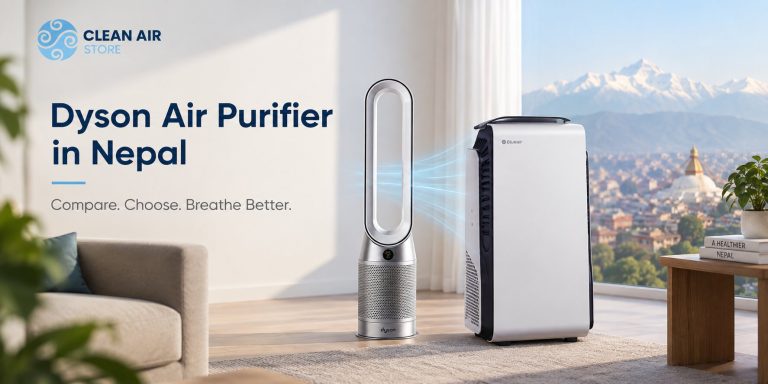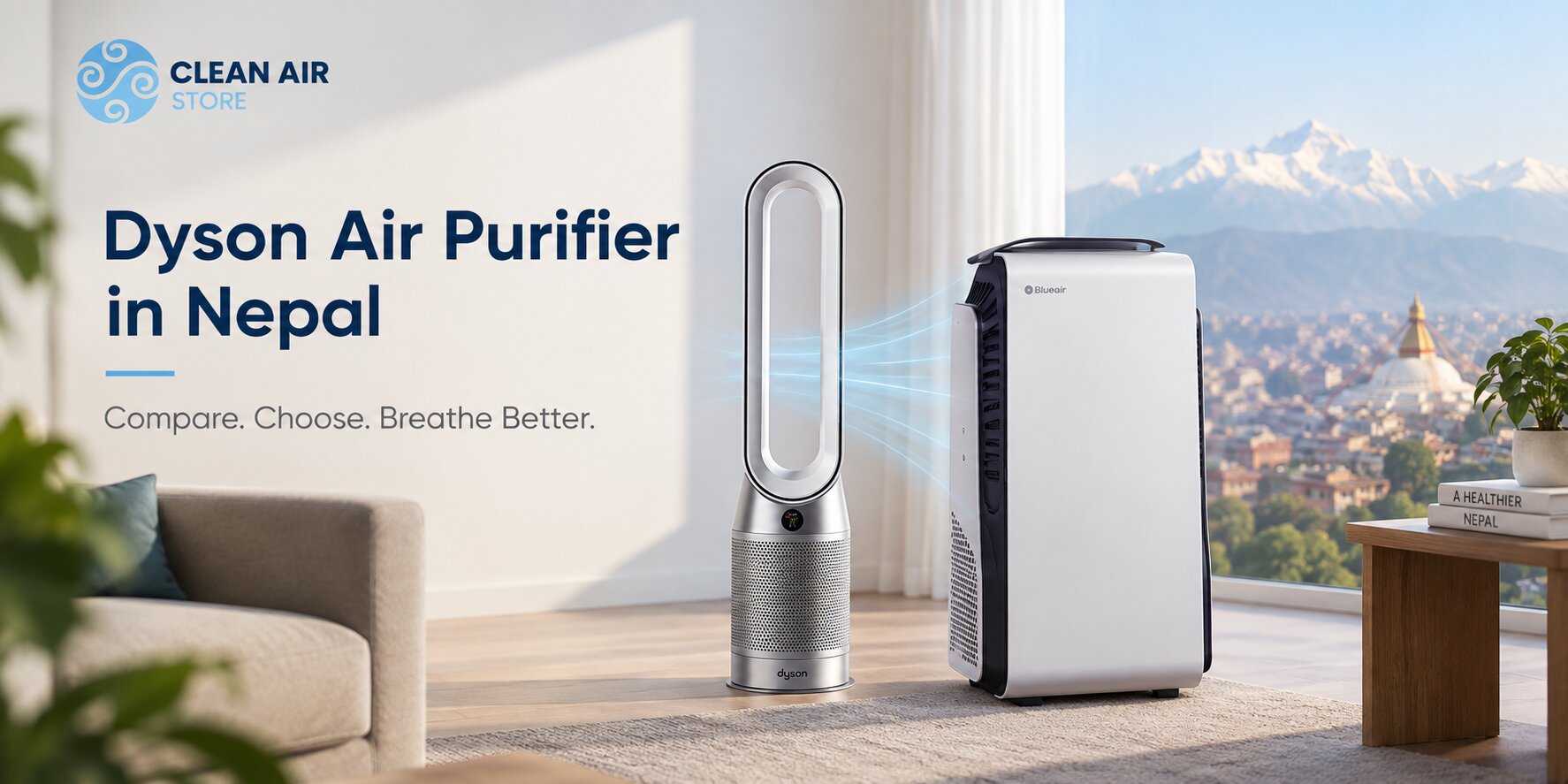
A Dyson air purifier can be attractive to buyers in Nepal who want air purification combined with premium design, smart air-quality monitoring and, depending on the model, fan or heating functionality. Dyson’s range includes models such as the Purifier Cool TP07, Purifier Cool Formaldehyde TP09, Purifier Hot+Cool and Purifier Big+Quiet.
However, design and extra features should not be the only considerations when choosing an air purifier in Nepal. Room size, filtration, Clean Air Delivery Rate (CADR), noise, filter availability, and long-term running costs matter when comparing models.
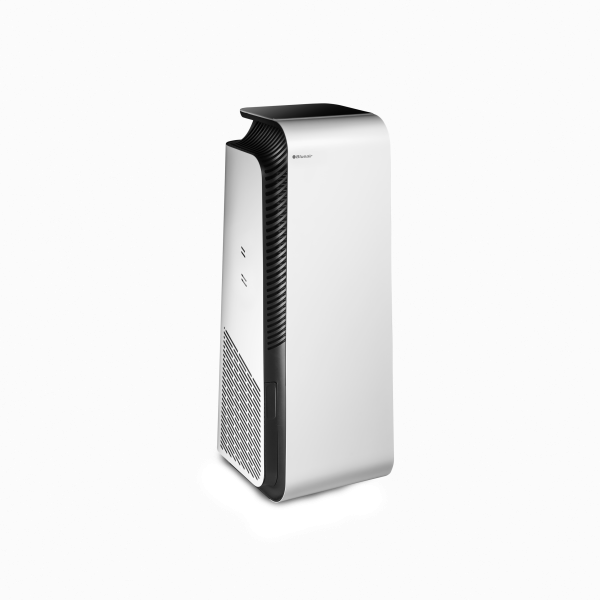
For buyers primarily focused on air-cleaning performance, Blueair is another option worth considering. You can learn more about how its filtration system works in this guide to Blueair air purification technology. This article compares Dyson’s key models with relevant Blueair options, covering air-cleaning performance, room suitability, pricing, filtration, features, and long-term running costs to help buyers in Nepal choose more confidently.
What to Know Before Buying a Dyson Air Purifier in Nepal
A few measurements decide how well any purifier works in your home.
- CADR and airflow. CADR describes how much filtered air a purifier delivers. Airflow figures and coverage claims are not the same thing. Our CADR and ACH room size guide explains how to calculate what you need.
- Room size and air changes. The EPA’s sizing chart suggests a minimum CADR of 130 cfm for a 200 sq ft room with an 8-foot ceiling. Higher ceilings, open doors and windows, and heavy dust or smoke all raise the requirement.
- HEPA and carbon filtration. HEPA captures particles. Activated carbon addresses gases, but no widely used rating system exists for gas removal, so treat odour and VOC claims cautiously.
- Noise. Compare sound levels at the speed you will actually use overnight.
- Filters and support. Ask where genuine filters are sold in Nepal, what they cost, and who honours the warranty.
- Smart features versus performance. Sensors and apps report air quality. They do not clean it.
Dyson Air Purifier Models Available/Relevant to Nepal
Dyson air purifiers combine air filtration with premium design and additional features such as air-quality monitoring, app controls, fan airflow and, on selected models, heating or formaldehyde sensing.
However, if air purification is your main priority, factors such as room size, filtration performance, noise and replacement-filter costs are more important when deciding whether a Dyson model suits your needs.
Dyson Purifier Cool TP07
A purifying fan with sealed HEPA H13 and activated carbon filtration, with the combined filter replaced roughly every 12 months. It suits bedrooms and small to mid-sized rooms. Independent testing found it comparable to a far cheaper purifier for very fine particle removal, and best suited to smaller spaces. Dyson does not publish a CADR figure for this model.
Dyson Purifier Cool Formaldehyde TP09
Adds a solid-state formaldehyde sensor and a catalytic filter that breaks formaldehyde down into carbon dioxide and water; the catalytic filter itself never needs replacing, though the HEPA and carbon filter still does. This model is most relevant for homes with new furniture, fresh paint, or recent renovation, where formaldehyde off-gassing is more likely.
Dyson Purifier Hot+Cool
Combines purification with heating and a cooling fan mode. Dyson describes it as heating a room evenly with long-range projection, and offering a backwards-airflow mode that purifies without blowing air at the user. It suits year-round use in a bedroom or study, though running the heater uses considerably more electricity than purification alone; one US-market HP07 listing states 1,500 watts.
Dyson Purifier Big+Quiet
The Dyson Purifier Big+Quiet range is designed for larger spaces and adds long-range air projection, advanced sensing and enhanced filtration options depending on the model.
It is the more relevant Dyson option for larger living areas where greater airflow is required. However, its size, features and premium positioning mean buyers should compare it with dedicated large-room purifiers before deciding.
Dyson Air Purifier Models Compared
| Model | Main purification | Extra functionality | Best suited for |
| TP07 | HEPA H13 + activated carbon | Fan, sensors, app | Buyers wanting purification + fan |
| TP09 | HEPA + carbon + formaldehyde filtration | Fan, formaldehyde sensing, app | Buyers wanting additional monitoring |
| Hot+Cool | HEPA + carbon* | Fan + heating | Multifunctional year-round use |
| Big+Quiet | Model-dependent HEPA/carbon system | Long-range airflow, advanced sensing | Larger premium spaces |
What Makes Dyson Air Purifiers Attractive?
- Design. Slim, distinctive machines that suit modern interiors, unlike a boxy standalone purifier.
- Sealed filtration. A documented feature: Dyson states the entire purifier, not just the filter cartridge, is sealed to the HEPA H13 standard.
- Monitoring. Live readings and filter-life alerts are a documented, practical feature, though detecting pollutants is different from removing them.
- Multifunctionality. Heating and cooling airflow on relevant models is genuinely useful in Nepal’s cooler months, and is a documented feature rather than a marketing claim.
Limitations of Dyson Air Purifiers
- Premium upfront price. Verified Nepal listings for the Big+Quiet range sit above NPR 120,000.
- No published CADR. This makes it harder to compare Dyson’s real-world clean-air output against other brands.
- Replacement filters. We could not verify Nepal pricing or availability for Dyson filters; confirm this with the seller before buying, since a purifier is only as useful as its ongoing filter supply.
- Do you need the extra functions? Heating, formaldehyde destruction and app control add cost. If a household’s main concern is everyday dust and PM2.5, a simpler purifier may cover the same need.
- After-sales in Nepal. Warranty terms and service arrangements for Dyson in Nepal were not verifiable from a reliable source at the time of writing.
Dyson vs Blueair: Which Makes More Sense for Nepal?
Blueair, sold in Nepal by Clean Air Nepal, takes a narrower approach: dedicated air purifiers, without built-in heating or cooling, with published room coverage and CADR for most models.
| Factor | Dyson | Blueair |
| Design | Premium, minimalist | Modern, practical |
| Smart features | Strong on supported models | Available on select models, e.g. DustMagnet 5440i, HealthProtect 7770i |
| Air purification | HEPA H13 + carbon, formaldehyde on some models | HEPASilent electrostatic + mechanical filtration |
| CADR | Not published by Dyson | Published for many models (see below) |
| Room suitability | Model-dependent; Big+Quiet claims up to 1,000 sq ft | Model-dependent; 15 m² to 62 m² across the range checked here |
| Upfront price | Generally premium; verified Nepal prices from NPR 123,000 | Verified Nepal prices from NPR 22,000 |
| Filter replacement | Not verified for Nepal | NPR 7,000–22,500 depending on model |
| Running cost | Heating models use significantly more power | 7–72 watts across the models checked here |
| Cooling/heating | Available on Hot+Cool | Not offered; purification-focused |
| Best suited for | Buyers prioritising design, multifunctionality, smart features | Buyers prioritising purification performance, room fit, and value |
Dyson may appeal to buyers who value design, multifunctionality and smart features. Blueair can be more practical for buyers focused mainly on air purification, CADR, room coverage, filter costs and value for typical Nepali rooms. Neither is a universal winner; the right choice depends on which of these a household actually needs.
Why Consider a Blueair Air Purifier?
If your priority is primarily cleaning indoor air rather than combining purification with heating or fan-style cooling, Blueair takes a more focused approach.
Its range includes dedicated purifiers for small bedrooms, medium-sized rooms and larger living spaces. This allows buyers to select according to the amount of air that actually needs to be cleaned.
Blueair’s HEPASilent air purification technology combines mechanical filtration with electrostatic particle charging. Different models then add features such as Auto mode, air-quality monitoring, smartphone controls and dust-focused filtration. For a purifier expected to operate for several hours every day, this makes CADR, room coverage, noise and power consumption especially important.
Why CADR and Room Size Matter
CADR stands for Clean Air Delivery Rate. In simple terms, it measures how much filtered air a purifier delivers. The U.S. EPA’s Guide to Air Cleaners in the Home recommends choosing a portable air cleaner with a CADR appropriate for the room where it will operate.
The EPA also notes that higher CADR generally means a purifier can filter more particles and serve a larger area. This is why buying the most expensive purifier does not automatically mean buying the right purifier.
A small bedroom and a large open-plan living room have very different requirements. Ceiling height, open doors, windows and operating speed can also affect real-world performance.
How to Choose an Air Purifier in Nepal
Before buying either Dyson, Blueair or another purifier, check these factors:
- Measure your room.
Calculate the floor area and consider ceiling height. Large open spaces need more cleaning capacity than small bedrooms. - Check CADR or equivalent performance information.
Use measurable air-cleaning data where available rather than relying only on advertised room-size claims. - Look at filtration.
Particle filtration is important for dust and PM2.5, while activated carbon is relevant when gases and odours are also concerns. - Consider noise.
For bedrooms and offices, check the operating noise range rather than only maximum performance. - Check electricity consumption.
An air purifier may run for many hours each day, making energy efficiency relevant over time. - Check replacement filters before buying.
Confirm their price, expected replacement interval and local availability. - Decide which smart features you actually need.
App controls and sensors can be convenient, but they should complement rather than replace appropriate purification capacity.
Dyson vs Blueair: Which Makes More Sense for Nepal?
Dyson and Blueair take different approaches to air purification. Dyson combines purification with premium design and multifunctional features, while Blueair focuses more directly on dedicated air cleaning. For buyers in Nepal, the right fit depends on room size, required features, budget and long-term running costs.
Dyson Air Purifiers
- Primary focus: Combines air purification with additional functions such as fan airflow and, on selected models, heating.
- Design: Distinctive, premium design suited to buyers who value appearance as well as functionality.
- Smart features: Selected models include air-quality monitoring, Auto mode and app controls.
- Fan & heating: Fan airflow is available across relevant models, while Hot+Cool models also provide heating.
- CADR: Dyson does not conventionally publish CADR for several purifier models, making direct room-size comparisons more difficult.
- Replacement filters: Buyers in Nepal should confirm genuine filter availability, replacement cost and warranty support before purchasing.
Blueair Air Purifiers
- Primary focus: Uses Blueair air purification technology with models designed for different room sizes.
- Design: Modern and practical, with designs varying between Blue, DustMagnet and HealthProtect ranges.
- CADR & room size: CADR and room-coverage information is available for many models, making it easier to select according to room requirements. This CADR and ACH room-size guide explains how purifier capacity relates to room size.
- Smart features: Selected models include Auto mode, air-quality monitoring, scheduling and app controls.
- Purification-focused: Blueair does not offer heating or personal cooling functions, keeping the focus primarily on air cleaning.
- Replacement filters: Replacement filters for Blueair air purifiers are available locally, making ongoing maintenance easier to plan.
If you specifically want purification combined with fan airflow or heating, Dyson’s multifunctional approach may suit you. If dedicated air purification is the priority, options such as the Blue 3610 and DustMagnet 5440i make it easier to compare room suitability, purification capacity, noise, energy use and filter costs.
Find the Right Air Purifier for Your Space
Choose an air purifier based on room size, CADR, filtration needs and long-term running costs, not just the brand name. Explore available Blueair air purifiers to compare suitable options for bedrooms, living rooms and larger spaces.
FAQs
Is Dyson air purifier available in Nepal?
Yes. Some Dyson air purifier models are available through importers and resellers in Nepal. Check the model, warranty and replacement-filter availability before buying.
How much does a Dyson air purifier cost in Nepal?
As of September 2026, listed prices include around NPR 104,100 for the TP10, NPR 123,400 for the BP03 and NPR 132,600 for the BP04. Prices for the TP07, TP09 and Hot+Cool could not be verified.
Which Dyson air purifier is suitable for a bedroom?
The TP07 and TP09 are more suitable options for typical bedrooms, depending on room size and required features.
Is Dyson better than Blueair?
Neither is better for everyone. Dyson focuses more on design and multifunctionality, while Blueair focuses more directly on air purification, CADR and room coverage.
Are Dyson air purifiers worth the price?
They can be if you value premium design, smart controls and additional functions. If purification is your main priority, compare CADR, room coverage and running costs before deciding.
What should I check before buying an air purifier in Nepal?
Check room size, CADR, filtration, noise, power consumption, filter cost and availability, warranty and after-sales support.