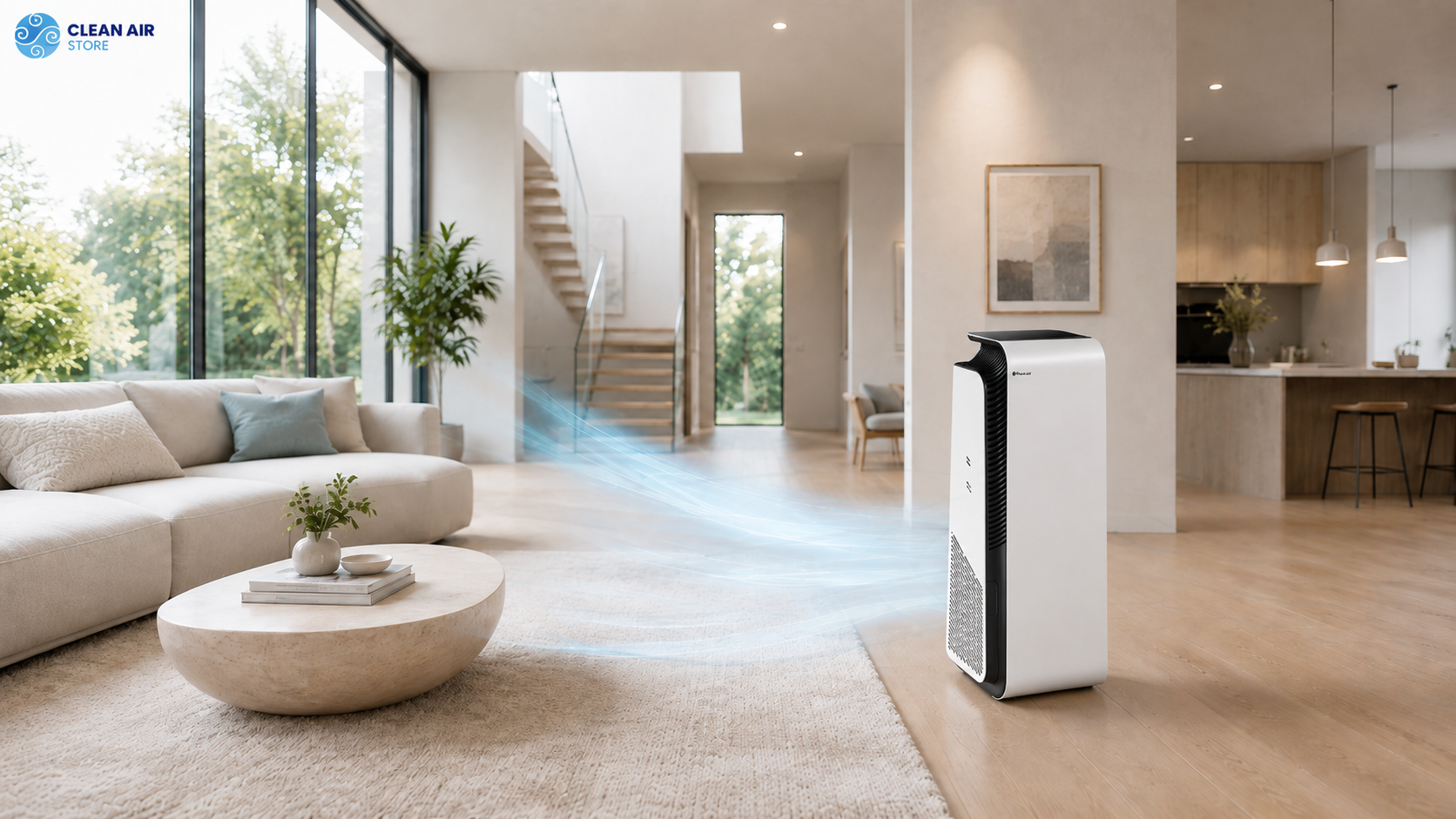
Choosing the right air purifier gets much easier once you understand two measurements: CADR and ACH. CADR tells you how much clean air a purifier delivers, while ACH tells you how many times that clean air can pass through the full volume of your room every hour. Together, these two numbers answer the question that actually matters: is this purifier powerful enough for this specific room?
They also give you a far more reliable comparison than price, design, or the “covers up to X sq ft” figure printed on the box. A purifier can claim a large coverage area and still be too slow in practice, because that number is often calculated using a low ACH that barely cleans the air once or twice an hour. Room size is also more than floor area, since ceiling height, connected spaces, outdoor pollution, pets, smoke, and allergies can all raise the amount of clean air your room really needs.
Getting this wrong usually means an undersized purifier that has to run flat out on its loudest setting just to keep up. This guide breaks down what CADR and ACH mean, how to work out your room’s air volume, and the practical sizing targets to aim for. That way, you can judge any purifier by how well it fits your room rather than how it looks on a shelf.
What Is CADR in an Air Purifier?
CADR stands for Clean Air Delivery Rate, and it measures how much filtered air a purifier actually delivers in a given time, shown in cubic metres per hour (m³/h) or cubic feet per minute (cfm). A higher CADR means the purifier can remove airborne particles faster or serve a larger room.
According to the US Environmental Protection Agency’s guide to home air cleaners, buyers should choose a purifier with a CADR large enough for the room or area in which it will operate.
What Do Smoke, Dust and Pollen CADR Mean?
Some independently tested air purifiers display three CADR values:
- Smoke CADR: Performance against smaller particles similar in size to fine smoke particles.
- Dust CADR: Performance against medium-sized particles.
- Pollen CADR: Performance against larger particles such as pollen.
The numbers can differ because a purifier may remove different particle sizes at different rates. When comparing purifiers for PM2.5, traffic pollution or smoke particles, the smoke CADR is the most useful starting point.
CADR mainly describes particle removal. It does not tell you how well a purifier removes gases, volatile organic compounds or odours. Those pollutants require a suitable gas filter, normally containing activated carbon. For more details, read our guide on air purifiers for smoke, odour and cooking fumes.
What Is ACH in an Air Purifier?
ACH stands for Air Changes per Hour. It estimates how many times the purifier can filter a volume of air equal to the room’s total air volume in one hour. For example, 5 ACH means the purifier delivers enough clean air to equal the room’s full volume five times per hour. That is approximately one theoretical air change every 12 minutes.
ACH is not a fixed property of the purifier. The same purifier produces a higher ACH in a small bedroom and a lower ACH in a large living room because the amount of air in each space is different.
What Is the Difference Between CADR and ACH?
CADR measures the purifier’s clean air output. ACH connects that output to the volume of a particular room.
| Point of comparison | CADR | ACH |
| Full form | Clean Air Delivery Rate | Air Changes per Hour |
| What it measures | Volume of clean air delivered | Number of equivalent room air changes per hour |
| Common units | m³/h or cfm | Changes per hour |
| Is it tied to room size? | No, it is a purifier performance rating | Yes, it changes with room volume |
| Main use | Comparing purifier power | Checking suitability for a specific room |
| Higher number means | More clean air is produced | The room air is filtered more frequently |
| Main limitation | Does not fully describe gas or odour removal | Assumes reasonably good air mixing |
Think of CADR as the amount of clean air coming from a tap and ACH as how often that water could refill a container. The tap’s flow stays the same, but a small container fills more frequently than a large one.
How Many Air Changes per Hour Do You Need?
For most homes and offices, approximately 4 to 5 ACH is a practical sizing target. Rooms affected by smoke, heavy pollution, pets or airborne allergens may benefit from 5 to 6 ACH or more when the purifier is operated at an appropriate speed.
| Room condition | Practical ACH target |
| Light everyday use in a relatively clean room | 3 to 4 ACH |
| Bedroom, home office or normal living space | 4 to 5 ACH |
| Dust, pets or allergy concerns | 5 to 6 ACH |
| Smoke or a temporary heavy particle event | 6 ACH or more, if practical |
These are general selection targets, not medical standards. Actual results depend on air leakage, pollutant sources, ventilation, placement, filter condition and the fan speed used.
Some manufacturers advertise a very large coverage area based on only one or two air changes per hour. Although the calculation may be technically correct, purification will be slower in that larger area. Always check the ACH used to calculate the advertised coverage.
What CADR Do You Need for Your Room?
The right CADR depends on the room’s floor area, ceiling height and desired ACH. The following table uses a target of 5 ACH and a standard 2.4 metre ceiling. This table provides a useful starting point, but it should not replace an exact calculation when a room has high ceilings, an open layout or a strong pollution source.
| Room area | Approximate area | Minimum CADR for 5 ACH |
| 10 m² | 108 sq. ft. | 120 m³/h or 71 cfm |
| 15 m² | 161 sq. ft. | 180 m³/h or 106 cfm |
| 20 m² | 215 sq. ft. | 240 m³/h or 141 cfm |
| 25 m² | 269 sq. ft. | 300 m³/h or 177 cfm |
| 30 m² | 323 sq. ft. | 360 m³/h or 212 cfm |
| 40 m² | 431 sq. ft. | 480 m³/h or 283 cfm |
| 50 m² | 538 sq. ft. | 600 m³/h or 353 cfm |
| 60 m² | 646 sq. ft. | 720 m³/h or 424 cfm |
The AHAM Verifide two thirds rule provides another quick method. It recommends a tobacco smoke CADR in cfm equal to at least two-thirds of the room area in square feet under normal conditions. For heavy wildfire smoke, AHAM recommends a smoke CADR approximately equal to the room area.
How Do You Calculate the Required CADR and ACH?
CADR and ACH require different calculations. CADR helps determine the purifier capacity needed for a room, while ACH shows how frequently a particular purifier can filter that room’s air.
Calculate the Required CADR
- Measure the room’s length, width and ceiling height.
- Calculate room volume: Length × width × ceiling height
- Select the desired ACH, usually around 4 to 5 for everyday use.
- Calculate the required CADR: Room volume × desired ACH
For example, a 4 m × 5 m × 2.7 m room has a volume of 54 m³. At 5 ACH, it requires a CADR of 270 m³/h. A purifier rated around 300 m³/h would provide some additional capacity.
Calculate the ACH Provided by a Purifier
- Find the purifier’s published CADR.
- Calculate the total volume of your room.
- Calculate ACH: CADR in m³/h ÷ room volume in m³
For example, a purifier rated at 400 m³/h in a 72 m³ room provides approximately 5.6 ACH. This means it can theoretically filter an amount of air equal to the room’s entire volume about 5.6 times per hour.
For imperial measurements:
- Required CADR in cfm = Room volume in cubic feet × desired ACH ÷ 60
- ACH = CADR in cfm × 60 ÷ room volume in cubic feet
Which Factors May Require a Higher CADR?
A basic calculation assumes reasonably normal indoor conditions. Choose additional capacity when pollution enters frequently, or sensitive users need faster particle removal.
Outdoor Pollution and Road Dust
Homes and offices near busy roads, construction projects or dusty open areas may experience continuing particle entry. A purifier with extra capacity is more likely to maintain the desired ACH without operating at maximum speed all day. Understanding what AQI means and how its categories are interpreted can make these decisions easier.
Smoke and Cooking Particles
Cooking, incense, candles and tobacco smoke can release particles quickly. Use a kitchen exhaust fan or ventilation at the source whenever outdoor conditions allow, and run the purifier at a higher speed during and after the activity.
An air purifier can reduce airborne particles and some odours when it has suitable carbon filtration. It cannot replace a kitchen exhaust system, and it does not make smoking indoors safe.
Pets
Pets can add dander, hair and odours to the room. Pet hair often settles before reaching the filter, but airborne dander can remain suspended. Homes with several pets may benefit from a higher CADR, good airflow around the purifier and more frequent prefilter cleaning.
Allergies
People sensitive to pollen, dust or pet dander may prefer 5 to 6 ACH for faster particle reduction. A stronger purifier also gives the user more flexibility to maintain useful airflow at a quieter fan setting.
An air purifier can reduce airborne allergens, but it does not remove allergens already settled in mattresses, carpets or furniture. Regular cleaning and source control remain necessary.
Open Doors and Windows
Open windows, doors and gaps allow outdoor particles to enter continuously. The purifier may still reduce indoor particle levels, but it must work harder and may not achieve the performance expected from a closed-room calculation. Combining air purification with proper ventilation, cleaning and moisture control can support better indoor air quality throughout the home.
What Happens If an Air Purifier Is Too Small or Too Large?
The purifier should provide enough CADR for the room without being unnecessarily powerful.
If the Air Purifier Is Too Small
An undersized purifier cleans the air slowly and may struggle with ongoing pollution.
- Slow removal of dust, smoke and cooking particles
- Continuous operation at the highest and loudest fan speed
- Difficulty maintaining cleaner air when pollution enters regularly
- Reduced performance in open spaces or rooms with high ceilings
- Limited improvement in rooms larger than its rated coverage
If the Air Purifier Is Too Large
A moderately oversized purifier can clean faster and operate quietly at a lower setting. However, an excessively large model may involve:
- A higher purchase price
- More expensive replacement filters
- Greater physical size and stronger airflow
- Higher power consumption at maximum speed
When possible, select approximately 20 to 30 per cent more CADR than the basic calculation to accommodate high ceilings, open layouts and occasional pollution.
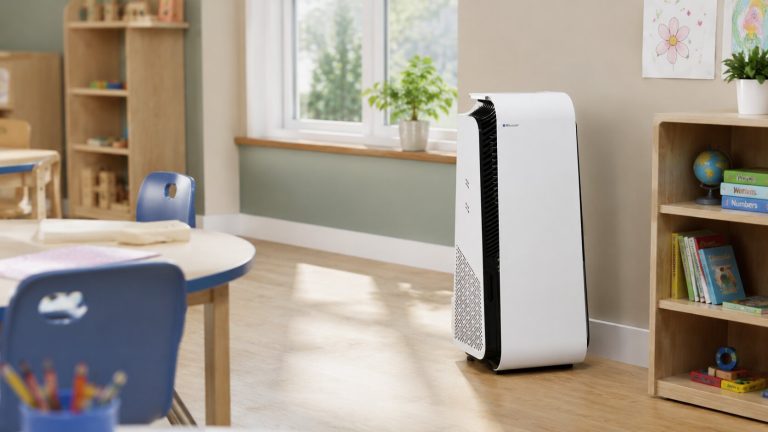
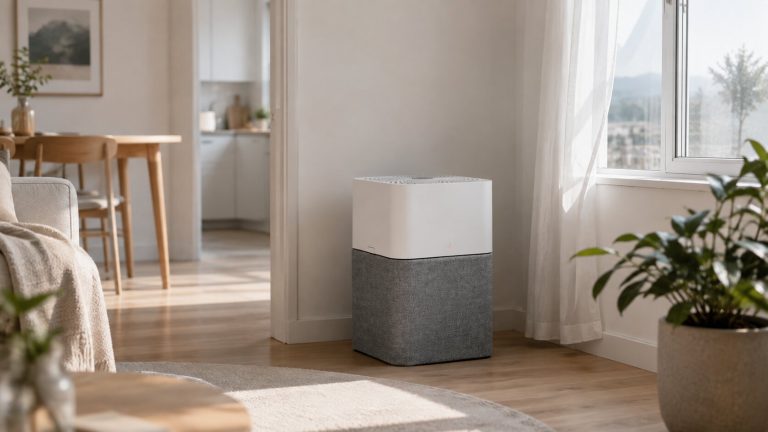
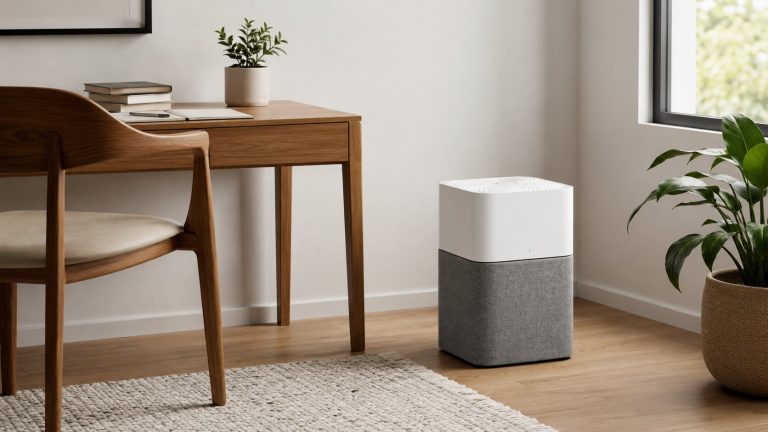
The following models provide practical capacity examples based on approximately 5 ACH under the manufacturer’s test conditions.
| Room type | Example model | Published coverage | Smoke CADR |
| Compact bedroom or personal room | Blue Pure 411 | Up to 15 m² | 180 m³/h |
| Medium bedroom, office or living space | Blue 3410 | Up to 36 m² | 425 m³/h |
| Large living room, office or open-plan area | HealthProtect 7770i | Up to 62 m² | 735 m³/h |
Use these figures as starting points. High ceilings, open layouts and frequent pollution may require additional CADR.
FAQs
What is a good CADR for an air purifier?
A good CADR provides approximately 4 to 5 air changes per hour in your room. For example, a 20 m² room with a 2.4 metre ceiling needs about 240 m³/h for 5 ACH.
Is a higher CADR always better?
A higher CADR provides faster particle removal and supports larger rooms. However, the highest possible CADR is not always necessary if it results in high cost, size or noise for a small room.
Is 5 ACH good for an air purifier?
Yes. Approximately 5 ACH is a strong practical target for bedrooms, living rooms and offices. It is equal to one theoretical air change every 12 minutes.
Is 2 ACH enough for a bedroom?
Two ACH provides relatively slow filtration and may be insufficient for dust, smoke, pets or allergy concerns. Approximately 4 to 5 ACH is a better general target for a frequently used bedroom.
How do I calculate the CADR needed for my room?
Multiply the room’s length, width and ceiling height to find its volume. Multiply that volume by your desired ACH. The result is the required CADR in m³/h.
Should I use smoke, dust or pollen CADR?
Use smoke CADR as the main comparison for fine particles, PM2.5 and smoke-related concerns. Dust and pollen CADR provide additional information about performance against medium and larger particles.
Can an air purifier be too powerful for a room?
A more powerful purifier is generally safe and may operate more quietly at a lower speed. However, a heavily oversized unit may cost more, occupy more space and use more expensive filters than necessary.
Does a higher ceiling require a larger air purifier?
Yes. A higher ceiling increases the room’s air volume. Calculate the complete volume or choose a purifier rated for a larger room than the floor area alone suggests.
Can one air purifier clean two rooms?
It may reduce some particles when doors are open, but airflow between rooms is unpredictable. For reliable performance, use the purifier in one connected space or place separate units in frequently occupied rooms.
Does CADR measure odour removal?
No. Standard smoke, dust and pollen CADR ratings measure particle removal. Odours and gases require suitable activated carbon or another gas filtration medium.