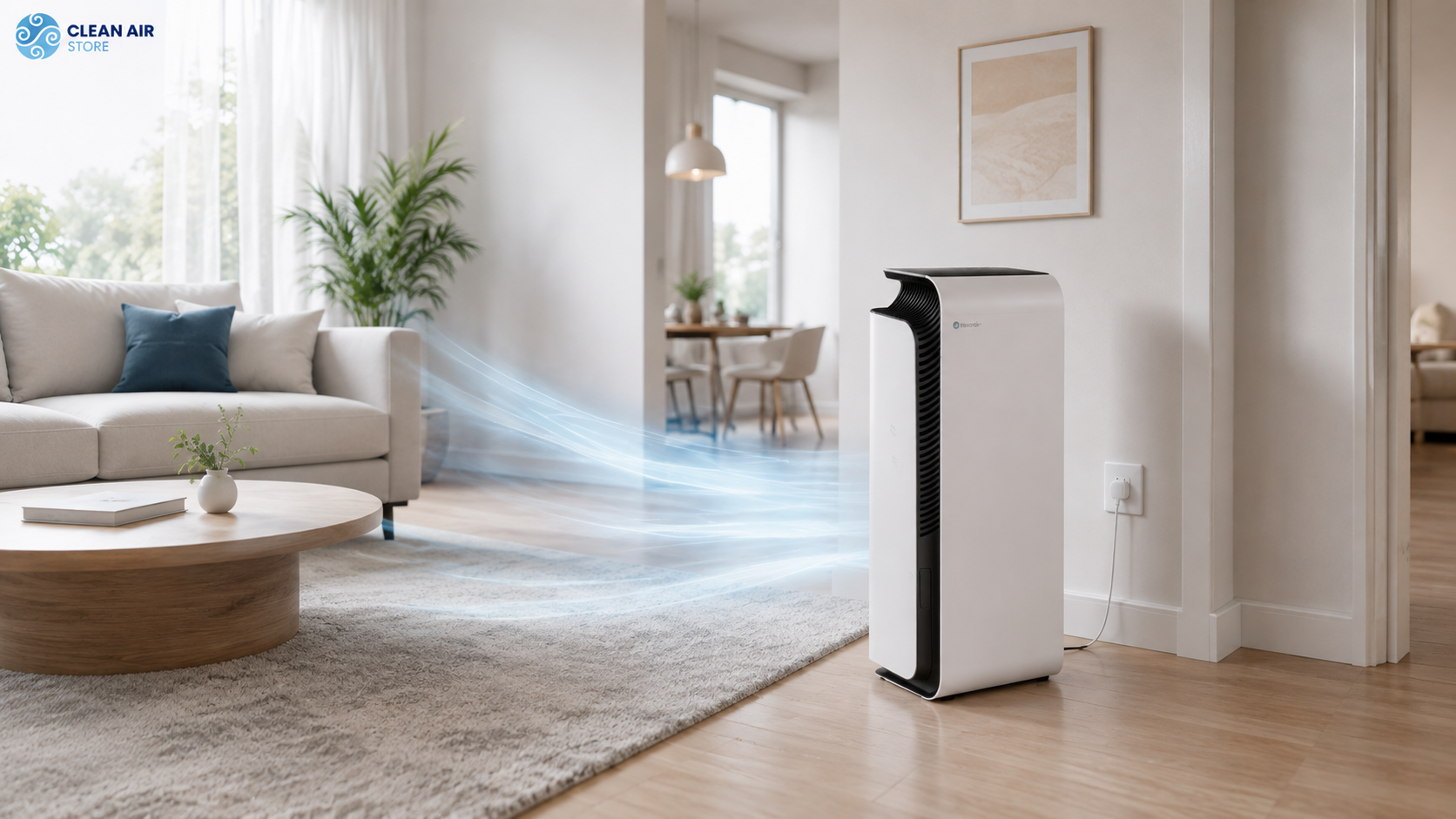
An air purifier generally adds only a modest amount to a household electricity bill in Nepal. Using the five Blueair models in this guide as examples, monthly electricity costs range from approximately NPR 3–98 for eight hours of daily use and NPR 10–294 for continuous operation at NPR 9.50 per kWh.
Actual cost depends on wattage, fan speed, operating time, Auto Mode activity and the applicable NEA slab. Filter replacement is a separate expense and is usually the larger annual running cost.
How Much Electricity Does an Air Purifier Use?
An air purifier can use approximately 1.5 to 43 W, depending on its size, fan speed and features. Using the models in this guide as examples, eight hours of daily operation uses around 0.36–10.32 kWh per month and costs approximately NPR 3–98 at NPR 9.50 per unit. Continuous 24-hour operation uses about 1.08–30.96 kWh and costs approximately NPR 10–294 per month.
Actual consumption usually falls between the published minimum and maximum because fan speeds change during use. Auto Mode can also raise or lower power consumption according to indoor particle levels.
What Do Watts, Kilowatts and Electricity Units Mean?
Watts (W) measure how much power an air purifier draws at a particular moment. A kilowatt (kW) is a larger unit of power, with one kilowatt equal to 1,000 W.
Kilowatt-hours (kWh) measure how much electricity is used over time. NEA records this consumption as electricity units, and one unit equals one kWh. For example, a 35 W purifier running for one hour uses 0.035 kWh.
How Do You Calculate an Air Purifier’s Electricity Cost?
We can calculate an air purifier’s electricity cost by converting its wattage into kilowatts, multiplying it by the number of hours used and applying the relevant electricity rate:
- Hourly use in kWh = watts ÷ 1,000
- Daily use = watts ÷ 1,000 × daily operating hours
- Monthly use = daily kWh × 30
- Yearly use = daily kWh × 365
- Electricity cost = total kWh × applicable per-unit rate
For example, a 35 W purifier used for eight hours consumes 0.28 kWh per day and 8.40 kWh per month. At NPR 9.50 per unit, it costs approximately NPR 79.80 per month. Its yearly consumption would be 102.20 kWh, costing about NPR 970.90. If the exact wattage for a fan speed is unavailable, calculate both the published minimum and maximum to create an estimated range.
Which NEA Electricity Rate Should You Use?
You should use the NEA rate that applies to the additional electricity units your air purifier adds to your household’s monthly consumption. Nepal uses progressive domestic tariffs, so the applicable per-unit rate depends on total monthly consumption.
| Monthly household use | Energy charge |
| First 20 units | Depends on meter capacity and total use |
| 21–30 units | NPR 6.50 per unit |
| 31–50 units | NPR 8.00 per unit |
| 51–250 units | NPR 9.50 per unit |
| Above 250 units | NPR 11.00 per unit |
NPR 9.50 per kWh is used for the calculations because it applies to the 51–250 unit slab. Your actual cost may differ if the added consumption falls into another slab.
How Does Fan Speed Affect Air Purifier Power Consumption?
Higher fan speeds use more electricity because the motor must move a greater volume of air through the filter. This is why air purifier power consumption is usually published as a wattage range rather than one fixed figure.
Low or Night Mode
Low or Night Mode generally operates near the lower end of the published wattage range. It is suitable for quieter operation when indoor particle levels are already controlled.
Medium or Everyday Speed
Medium speed normally uses more than the minimum wattage but less than the maximum. Do not assign it an exact figure unless the manufacturer publishes one.
High or Boost Mode
High or Boost Mode generally approaches the maximum wattage. It is useful during cooking, cleaning, smoke exposure or a noticeable rise in indoor pollution.
Auto Mode
Auto Mode adjusts fan speed according to sensor readings. It may use less electricity when the air is cleaner, but it does not provide a fixed saving because indoor particle levels continually change.
What Is the Monthly Electricity Cost of Popular Blueair Models?
Popular Blueair models can cost approximately NPR 3–98 per month when used for eight hours a day, or NPR 10–294 per month when operated continuously. These estimates use the published minimum and maximum wattages, 30 days of operation and an illustrative electricity rate of NPR 9.50 per kWh.
| Model | Wattage | 8 hours/day | 24 hours/day |
| Blue Pure 411 | 1.5–10 W | 0.36–2.40 kWh, NPR 3–23 | 1.08–7.20 kWh, NPR 10–68 |
| Blue 3410 | 3–35 W | 0.72–8.40 kWh, NPR 7–80 | 2.16–25.20 kWh, NPR 21–239 |
| Blue 3610 | 4–38 W | 0.96–9.12 kWh, NPR 9–87 | 2.88–27.36 kWh, NPR 27–260 |
| DustMagnet 5440i | 7–42 W | 1.68–10.08 kWh, NPR 16–96 | 5.04–30.24 kWh, NPR 48–287 |
| HealthProtect 7470i | 9–43 W | 2.16–10.32 kWh, NPR 21–98 | 6.48–30.96 kWh, NPR 62–294 |
A larger model may cost more to run, but it may also be more suitable for a larger room. Compare wattage with room coverage and CADR instead of choosing a purifier based only on the lowest power consumption.
How Much Does an Air Purifier Cost to Run in Real-Life Scenarios?
An air purifier can cost approximately NPR 11–103 per month to run under the illustrative scenarios below. Each calculation assumes 30 days of operation and an electricity rate of NPR 9.50 per kWh.
| Scenario | Assumption | Monthly use | Monthly cost |
| Small bedroom | 5 W for 8 hours/day | 1.20 kWh | NPR 11 |
| Living room | 20 W for 12 hours/day | 7.20 kWh | NPR 68 |
| Continuous low-speed use | 10 W for 24 hours/day | 7.20 kWh | NPR 68 |
| High-pollution pattern | 40 W for 4 hours, then 10 W for 20 hours/day | 10.80 kWh | NPR 103 |
| Office use | 25 W for 9 hours/day | 6.75 kWh | NPR 64 |
These are illustrative estimates rather than manufacturer-specified operating patterns. Actual running costs may vary as fan speed and Auto Mode activity change throughout the day.
How Much Does an Air Purifier Cost to Run for a Year?
An air purifier may cost approximately NPR 139–1,248 per year at NPR 9.50 per kWh. A 5 W unit used eight hours daily costs about NPR 139 annually, while a 20 W unit used for 12 hours costs around NPR 832.
A purifier averaging 15 W continuously costs about NPR 1,248 per year. These examples are illustrative; actual costs depend on fan speed, Auto Mode and the applicable NEA rate.
Is Electricity or Filter Replacement the Bigger Running Cost?
Filter replacement is usually the bigger running cost for these air purifiers. At NPR 9.50 per kWh, annual electricity costs range from approximately NPR 62–1,789 when operated for 12 hours a day at the published minimum or maximum wattage. Estimated annual filter expenses range from NPR 8,000–36,000.
| Model | Annual electricity | Filter cost per year |
| Blue Pure 411 | NPR 62–416 | NPR 8,000 (2 × NPR 4,000) |
| Blue 3410 | NPR 125–1,456 | NPR 14,000 (2 × NPR 7,000) |
| Blue 3610 | NPR 166–1,581 | NPR 25,000 (2 × NPR 12,500) |
| DustMagnet 5440i | NPR 291–1,748 | NPR 13,000–26,000 (1–2 filters) |
| HealthProtect 7470i | NPR 374–1,789 | NPR 18,000–36,000 (1–2 filters) |
Filter replacement therefore has a much greater effect on annual ownership costs than electricity. Actual costs vary by model, usage and indoor air quality.
What Factors Affect Air Purifier Electricity Consumption?
The main factors affecting air purifier electricity consumption are fan speed and operating hours. Room size, pollution levels, Auto Mode, filter condition and placement can also affect how long the purifier operates at each speed.
- Fan speed: Higher settings draw more power than Low or Night Mode.
- Operating time: Longer daily use increases total electricity consumption.
- Auto Mode: Frequent dust, smoke or PM2.5 increases can keep the fan at higher speeds.
- Room conditions: Larger rooms and high pollution levels may require longer cleaning periods.
- Filter and airflow: Dirty filters or blocked vents can restrict airflow and extend cleaning time.
- Number of purifiers: Running multiple units increases total household consumption.
Actual consumption will usually remain within the published wattage range but change as fan speed and operating time vary.
How Can You Lower Air Purifier Costs Without Affecting Performance?
You can reduce air purifier running costs by choosing the right model for the room, using high speed only when necessary and maintaining unrestricted airflow. Regular filter care also helps the purifier clean the air effectively.
- Choose a purifier correctly sized for the room.
- Use Auto Mode when it responds reliably to particle pollution.
- Use high speed during cooking, cleaning, smoke or heavy pollution.
- Lower the speed after indoor air quality improves.
- Keep air inlets and outlets unobstructed.
- Clean the pre-filter and replace the main filter when required.
- Use schedules when continuous operation is unnecessary.
The aim is to avoid unnecessary high-speed operation, not to switch off the purifier while the air remains polluted.
Is an Air Purifier Expensive to Run in Nepal?
An air purifier is generally inexpensive to run on electricity in Nepal, but filter replacement is the larger long-term expense. Comparing both costs provides a more realistic picture of total ownership.
Before choosing a model, consider room size, CADR, power consumption and filter availability. Contact Clean Air Nepal for help comparing models suited to your room and indoor air quality needs.
Frequently Asked Questions
Do air purifiers use a lot of electricity?
No, most air purifiers use relatively little electricity. The models in this guide draw between 1.5 and 43 W, depending on the model and fan speed.
How much does it cost to run an air purifier for 24 hours in Nepal?
Running one of the compared models for 24 hours costs approximately NPR 0.34–9.80 per day or NPR 10–294 per month at NPR 9.50 per kWh.
Does Auto Mode reduce electricity consumption?
Auto Mode may reduce electricity consumption by lowering the fan speed when indoor air is cleaner. However, dust or smoke may keep the purifier operating faster for longer.
Can an air purifier be left on all day and night?
Yes, many air purifiers support continuous operation. Follow the manufacturer’s instructions and keep the air vents unobstructed.
Can a dirty filter increase an air purifier’s power use?
A dirty filter may increase total energy use indirectly by restricting airflow and keeping Auto Mode at higher speeds for longer.
How can I measure my air purifier’s actual electricity consumption?
Use a compatible plug-in electricity meter for several days. Multiply the recorded kWh by the applicable NEA rate.