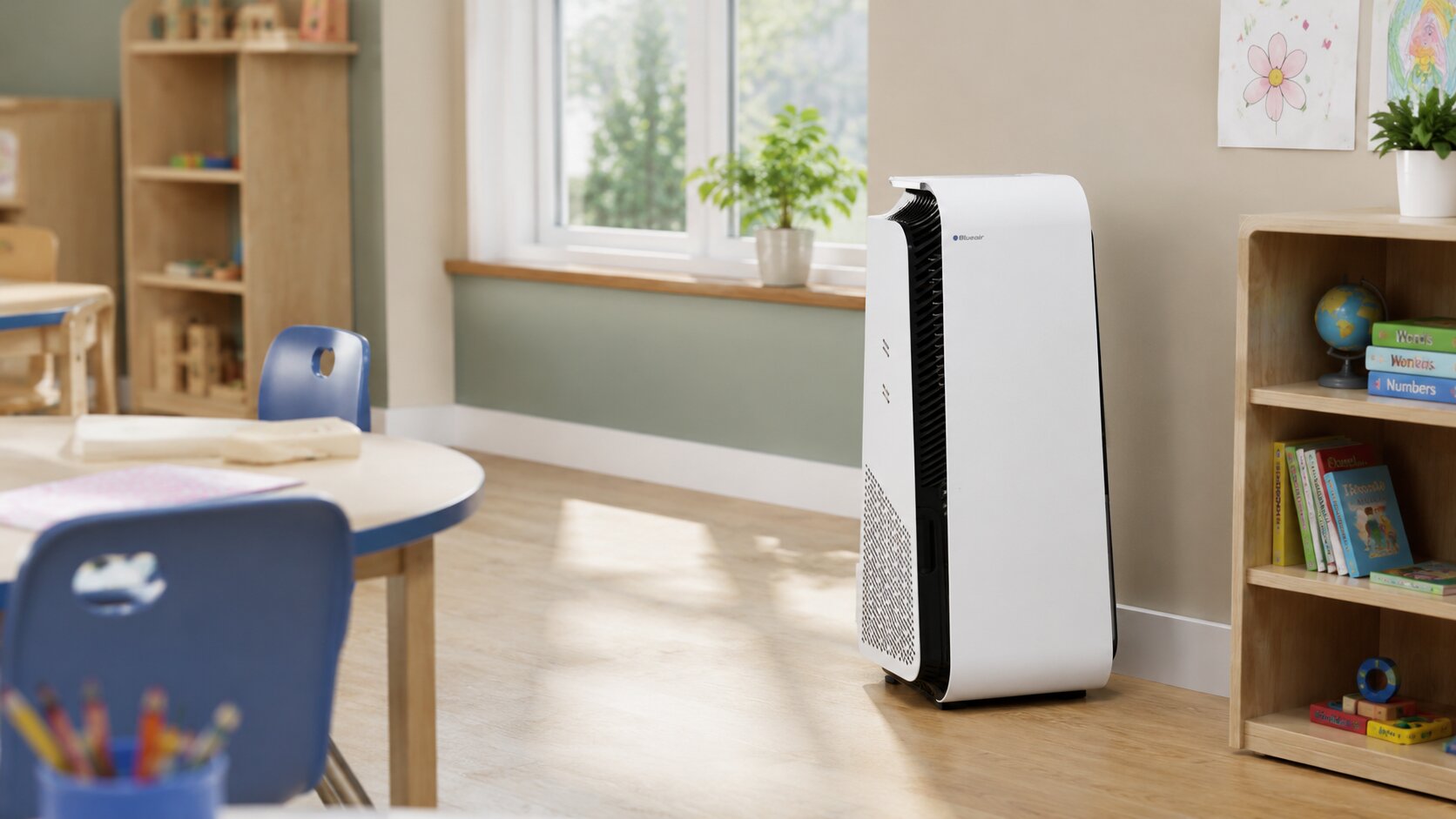
A correctly selected classroom air purifier can reduce airborne PM2.5, dust, pollen, smoke particles and other fine pollutants. However, it must be matched to the room’s volume and operated at a fan speed that teachers and students can comfortably tolerate throughout the day. Indoor air quality is especially important because children spend many hours in classrooms and daycare centres.
The World Health Organisation reports that children are particularly vulnerable to air pollution, making exposure reduction worthwhile. Air pollution can come from outside or from indoor sources like dust, cleaning products, art and craft materials, and damp areas. Since children’s lungs are still developing, they are more sensitive to polluted air. Taking simple steps to improve indoor air quality can help create a healthier and safer learning environment.
Buying an air purifier based only on brand or advertised floor area is not enough. Room height, occupancy, ventilation, outdoor pollution, noise and filter costs must all be considered. A purifier cannot prevent every illness or correct every indoor air problem, but it can lower airborne particle levels when correctly sized and operated.
Why Indoor Air Quality Matters in Schools and Daycare Centres
A classroom may look clean while still containing invisible pollutants. Outdoor PM2.5 can enter through doors and windows, while dust, cleaning products, damp materials and everyday movement can affect the air indoors. Since children spend several hours in these spaces and are more sensitive to air pollution, cleaner classroom air supports a more comfortable learning environment.
When correctly sized and used throughout the school day, an air purifier can reduce airborne dust, smoke, pollen and other fine particles. It works alongside regular cleaning and suitable ventilation as part of a complete classroom air-quality plan. Our guide to PM2.5 and air pollution in Kathmandu explains why these tiny particles need particular attention.
Common Classroom Air Quality Problems in Nepal
Conditions differ between a roadside school, a daycare beside construction and a hill-town classroom affected by seasonal smoke. Begin with a building walk-through rather than one assumption for the whole campus.
Common concerns include:
- Outdoor PM2.5 and traffic pollution entering through doors, windows and gaps
- Road and construction dust carried indoors or resuspended by movement
- Chalk dust, craft materials and particles from sweeping
- Pollen, mould spores and other allergens
- Smoke from waste burning, wildfires or nearby cooking
- Moisture, leaks and damp surfaces during the monsoon
- Odours and volatile compounds from paint, furniture and cleaning products
- Carbon dioxide and stuffiness caused by high occupancy and weak ventilation
A particle purifier can capture airborne particles, including some bacteria- or virus-containing aerosols. It does not remove carbon dioxide, repair dampness or clean surface mould. Remove sources where possible and repair moisture problems separately.
How to Size a Classroom Air Purifier in Nepal
Before comparing purifier models, calculate how much air the classroom contains. Room volume provides a more accurate picture than floor area alone and helps determine the required CADR and airflow capacity.
Step 1: Calculate Classroom Volume
Record the classroom’s internal length, width and average height in metres. The calculation is straightforward: Room volume (m³) = Length × Width × Height
A room measuring 8 m × 6 m × 3 m has a total volume of 144 m³. If the classroom connects to another open area, include that space in the calculation because air and pollutants can move between them.
Step 2: Account for Occupancy
A room with 30 students has more breathing, movement and door opening than one used by six staff. Higher occupancy can increase aerosol levels, resuspend dust, and raise carbon dioxide levels faster.
Do not increase purifier capacity as a substitute for fresh-air ventilation. Use occupancy to consider a stronger clean-air target or extra units, while addressing carbon dioxide separately.
Step 3: Select an ACH Target
Air Changes per Hour, or ACH, shows how many room-equivalents of clean air are supplied hourly. For a purifier, this is equivalent ACH because filtered air is recirculated rather than replaced.
The CDC advises aiming for five or more air changes per hour of clean air when possible for respiratory-virus risk reduction, while noting that no figure makes a space completely safe. Use the table as a planning guide.
| Classroom situation | Practical planning target | How to use it |
| Low occupancy, good ventilation, modest particle load | 3–4 equivalent ACH from filtration | A starting range for supplementary particle control |
| Regular occupied classroom | About 5 equivalent ACH | A practical target for purifier sizing |
| Crowded room, nurse’s room, severe haze or smoke episode | 5–6+ equivalent ACH | Use higher capacity, multiple units or combined ventilation and filtration |
Combine the purifier’s contribution with clean outdoor air and central filtration. Do not count an unknown natural-ventilation rate without assessing it.
Step 4: Convert ACH Into Required CADR
Clean Air Delivery Rate, or CADR, is the volume of filtered air a purifier delivers per unit of time. To estimate the CADR needed in cubic metres per hour:
Required CADR (m³/h) = Room volume (m³) × Target ACH
The 144 m³ classroom above requires 720 m³/h of CADR for five ACH. Convert units before comparing products. Clean Air Nepal’s CADR and ACH room-sizing guide explains the calculation further.
| Room volume | CADR for 4 ACH | CADR for 5 ACH | CADR for 6 ACH |
| 75 m³ | 300 m³/h | 375 m³/h | 450 m³/h |
| 100 m³ | 400 m³/h | 500 m³/h | 600 m³/h |
| 125 m³ | 500 m³/h | 625 m³/h | 750 m³/h |
| 150 m³ | 600 m³/h | 750 m³/h | 900 m³/h |
Use CADR at the fan speed the school will actually run. A unit that reaches the target only on an unacceptably loud maximum setting may be undersized for lessons.
What Filtration Should a School Air Purifier Use?
Prioritise high-efficiency particle filtration for dust, pollen, PM2.5, allergens and smoke particles. Read the specification instead of relying on terms such as “HEPA-type”. This HEPA air purifier guide explains the differences.
Activated carbon can reduce some odours and gases, depending on its amount and type. A purifier is not allowed to have smoke or strong chemical sources in a classroom.
Is One Large Purifier or Two Smaller Units Better?
One large unit is simpler to maintain. Two smaller units can distribute air more evenly, reduce strong draughts and run more quietly. Their combined CADR must meet the room target.
Multiple units help when partitions or an irregular layout interrupt airflow. A corridor purifier does not serve closed classrooms. Each room needs correctly sized filtration or a designed central system.
Noise Matters During Teaching
Low fan speed means less noise but also less clean air. Compare noise and CADR at the intended setting, not the minimum printed on the box.
Run units on high before students arrive, use a verified teaching setting during lessons and increase speed during breaks or pollution spikes. Keep louder units away from teaching and reading areas.
Where Should Air Purifiers Be Placed in a Classroom?
Use a stable position with unobstructed inlets and outlets, following required clearances. Avoid blowing continuously into a child’s face or scattering loose paper.
Avoid:
- Tight corners, cupboards, curtains and blocked intake grilles
- Directly beside an open external door or window
- Locations where bags, toys or furniture can cover the unit
- Trip routes, emergency exits and wet cleaning areas
- Unsecured positions where young children can tip or tamper with it
In large rooms, place two units in different zones. Clean Air Nepal’s air purifier placement guide provides more examples.
Ventilation and Air Purifiers Must Work Together
Ventilation supplies outdoor air and helps control carbon dioxide; a particle purifier recirculates and filters indoor air. Neither performs the other’s full job. The EPA similarly advises that air cleaning should support, not replace, source control and ventilation.
Open windows when outdoor air is cleaner, and conditions are safe. During severe PM2.5 or smoke, reduce uncontrolled entry while maintaining safe designed ventilation. A CO₂ monitor flags ventilation concerns; a PM2.5 monitor assesses particle control.
Blueair Options for Different Classroom Sizes
These models are starting points based on Clean Air Nepal’s listed room capacities. Still check CADR against room volume, target ACH and operating speed. Larger or crowded rooms may need multiple units.
| Classroom need | Models to assess | Site-listed room coverage | Why they may fit |
| Small classroom, daycare room or staff room | HealthProtect 7470i or Classic 480i | 38 m² and 40 m² | 7470i offers quieter listed operation and child-lock controls; 480i is an alternative where particle and odour filtration are both priorities |
| Medium classroom or activity room | Blue 3610 or HealthProtect 7770i | 51 m² and 62 m² | Blue 3610 is a simpler option; 7770i adds monitoring, scheduling and child-lock features |
| Large classroom, library or multipurpose room | Classic 680i or multiple appropriately sized units | 72 m² | Higher-capacity option for a large air volume; multiple units may improve distribution and lesson-time noise |
An 8 m × 6 m classroom with a 3 m ceiling needs 720 m³/h for five ACH, regardless of its 48 m² floor area. Ask for CADR at the intended speed before ordering.
Maintenance, Filter Replacement and Budgeting
Assign one staff member to the programme. Record each unit’s room, installation date, operating setting, inspection and filter-change date. A clogged filter can reduce airflow while the fan still runs.
Budget for:
- Purchase price and the number of units required
- Genuine replacement filters and a small spare stock
- Electricity for the planned daily schedule
- Cleaning, inspection and staff responsibility
- Warranty, local servicing and future room changes
Blueair guidance places filter life around six to twelve months, with some Classic and Blue models listed at about six months. Heavy dust and pollution may shorten this, so follow the indicator and inspect performance. See the guide to changing Blueair filters in Nepal for warning signs.
School Air Purifier Buying Checklist
Before purchasing, confirm:
- Room dimensions, ceiling height and calculated volume
- Normal and maximum student occupancy
- Target equivalent ACH and required total CADR
- CADR and noise at the fan speed used during lessons
- Particle filtration and any genuine need for carbon filtration
- Safe placement, electrical sockets and child-lock requirements
- Availability and annual cost of replacement filters in Nepal
- Local warranty, servicing and a named maintenance owner
- A ventilation plan for carbon dioxide, moisture and gaseous pollutants
- A short pilot test in one representative classroom where possible
This turns a purchase into a measurable indoor-air plan.
Plan Cleaner Air for Your School
Every classroom has a different size, layout, occupancy level and pollution challenge. Speak with an indoor air specialist to review your room measurements and compare suitable purifier options for classrooms, daycare rooms and shared learning spaces.
Get practical guidance on clean-air capacity, purifier placement and unit combinations so the space is not left underpowered or fitted with more capacity than it needs.
FAQs
What ACH Is Recommended for a Classroom?
About five equivalent air changes per hour is a practical target for occupied classrooms. Crowded or higher-risk rooms may need more, depending on ventilation and use.
How Much CADR Does a School Air Purifier Need?
Multiply room volume by target ACH. A 120 m³ classroom targeting five ACH needs 600 m³/h. Two units must reach that total at the selected speed.
Can One Air Purifier Serve Several Classrooms?
Not through closed doors and walls. Each classroom needs its own purifier capacity or a properly designed central ventilation and filtration system.
Does a Daycare Air Purifier Need Special Features?
A daycare air purifier needs stable placement, protected controls and manageable noise. Keep cords and airflow openings away from play areas and free of toys or blankets.
Should Classroom Windows Stay Open When a Purifier Is Running?
Open windows when outdoor air is cleaner and safe. During severe smoke or PM2.5, limit uncontrolled entry while maintaining safe ventilation and suitable filtration.
Can a HEPA Air Purifier Remove Bacteria and Viruses?
A high-efficiency purifier can capture particles carrying some bacteria and viruses. It cannot prevent every infection and should support ventilation, hygiene and other public-health measures.
How Often Should Schools Replace Air Purifier Filters?
Follow the filter indicator and manufacturer schedule. Many last six to twelve months, but Nepal’s dust, haze and long classroom use may require earlier replacement. Check monthly.