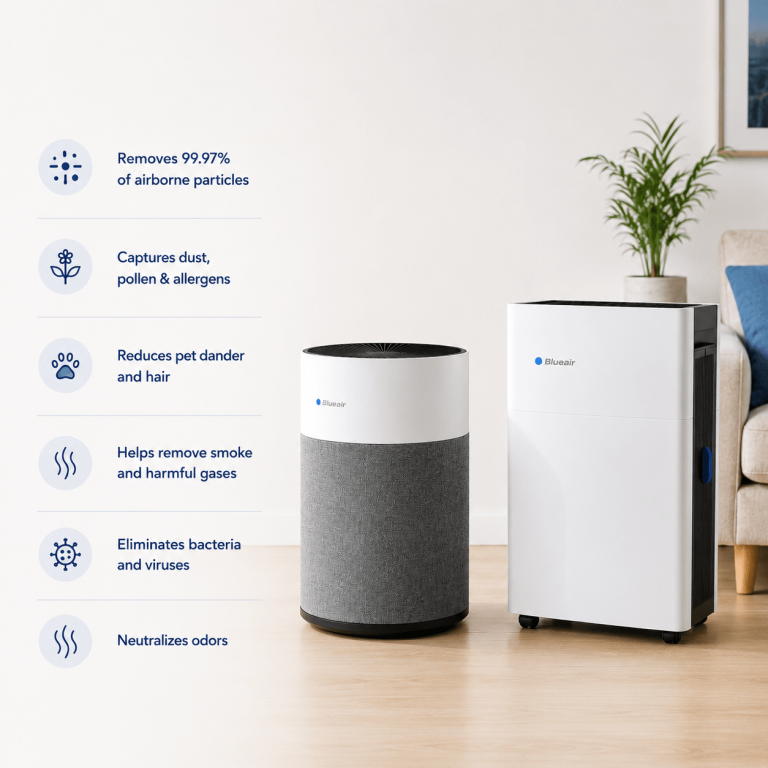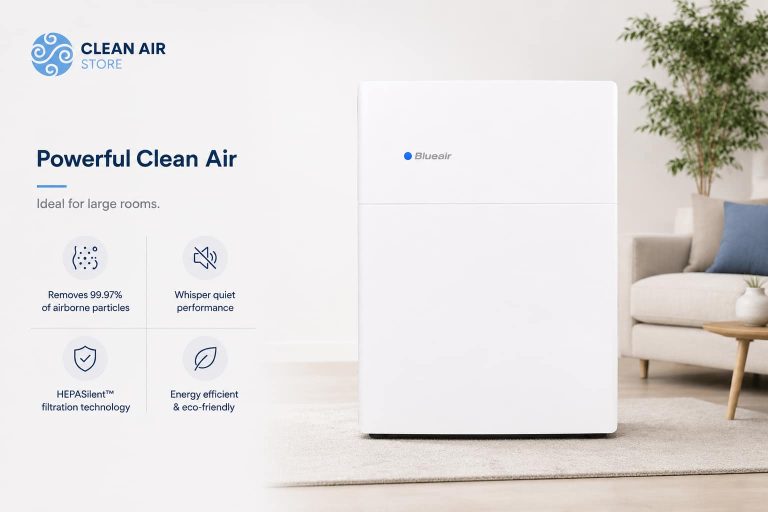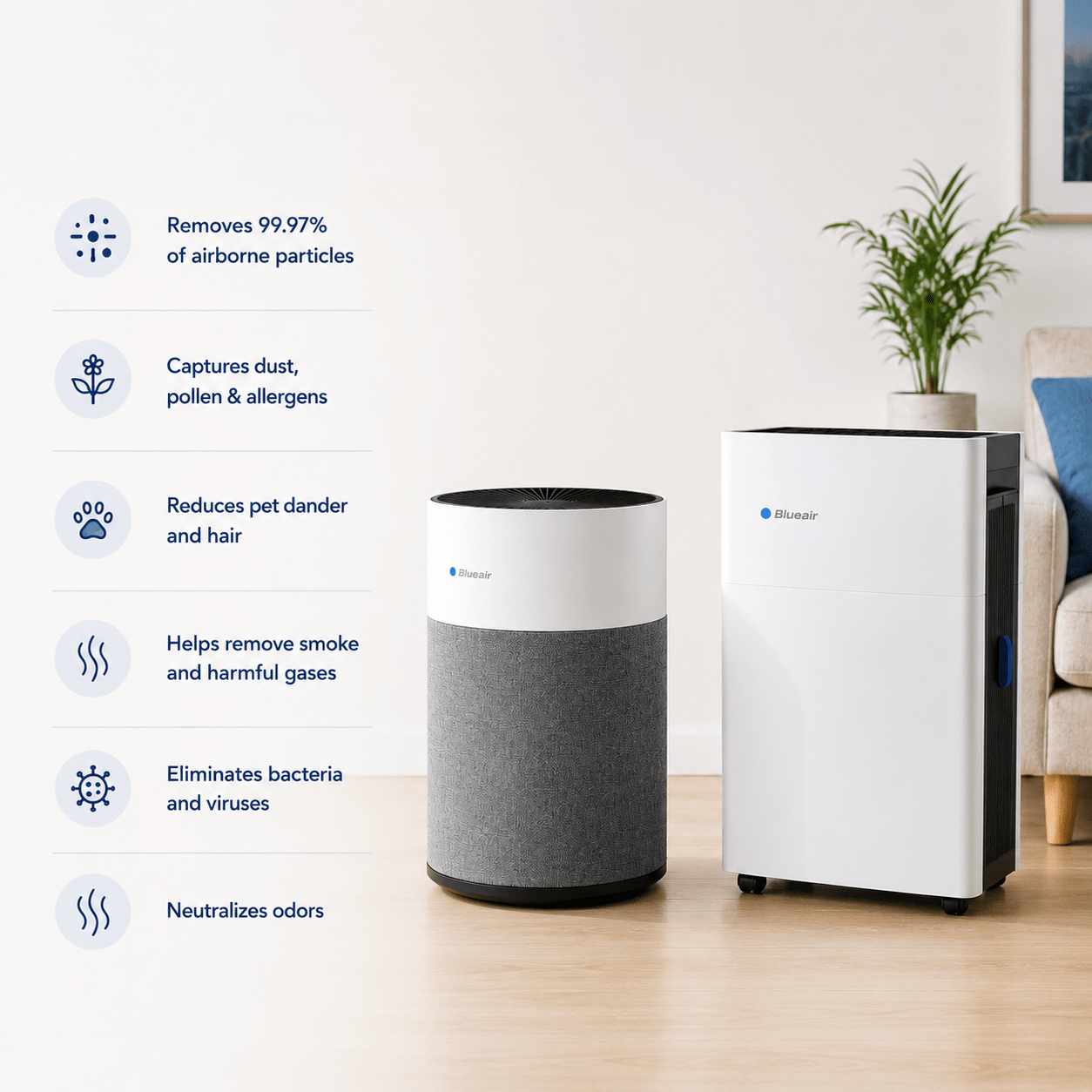
A HEPA-filter air purifier is a practical choice for homes, offices, clinics, and cars in Nepal. It reduces airborne dust, pollen, smoke particles, pet dander, mould spores, PM2.5, and other fine pollutants that can remain suspended in indoor air.
In places like Kathmandu, indoor spaces often face road dust, construction dust, traffic pollution, smoke, and seasonal haze. A high-efficiency particle filter helps make indoor air cleaner and more comfortable, especially when the purifier is matched with the right room size, airflow, filter type, and replacement support.
HEPA filtration primarily removes particles, while activated carbon filtration helps remove odors, gases, traffic fumes, cooking smells, chemical odours, and VOCs. For many homes in Nepal, the best option is an air purifier that combines strong particle filtration with activated carbon.
What is a HEPA Filter Air Purifier?
HEPA stands for High Efficiency Particulate Air. A HEPA-filter air purifier is a device that pulls indoor air through a dense particle filter and releases cleaner air back into the room. This filter is made to trap very small airborne particles that are too tiny to see. These particles can include dust, pollen, mould spores, pet dander, smoke, bacteria, and fine particulate pollution.
A true HEPA filter is commonly tested to capture 99.97% of 0.3-micron particles under standard test conditions. The 0.3-micron particle size is important because it is one of the hardest particle sizes to capture. HEPA filters can also capture a wide range of particle sizes through various physical mechanisms.
What Does a HEPA Filter Air Purifier Do?
A HEPA filter air purifier removes airborne particles such as dust, pollen, PM2.5, smoke particles, pet dander, mould spores, and some microscopic pollutants from indoor air. For odours, gases, traffic fumes, cooking smells, and VOCs, it should be combined with activated carbon filtration.
The U.S. EPA defines HEPA as a pleated mechanical filter that can theoretically remove at least 99.97% of dust, pollen, mould, bacteria, and airborne particles 0.3 microns in size, with 0.3 microns considered the most difficult size to capture.
How Does a HEPA Filter Work?
A HEPA filter works by pulling air through a dense mesh of fine fibres, where larger particles crash into the fibres, and medium-sized particles touch and stick to them. As the air continues to move through the filter, very tiny particles move randomly until they are captured, while larger particles are blocked by the small gaps in the filter.
HEPA filters do not work like a simple net. They capture particles through several physical actions depending on particle size, weight, and movement pattern. HEPA filtration uses four main actions:
| HEPA Mechanism | Simple Meaning | How It Works | Common Particles Captured |
| Interception | Particles touch the fibres and stick | Small and medium particles follow the airflow through the filter, but when they pass close to a fibre, they touch it and stay attached. | Pollen, dust particles, mould spores, pet dander |
| Impaction | Larger particles hit the fibres directly | Bigger or heavier particles cannot move smoothly around the filter fibres, so they crash into the fibres and get trapped. | Coarse dust, hair, lint, and larger pollen particles |
| Diffusion | Very tiny particles move randomly until captured | Ultrafine particles move along irregular paths rather than in straight lines, increasing their chances of hitting and sticking to fibres. | Fine smoke particles, ultrafine particles, and some PM2.5 particles |
| Sieving | Particles are too large to pass through the gaps | Larger particles are physically blocked because they cannot fit through the small spaces in the dense fibre mesh. | Dust clumps, visible dust, hair, lint, and larger debris |
The process can be understood in these simple step-by-step stages:
- Step 1: The fan draws in polluted air: The purifier fan creates airflow by pulling indoor air into the machine. This air may contain dust, pollen, smoke particles, pet dander, mould spores, PM2.5, and other fine pollutants.
- Step 2: The air moves toward the HEPA filter. After entering the purifier, it is pushed toward the HEPA filter. The filter is made of a dense mesh of fine fibres, so air cannot pass through freely as it would in open space.
- Step 3: The filter creates resistance: The dense fibre layer creates resistance as air passes through it. This slightly slows the air, giving the filter a better chance to capture airborne particles.
- Step 4: The fibre mesh traps particles: As air moves through the filter, larger particles, such as dust and lint, collide with the fibres or are blocked by the small gaps. Medium particles like pollen touch the fibres and stick, while very tiny particles like smoke particles and PM2.5 move randomly until they hit the fibres and get captured.
- Step 5: Cleaned air leaves the purifier: After passing through the filter, it exits through the outlet and circulates back into the room.
- Step 6: The process repeats continuously: The purifier keeps pulling in indoor air, filtering it, and releasing cleaner air again and again. Over time, this continuous circulation helps reduce airborne dust, allergens, smoke particles, and fine particulate matter in the room.
Why Do Homes in Nepal Need HEPA Air Purifiers?
Homes in Nepal need HEPA air purifiers because indoor air often contains dust, smoke particles, allergens, fine particulate pollution, and outdoor pollutants that enter through windows, doors, clothing, shoes, and ventilation gaps. A high-efficiency air purifier continuously filters indoor air to reduce fine and coarse airborne particles before they settle on surfaces or stay in the breathing zone.
Kathmandu homes need air purifiers to manage outdoor pollution, road dust, construction particles, and vehicle emissions that often enter indoor spaces and affect everyday breathing comfort. For many Nepali homes, it is especially helpful during dry seasons, winter pollution, dusty months, and days when outdoor air quality becomes unhealthy. It can also support people who are sensitive to dust, allergies, asthma triggers, smoke, or fine particles by keeping indoor air cleaner and more comfortable to breathe.
What Does a HEPA Filter Air Purifier Remove?
An air purifier with a HEPA filter removes airborne particles such as dust, pollen, PM2.5, PM10, smoke, pet dander, mould spores, dust mites, hair, lint, and some microscopic pollutants. It is designed to capture tiny solid and liquid particles in the air, especially those that are hard to see but easy to inhale.
| Indoor air problem | Can a HEPA filter help? | Explanation |
| Dust | Yes | A HEPA filter for dust helps reduce airborne dust before it settles on surfaces. |
| PM2.5 | Yes | A HEPA filter for PM2.5 helps capture fine particle pollution from smoke, traffic, and outdoor pollution. |
| Pollen | Yes | Helpful for people with seasonal allergies or pollen sensitivity. |
| Pet dander | Yes | Useful in homes with dogs, cats, or other pets. |
| Mold spores | Yes | Captures airborne mould particles, but does not solve the moisture source. |
| Smoke particles | Yes | Helps reduce particle pollution from smoke, but the smoke smell needs carbon filtration. |
| Bacteria | Can help | HEPA filters can capture some airborne bacteria and particle-bound microorganisms. |
| Virus-carrying particles | Can help reduce exposure | Use careful wording. HEPA filtration can reduce airborne particles, but it should not be described as a guaranteed solution for viruses. |
| Odor | Not by HEPA alone | Odour needs activated carbon or gas-phase filtration. |
| VOCs and gases | Not by HEPA alone | VOCs, chemical fumes, and gases require carbon or gas-specific filtration. |
However, a HEPA filter mainly works on particles, not gases. For cooking smells, cigarette odour, traffic fumes, chemical smells, and VOCs, an air purifier with activated carbon filtration is a better choice.
Which HEPA Air Purifier Should You Choose in Nepal?
Choose a HEPA air purifier Nepal model based on room size, CADR, filter type, carbon quality, noise level, energy use, filter cost, and local service support. A large living room needs more airflow than a small bedroom.
A roadside apartment needs stronger filtration than a low-dust room. A smoker’s room needs activated carbon. An allergy-focused bedroom needs quiet operation and strong particle capture. To compare suitable models by room size, use case, and budget, you can also explore our guide on the best air purifier in Nepal before making a final decision.
| Use case | Suggested Blueair model | Why it fits |
| Medium bedroom or everyday room | Blueair Blue 3410 | Suitable for rooms up to 36 m² / 388 sq ft, with HEPASilent™ technology to capture dust, pollen, smoke, and other airborne particles. |
| Larger bedroom, living room, or office | Blueair Blue 3610 | Suitable for larger rooms up to 51 m² / 549 sq ft, with quiet operation and auto mode. |
| Medium to large home or office spaces | Blueair Classic Series | Classic 405 and Classic 480i are listed for rooms up to 40 m², while Classic 680i is built for large rooms up to 72 m² (775 sq ft). |
| Premium bedroom, home office, or high-use room | HealthProtect™ 7470i | Suitable for bedrooms and home offices up to 38 m², with smart control and advanced 24/7 protection features. |
| Car cabin and daily driving | Blueair Cabin P1 / Cabin P2i | Cabin P1 helps reduce dust, smoke, exhaust, and odours inside cars, while Cabin P2i adds sensors and Bluetooth control. |
HEPA Filtration vs. Activated Carbon Filtration: What Is the Difference
HEPA filtration captures airborne particles such as dust, pollen, PM2.5, smoke particles, pet dander, and mould spores. Activated carbon filtration removes odours, gases, traffic fumes, cooking smells, cigarette smoke, and VOCs that HEPA filtration alone cannot effectively remove.
| Comparison Point | HEPA Filtration | Activated Carbon Filtration |
| Main function | Captures airborne particle pollution from indoor air, including both visible dust and very fine particles that can stay suspended in the breathing zone. | Reduces gas-based pollution by adsorbing odours, fumes, smoke, and chemical molecules onto the surface of activated carbon. |
| Best for | Best for dust, pollen, PM2.5, PM10, smoke particles, pet dander, mould spores, dust mite particles, hair, lint, and other microscopic particles. | Best for cooking odours, cigarette smoke, incense, traffic fumes, paint, cleaning chemical odours, VOCs, and general room smell. |
| How it works | Air passes through a dense mesh of fine fibres. Particles are captured when they crash into fibres, touch and stick to fibres, move randomly into fibres, or get blocked by small gaps. | Air passes through porous carbon with a large surface area. Odour and gas molecules adsorb onto the carbon surface and are retained within the filter rather than returning to the room. |
| Limitation | HEPA filtration is not designed to remove gases, VOCs, cooking smells, traffic fumes, or chemical odours on its own. | Activated carbon filtration is not designed to capture dust, pollen, PM2.5, pet dander, or other fine particles on its own. |
| Best choice for Nepal homes | Useful for homes exposed to road dust, construction dust, seasonal haze, smoke particles, pollen, and fine outdoor pollution entering indoor spaces. | Useful for homes affected by cooking smells, incense smoke, cigarette smoke, vehicle fumes, and chemical odours from paint, furniture, or cleaning products. |
| Ideal setup | Works best with activated carbon when the room has both particle pollution and odour or fume problems. | Works best with HEPA filtration when the room needs both particle removal and odour or gas control. |
How to Choose the Right HEPA Air Purifier in Nepal?
Choose the right HEPA air purifier in Nepal by matching the purifier to your room size, pollution level, filter type, CADR, noise level, filter cost, and after-sales support. The best model cleans your room effectively and uses genuine, easy-to-replace filters.
Check Your Room Size
Choose a HEPA air purifier according to the room where you will use it. A small bedroom, study room, living room, office, clinic, and car each require a different purifier capacity. If the purifier is too small for the space, it may run for a long time but still clean the air slowly.
Match the Purifier to Your Air Problem
Different homes have different air quality problems. For dust, pollen, PM2.5, smoke particles, pet dander, and mould spores, choose a purifier with strong particle filtration. For cooking smells, cigarette smoke, incense, traffic fumes, and VOCs, choose a purifier with activated carbon filtration.
Check CADR or Airflow Strength
CADR, or airflow strength, indicates how quickly a purifier can clean the air in a room. This is important for larger rooms, dusty homes in Kathmandu, roadside spaces, offices, and clinics. A purifier with better airflow can clean more air in less time.
Look at the Noise Level
A HEPA air purifier should be comfortable to use every day. For bedrooms, baby rooms, study rooms, and offices, choose a model that runs quietly, especially on low or night mode. For baby rooms, quiet operation, low noise, proper room coverage, and reliable filtration matter even more. Our guide on the best air purifier for baby rooms explains what to check before choosing one.
Check Filter Replacement Cost
The filter is the main part of the purifier, so replacement cost matters. Before buying, check the price of the replacement filter and how often it may need to be changed in Nepal’s dusty conditions.
Confirm Genuine Filter Availability
A purifier is only useful when genuine replacement filters are available. Always choose a brand or seller that provides original filters, warranty support, and after-sales service in Nepal.
Compare Energy Use and Daily Running Cost
Air purifiers are often used for many hours a day, so energy use matters. A good purifier should clean the air effectively without using too much electricity.
Choose the Right Model for Long-Term Use
Do not choose only by price. Compare room coverage, filter type, CADR, noise level, filter cost, warranty, and local support before buying. The right HEPA air purifier should fit your room, your pollution problem, and your long-term maintenance needs.
How Often to Change the HEPA Filter in an Air Purifier?
Most HEPA filters need replacement every 6 to 12 months, depending on usage, dust level, pollution level, and manufacturer guidance. In Nepal, filters may need attention sooner than in cleaner environments because indoor air often contains more dust, fine particles, and smoke. It is useful to know when to replace an air filter to improve a purifier’s long-term performance.
A practical routine is:
- Check the filter condition monthly
- Follow the purifier’s filter indicator
- Replace the filter when the airflow feels weaker
- Replace sooner if the room is dusty, smoky, or roadside
- Use genuine replacement filters for proper fit and performance
Signs your HEPA filter may need replacement
- The purifier gives a filter warning
- Airflow feels weaker than before
- Dust returns quickly after cleaning
- The filter looks heavily grey or clogged
- Odour increases even when the purifier is running
- The purifier sounds louder than usual
- Allergy or dust discomfort increases indoors
Can you wash a HEPA filter?
Most HEPA filters are not washable unless the manufacturer clearly says they are. Washing a non-washable HEPA filter can damage the fibre structure and reduce performance.
Some purifiers have washable pre-filters, but the main particle filter usually needs replacement. Always check the model’s instructions before cleaning any filter. IQAir also notes that not all HEPA filters are washable, and cleaning a non-washable filter can damage it.
Who Benefits Most From a HEPA Air Purifier?
People with asthma, allergies, or sinus irritation; children; elderly adults; pet owners; and residents near roads or construction sites benefit most from HEPA air purifiers. These groups are more likely to be affected by airborne dust, pollen, PM2.5, smoke particles, pet dander, mould spores, and other fine pollutants that can stay suspended in indoor air.
- People with dust sensitivity or allergies: HEPA filtration helps reduce airborne dust, pollen, pet dander, mould spores, and dust mite particles that can trigger sneezing, irritation, or discomfort indoors.
- Families with babies or children: Babies and children spend much of their time indoors, especially in bedrooms and play areas. A HEPA air purifier can help reduce fine particles and common allergens from the air they breathe every day.
- Homes near roads or construction areas: Homes near busy roads, dusty lanes, construction sites, or high-traffic areas often face more road dust, vehicle particles, and outdoor pollution entering indoor spaces.
- Pet owners: Pet hair may be visible, but pet dander is much smaller and can stay airborne. HEPA filters help capture pet dander, hair, and other fine particles from indoor air.
- People living in polluted cities: In cities such as Kathmandu, Lalitpur, Bhaktapur, Biratnagar, and Pokhara, HEPA air purifiers can help reduce PM2.5, smoke particles, dust, and seasonal haze in homes and offices.
- Offices, clinics, and shared indoor spaces: Shared spaces collect dust, outdoor particles, and airborne pollutants throughout the day. An air purifier for an office should have strong airflow, quiet operation, proper room coverage, and reliable filter performance to help maintain cleaner indoor air for staff, visitors, patients, and customers.
Is a HEPA Air Purifier Good for Allergies?
Yes, a HEPA air purifier is good for allergies because it reduces airborne allergy triggers before they settle on surfaces or remain in the breathing zone. HEPA filtration captures common allergens such as pollen, dust mite particles, pet dander, mould spores, and fine dust that can circulate inside bedrooms, living rooms, and offices.
A HEPA filter uses a dense fibre mesh to trap particles through interception, impaction, diffusion, and sieving. This makes it useful for reducing both larger allergens, such as pollen, and smaller airborne particles that may irritate sensitive users.
A HEPA air purifier does not cure allergies or treat any medical condition, but it can reduce the amount of airborne allergens and fine particles indoors. Air pollution can also cause other health-related effects, including breathing discomfort, coughing, throat irritation, eye irritation, sinus irritation, poor sleep quality, and increased respiratory stress for sensitive people.
Explore Premium Swedish Air Purifiers in Nepal
If you are planning to choose a HEPA filter air purifier for your home, office, clinic, or car, explore Clean Air Nepal’s range of premium Swedish air purifiers from Blueair. You can also contact us to find genuine Blueair replacement filters that help maintain proper airflow, filtration performance, and long-term reliability in Nepal’s dusty and polluted conditions.
FAQs
Does a HEPA filter air purifier remove PM2.5?
Yes, a HEPA-filtered air purifier can help reduce PM2.5 in indoor air. HEPA filtration captures fine airborne particles from smoke, traffic pollution, dust, and outdoor air pollution, making it useful for homes in Kathmandu and other polluted areas of Nepal.
Can a HEPA air purifier remove dust from a room?
Yes, a HEPA air purifier can reduce airborne dust before it settles on furniture, floors, beds, and other surfaces. It is especially useful for homes near roads, construction areas, dusty lanes, or high-traffic zones.
Does a HEPA filter remove smell, smoke, and VOCs?
A HEPA filter can capture smoke particles, but it does not effectively remove smoke odours, cooking odours, traffic fumes, chemical odours, or VOCs. For odour and gas-based pollution, choose an air purifier with both HEPA filtration and activated carbon filtration.
Which HEPA air purifier is best for homes in Nepal?
The best HEPA air purifier in Nepal depends on room size, dust levels, exposure to pollution, noise preferences, filter cost, and the availability of genuine filters. For most homes, the Blueair Blue 3610 is a strong choice because it fits medium to large rooms, handles everyday dust and particles, and delivers reliable performance in bedrooms, living rooms, and apartments in Nepal’s dusty indoor conditions.
How often should you change a HEPA filter in Nepal?
Most HEPA filters need replacement every 6 to 12 months, but dusty or polluted conditions in Nepal may require earlier replacement. Check the filter monthly, follow the purifier’s filter indicator, and replace it sooner if airflow becomes weak, the filter looks clogged, or dust returns quickly indoors.
Is HEPA better than activated carbon?
HEPA is better for removing airborne particles such as dust, pollen, PM2.5, smoke particles, pet dander, and mould spores. Activated carbon is better for reducing odours, gases, traffic fumes, cooking smells, cigarette smell, and VOCs, so the best air purifier usually combines both HEPA and activated carbon filtration.