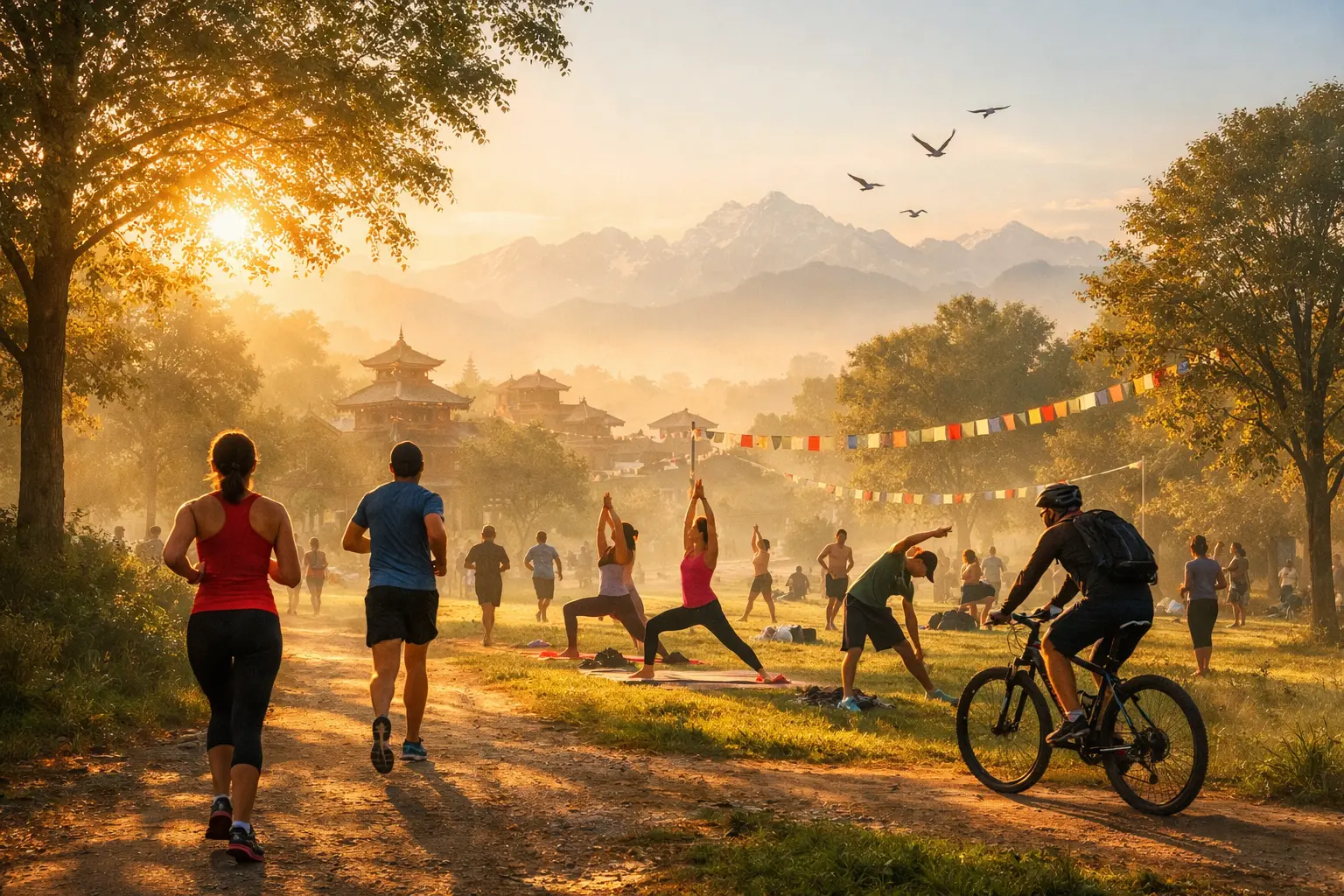
Outdoor exercise is one of the simplest and most effective ways to improve physical and mental health.
Activities such as walking, jogging, cycling, and yoga help reduce the risk of heart disease, improve fitness, and support overall well-being.
However, for residents of Kathmandu Valley, there is one additional factor to consider before heading outside for exercise: air pollution.
Kathmandu frequently experiences elevated levels of PM2.5, tiny airborne particles that can enter the lungs and bloodstream.
Because pollution levels fluctuate throughout the day, the timing of outdoor exercise can significantly affect how much pollution you breathe in.
During the rainy season, air quality often improves compared to winter months.
Rain helps remove particles from the atmosphere, and changing weather patterns help circulate air within the valley.
Even so, pollution levels still vary significantly from morning to evening.
So an important question arises:
What is the best time of day to exercise outdoors in Kathmandu?
To answer this, we analyzed air quality data collected from monitoring stations across the valley.
Understanding PM2.5 and Why It Matters for Exercise
PM2.5 refers to airborne particles smaller than 2.5 micrometers in diameter.
Because they are extremely small, they can travel deep into the lungs and even enter the bloodstream.
Long-term exposure to high levels of PM2.5 is linked to several health problems, including:
- Respiratory diseases
- Heart disease
- Reduced lung function
- Increased risk of stroke
- Irritation of the eyes and throat
When you exercise outdoors, your breathing becomes deeper and faster.
This means you inhale more air and potentially more pollutants than when resting.
That’s why choosing the right time of day for outdoor activity is especially important in cities with fluctuating air quality like Kathmandu.
What Air Quality Data in Kathmandu Shows
To better understand daily pollution patterns, data from the Drishti Kathmandu air quality monitoring network were analyzed.
The network includes 15 monitoring stations across the Kathmandu Valley that continuously measure PM2.5 concentrations.
Since July, these stations have recorded more than 50,000 measurements of PM2.5, providing valuable insight into how air pollution changes throughout the day.
The analysis revealed several clear patterns that can help residents make safer choices about when to exercise outdoors.
Best Time to Exercise Outdoors in Kathmandu
1. Early Morning: Before 6:00 AM
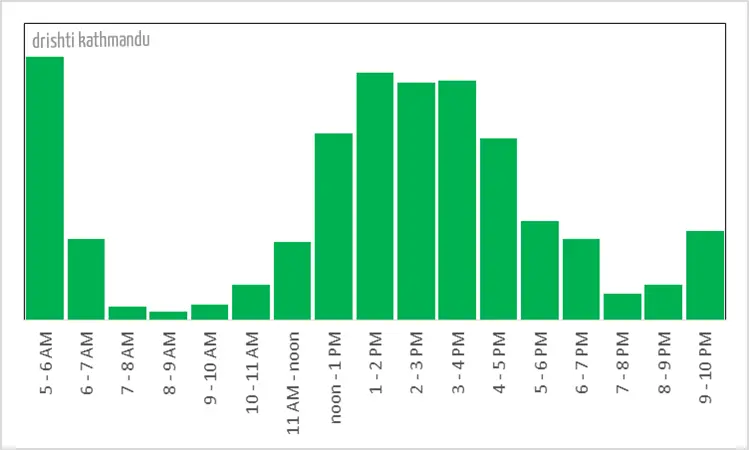
According to the monitoring data, the cleanest air of the day typically occurs before 6:00 in the morning.
Several environmental factors contribute to this improvement in air quality:
Nighttime Rainfall
During the rainy season, showers often occur overnight.
Rain removes airborne particles from the atmosphere through a process known as wet deposition, effectively washing pollutants out of the air.
Low Human Activity
In the early morning hours, Kathmandu’s streets are relatively quiet.
Traffic is minimal, shops remain closed, and construction activities have not yet begun.
As a result, emissions from vehicles and human activities are at their lowest.
Cleaner Air Circulation
Overnight cooling can also help circulate air within the valley, allowing cleaner air to replace polluted air near the ground.
Because of these combined factors, early morning provides the healthiest conditions for outdoor exercise.
People who enjoy walking, running, or cycling will benefit from scheduling their workouts before sunrise whenever possible.
2. Early Afternoon: 1:00 PM – 4:00 PM
For many people, waking up before 6 AM is not practical.
Fortunately, the data shows that early afternoon is the next best time to exercise outdoors.
Between 1:00 PM and 4:00 PM, the valley usually experiences warmer temperatures.
These higher temperatures cause air near the ground to mix with cooler air higher in the atmosphere.
This process, known as atmospheric mixing, helps dilute pollution concentrations.
Even though vehicles, businesses, and daily activities produce emissions during the afternoon, this vertical mixing spreads pollutants across a larger volume of air, making the air less concentrated with harmful particles.
For individuals with busy schedules, exercising during this window can still offer relatively good air quality.
Worst Time for Outdoor Exercise in Kathmandu
While some times of day provide cleaner air, others expose people to significantly higher pollution levels.
1. Late Morning: 7:00 AM – 10:00 AM
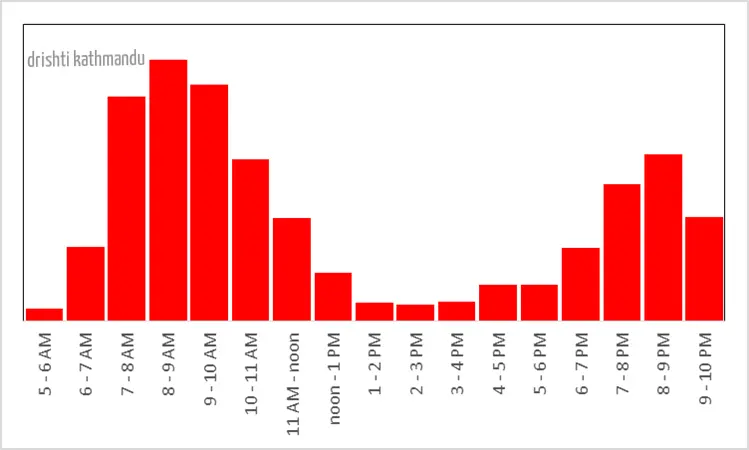
The worst time for outdoor exercise in Kathmandu is typically between 7:00 AM and 10:00 AM.
This period coincides with the city’s busiest hours.
Several major pollution sources become active during this time:
- Morning traffic congestion
- Cooking emissions from homes and restaurants
- Construction activity
- Generator use during electricity shortages
These sources release large amounts of pollutants into the atmosphere.
At the same time, morning temperatures remain relatively cool.
Without sufficient warmth, polluted air near the ground cannot rise and disperse effectively.
Instead, pollutants accumulate in the lower atmosphere, where people breathe.
As a result, exercising outdoors during these hours can expose individuals to the highest pollution levels of the day.
If exercising during this period is unavoidable, wearing a certified air pollution mask may help reduce exposure.
2. Evening: 7:00 PM – 9:00 PM
Evening hours represent the second-worst time for outdoor exercise.
Although traffic may be lighter compared to the morning rush, pollution can still remain trapped near the ground.
This occurs because temperatures drop after sunset, creating a stable layer of air that prevents pollutants from dispersing upward.
This atmospheric condition allows emissions from vehicles, cooking, and other activities to accumulate near breathing level.
Later at night, however, cooler and cleaner air from the surrounding hillsides begins to flow down into the valley.
This movement gradually lifts polluted air upward and improves air quality again.
Why Air Pollution in Kathmandu Changes Throughout the Day
Kathmandu Valley’s geography plays a major role in shaping its air pollution patterns.
Surrounded by hills, the valley often behaves like a natural bowl, where air circulation can become trapped under certain weather conditions.
Several factors influence pollution levels throughout the day:
Temperature Changes
Warm temperatures promote air mixing, while cooler temperatures trap pollution near the ground.
Human Activities
Traffic, construction, cooking, and generators contribute significant emissions during busy hours.
Rainfall
Rainfall helps remove pollutants from the atmosphere, particularly during the monsoon season.
Valley Wind Patterns
Airflow from surrounding hills can transport cleaner air into the valley during nighttime hours.
Because of these complex interactions, pollution levels fluctuate throughout the day and vary by season.
Quick Guide: Best and Worst Times to Exercise in Kathmandu
For those looking for a simple rule of thumb, the daily air pollution pattern can be summarized as follows:
Best times for outdoor exercise
- Before 6:00 AM
- Between 1:00 PM and 4:00 PM
Worst times for outdoor exercise
- 7:00 AM – 10:00 AM
- 7:00 PM – 9:00 PM
Planning an exercise around these time windows can significantly reduce pollution exposure.
Practical Tips for Exercising Safely in Polluted Cities
Even when air pollution is a concern, staying physically active remains essential for good health.
Here are several ways to exercise more safely in Kathmandu:
Check Air Quality Before Exercising
Monitoring daily PM2.5 levels can help you choose the safest time for outdoor activity.
Adjust Exercise Timing
Whenever possible, schedule outdoor workouts during cleaner air periods.
Choose Less Polluted Locations
Parks, open areas, and routes away from major roads typically have lower pollution levels.
Use Protective Masks
High-quality masks designed for air pollution can help filter harmful particles when pollution levels are high.
Consider Indoor Exercise
On days when pollution levels are extremely high, indoor exercise options such as gyms, yoga, or home workouts may be safer.
Don’t Let Air Pollution Stop You from Exercising
Air pollution is a real challenge for residents of Kathmandu, but it should not prevent people from staying active.
Exercise provides enormous benefits for both physical and mental health, including improved cardiovascular fitness, reduced stress, and stronger immunity.
The key is to exercise smarter by choosing the right time of day.
By planning workouts during cleaner air periods, especially before 6:00 AM or in the early afternoon, you can enjoy outdoor exercise while minimizing exposure to harmful pollutants.
If you ever forget these recommendations, remember that you can always check daily PM2.5 levels on air quality monitoring websites.
A simple change in timing can make a big difference in protecting your health.
FAQs
What is the best time to exercise outdoors in Kathmandu?
The best time is before 6:00 AM, when pollution levels are usually lowest. Early afternoon (1–4 PM) is the second-best option.
What time of day has the worst air pollution in Kathmandu?
Air pollution typically peaks between 7:00 AM and 10:00 AM, when traffic and other emissions are highest.
Is it safe to run outdoors in Kathmandu?
Yes, but it is safer to run during low-pollution hours, such as early morning or early afternoon.
Why does air pollution change during the day?
Changes in temperature, traffic patterns, atmospheric mixing, and valley geography cause pollution levels to fluctuate throughout the day.