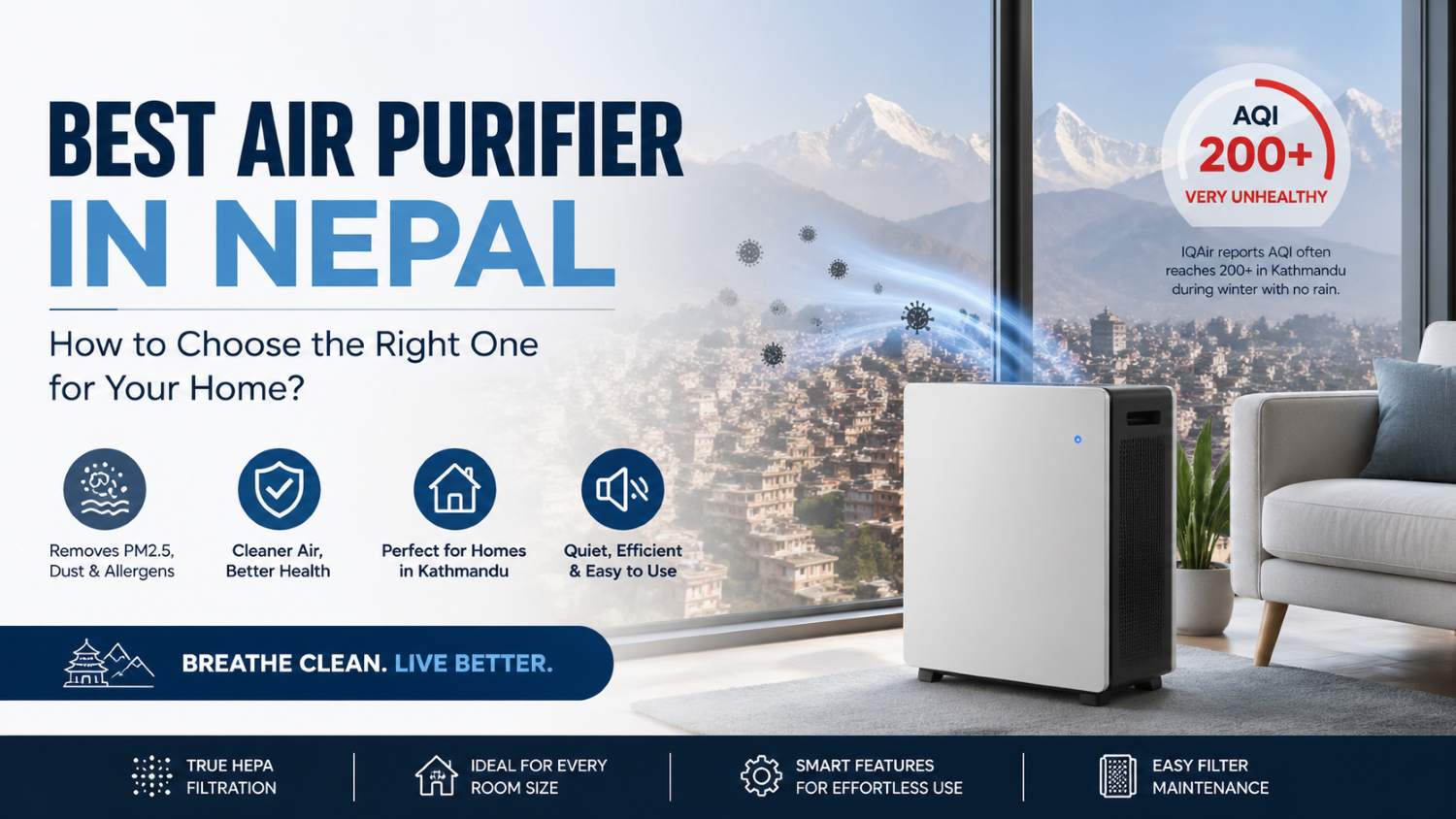
Air pollution has made choosing the right air purifier in Nepal more important than ever. High levels of dust, smoke from old vehicles, and fine particles like PM2.5 are now part of daily life, especially during winter, when air quality worsens significantly.
During dry winter months with little to no rainfall, IQAir reports that AQI levels in Kathmandu often reach 200+, which falls under “very unhealthy” air conditions. This means the air you breathe every day can directly affect your lungs, sleep, and overall health.
Many people assume staying indoors is enough, but without a proper air purifier, indoor air can remain just as polluted. Dust, smoke, cooking fumes, and allergens easily enter homes and get trapped inside, leading to long-term health effects. This is where an air purifier becomes essential. In this guide, you’ll learn how to choose the best air purifier in Nepal based on room size, budget, and specific needs like dust control and allergies.
What to Look for in an Air Purifier in Nepal?
When choosing an air purifier in Nepal, it is important to consider air pollution levels, room size, and your specific needs, such as dust, smoke, or allergies. Features like HEPA filtration, CADR (Clean Air Delivery Rate), and filter type also play a key role in how effectively a purifier can handle Kathmandu’s dust and PM2.5 pollution.
The right air purifier can improve indoor air quality, helping you breathe cleaner air and stay healthier, especially in cities like Kathmandu, where air quality often gets poor.
CADR (Clean Air Delivery Rate)
CADR (Clean Air Delivery Rate) refers to how quickly an air purifier can clean the air in a room. It measures the volume of clean air (in cubic meters per hour) that the purifier can deliver. A higher CADR means the purifier can remove pollutants like dust, smoke, and other pollutants more efficiently.
When choosing an air purifier, you should match the CADR with your room size. For example, a small room needs a lower CADR, while a larger room requires a higher one to clean the air effectively. If the CADR is too low for your space, the purifier will run slowly and may not significantly improve air quality. So, always look for a purifier with a CADR suitable for your room to get the best results.
True HEPA vs low-grade filters
When choosing an air purifier in Nepal, it’s important to understand the difference between True HEPA filters and low-grade or “HEPA-like” filters. A True HEPA filter can capture up to 99.97% of particles as small as 0.3 microns, including dust, smoke, and PM2.5, making it highly effective for polluted cities like Kathmandu.
Low-grade filters may look similar, but are less efficient and cannot properly trap very fine particles. For areas with high dust and pollution, choosing a True HEPA filter is important for better air cleaning and health protection.
Room size compatibility
Air purifiers are designed to clean air within a specific room size, so choosing the right capacity is very important. If the purifier is too small for your room, it won’t clean the air effectively, leaving pollutants behind.
This is where CADR becomes important. CADR measures how quickly an air purifier can clean the air in a given space. A higher Clean Air Delivery Rate means faster purification. For larger rooms or living areas in Kathmandu homes, always choose a purifier with greater coverage and a higher CADR to ensure efficient performance.
Noise level
If you plan to use the air purifier in your bedroom, noise level is an important factor, as some models produce noticeable noise at higher speeds, which may disturb sleep or concentration.
Most modern air purifiers come with a sleep mode or low-noise setting, designed to operate quietly during the night. Noise levels are usually measured in decibels (dB), and a quieter purifier typically operates below 30-40 dB, which is as quiet as a whisper. Choosing a low-noise model ensures better, more comfortable sleep without disturbance.
Filter replacement availability in Nepal
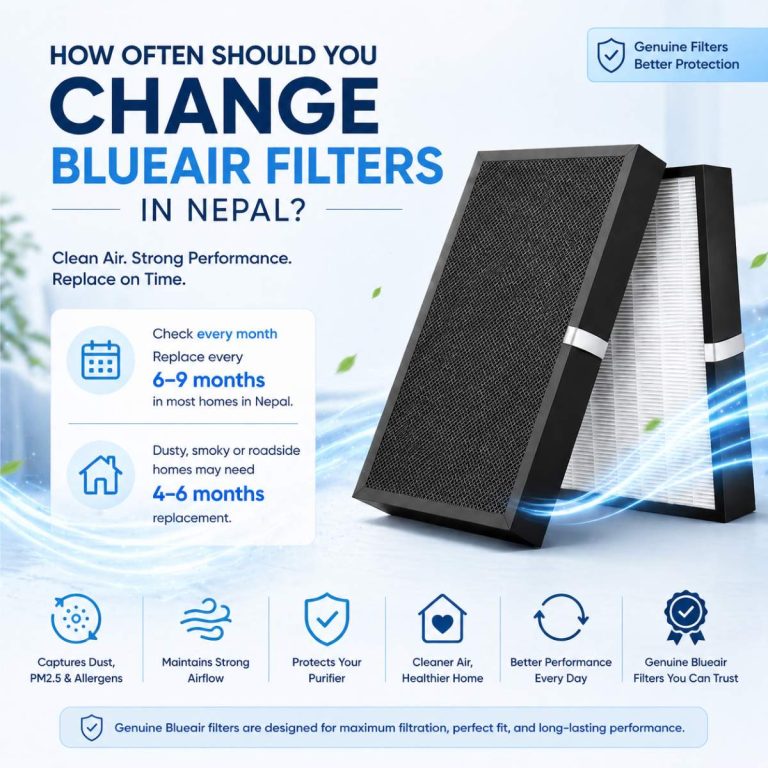
Air purifier filters need to be replaced every 6–12 months to maintain performance, depending on usage and pollution levels. In a city like Kathmandu, where dust levels are high, filters may need to be replaced more frequently, and if you want them to last longer than 12 months, you may need to upgrade to higher-quality filters.
It’s important to choose a brand where replacement filters are easily available in Nepal and affordable. If filters are hard to find or expensive, maintaining the purifier becomes difficult. Easy availability ensures long-term usability and consistent air cleaning performance.
Energy Consumption
If you plan to use your air purifier daily, energy consumption is an important factor to consider, as some purifiers use more electricity, which can increase your monthly electricity bill.
Air purifiers are rated in watts (W), which indicates how much power they use. Energy-efficient models consume around 20–100 watts, similar to a fan or light bulb. Choosing a low-energy purifier helps you run it continuously without worrying about high electricity costs, making it more practical for everyday use.
Ease of Use
Ease of use is an important factor when choosing an air purifier, especially for daily use in homes. Some basic models require manual adjustments, such as changing the fan speed or settings based on how polluted the air feels. While these are more affordable, they may need regular care to keep working at their best.
On the other hand, advanced air purifiers come with smart sensors that automatically detect air pollution levels and adjust settings accordingly. Although they are slightly more expensive, they offer greater convenience, better efficiency, and consistent air quality, making them ideal for busy households.
Types of Air Purifiers: What Works in Kathmandu?
Not all air purifiers work the same way, so choosing the right type is important in Kathmandu, where dust, smoke, and pollution are high. Different purifiers use different technologies to target specific pollutants, so understanding them helps you pick the most effective option.
HEPA filters
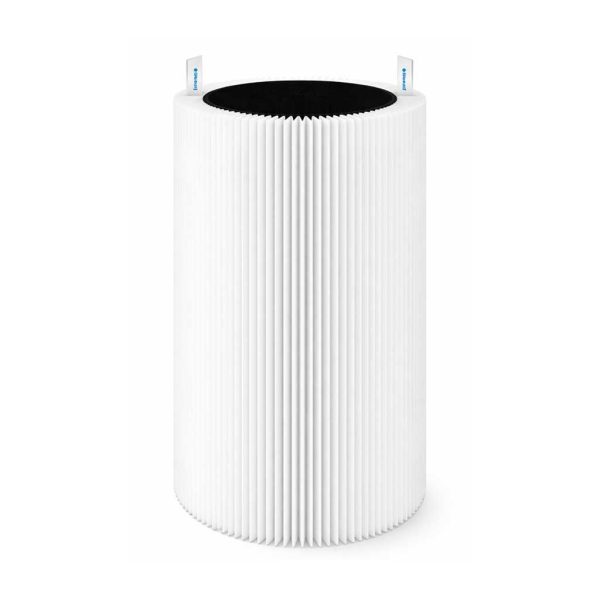
HEPA (High-Efficiency Particulate Air) filters are one of the most effective filtration systems available. They can capture up to 99.97% of tiny particles such as dust, pollen, smoke, and PM2.5, which are very common in Kathmandu’s air.
These filters are ideal for homes dealing with high dust levels, allergies, or respiratory issues, as they can trap very fine particles that often cause breathing problems. They help create a cleaner and healthier indoor environment, especially for people who are sensitive to polluted air.
In Kathmandu, where fine dust and PM2.5 particles are common, an air purifier with a True HEPA filter is highly recommended. It directly targets these tiny pollutants, improving air quality and making it easier to breathe safely and comfortably indoors.
Activated carbon
Activated carbon filters are designed to absorb gases, smoke, and unpleasant odours from the air. Unlike HEPA filters, which trap solid particles, carbon filters work by absorbing pollutants such as cooking smells, cigarette smoke, and harmful gases.
In Kathmandu, where smoke and urban pollution are common, this type of filter helps improve indoor air freshness and removes lingering odours. Air purifiers that combine HEPA + activated carbon filters offer the best overall protection by handling both fine particles and harmful gases, helping deliver cleaner, healthier air inside your home.
Best Air Purifier for Different Needs
Choosing the right air purifier depends on your room size, usage, and specific concerns like dust, smoke, or allergies. Here’s a simple guide to help you pick the best option for different needs in your home:
For Bedrooms
For bedrooms, choose a compact air purifier with low noise levels, sleep mode, and HEPA filtration to ensure uninterrupted sleep and clean air. A quiet model with efficient dust removal is ideal for night use.
A great option for Nepalese bedrooms is the Blue 411, which is specifically designed for small rooms and operates quietly. Its efficient filtration and low-noise performance make it perfect for uninterrupted sleep while maintaining clean, healthy air in your personal space.
For Living rooms
Living rooms require air purifiers with higher coverage and stronger filtration (HEPA + activated carbon) to handle dust, smoke, and daily indoor pollutants. Since this is a shared space where family members spend a lot of time, the air purifier needs to clean the air quickly and consistently across a larger area.
Look for models with a higher CADR (Clean Air Delivery Rate) to ensure faster air purification and better performance in medium-sized rooms. Features like energy efficiency and moderate noise levels are also important for continuous daytime use without disturbance.
The Blue 3610 Air Purifier is perfect for medium-sized spaces and offers powerful filtration, making it a great choice.
For Dust-heavy homes
For homes with high dust levels, it’s important to choose an air purifier with high-efficiency filtration that can capture even the smallest dust particles. This ensures that living spaces remain cleaner, reduces dust settling on furniture, and helps prevent respiratory issues from prolonged dust exposure. A purifier that continuously removes dust keeps the air fresh and healthy throughout the day.
A suitable option for dust-heavy homes is the Blueair Classic 680i, which features powerful HEPA filtration to handle high dust levels efficiently. Its strong performance ensures cleaner air throughout the home, making it ideal for households in dust-prone areas like Kathmandu.
For Babies and the Elderly
Babies and elderly individuals are more sensitive to air pollution due to weaker or developing immune systems. For such users, it’s important to choose an air purifier with True HEPA filtration, low noise levels, and consistent performance to maintain a safe and comfortable indoor environment.
A great choice for sensitive users is Health Protect-7470i, which provides continuous clean air with advanced filtration technology. It is specifically designed to maintain a safe and healthy environment for babies, children, and allergy-prone individuals, ensuring fresh air day and night.
What is the Air Purifier Price in Nepal?
The price of an air purifier in Nepal typically ranges from NPR 22,000 to NPR 100,000+, depending on room coverage, filtration technology (HEPA, carbon filters), brand quality, smart features, and how long it lasts. Air purifiers designed for larger spaces or heavy pollution cost more due to better performance and advanced features.
Entry-level Air Purifiers
Entry-level air purifiers are suitable for small rooms like bedrooms or home offices. They are simple to use, budget-friendly, and typically cost around NPR 22,000 – 50,000. They come with basic HEPA filtration that captures dust, pollen, and some fine particles, but they offer limited coverage and fewer advanced features.
Mid-range Air Purifiers
Mid-range models are better suited to medium-sized rooms, such as living rooms or apartments. These purifiers are priced around NPR 62,000 – 87,000. They have HEPA + activated carbon filters to remove particles and odour, offering higher air circulation for more effective cleaning. Some models may have additional features like timers, multiple fan speeds, or basic air quality sensors.
Premium Air Purifiers
Premium models are designed for large rooms and heavy pollution conditions. These air purifiers typically cost NPR 96,000 and above. They include advanced features like smart sensors, real-time air quality monitoring, and higher CADR for faster purification. Premium air purifiers are also more durable and built for long-term use, making them a better investment over time.
Common Mistakes to Avoid
Choosing the right air purifier requires careful consideration. Many people make simple mistakes that affect performance and long-term value, such as:
- Choosing based on price only: Going for the cheapest option may result in poor filtration and low durability. A very cheap model that doesn’t consider performance or filter quality may save money, but it fails to clean the air properly.
- Ignoring room size: A small purifier in a large room won’t clean the air effectively. A purifier that’s too small for your room will reduce its effectiveness; that’s why it is important to match the purifier’s coverage to your room size.
- Not checking filter costs: One common mistake is failing to factor in replacement filter costs before buying an air purifier. Many purifiers need filter changes every 6–12 months, and some brands have expensive or hard-to-find filters. If replacement costs are high or filters are difficult to get. Always check the availability and price of replacement filters before making a decision.
- Buying low-quality or uncertified products: Cheap or uncertified models may not provide proper filtration or safety. These models may not be used. Uncertified products can also lack safety approvals, increasing the risk of malfunctions or poor performance. So, to avoid risks, choose a trusted, HEPA-certified brand that ensures effective filtration, safety, and long-lasting reliability.
Why Your Decision to Buy Air Purifier in Nepal Matters
Air pollution in Kathmandu makes an air purifier essential in every home. It is not just about comfort but about protecting your health and improving your indoor environment.
Instead of focusing only on price, it’s important to choose an air purifier based on performance, room size, and filtration quality. The right choice can improve your air quality, enhance comfort, and support long-term health for you and your family.
Choose the right air purifier today and take a step toward cleaner, healthier living.
FAQs
What is the best air purifier in Nepal?
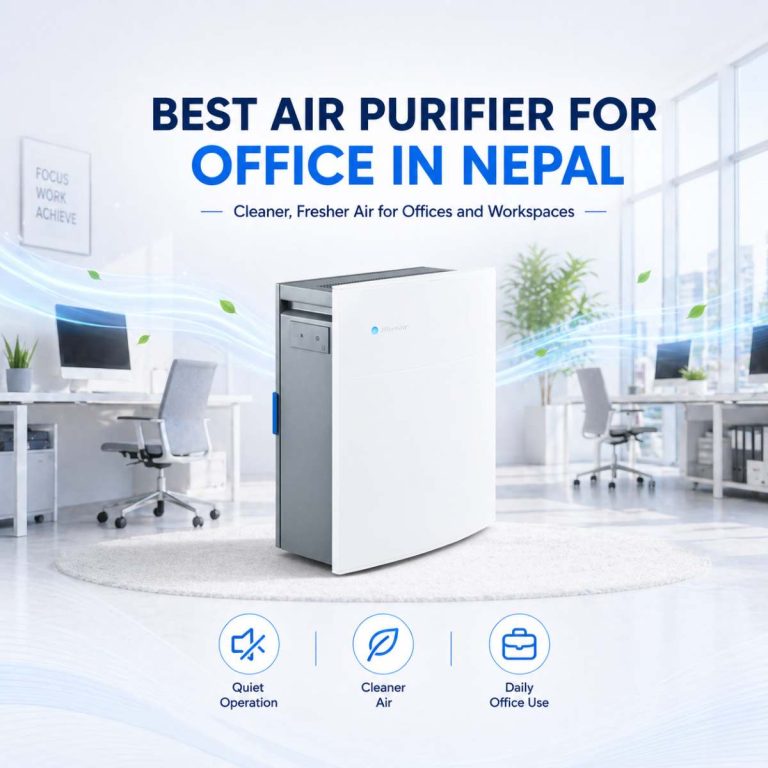
The best air purifier depends on your needs. For small rooms, compact models like Blue 411 work well, while for larger spaces or offices, high-performance models like Blueair 680i are more suitable.
How much does an air purifier cost in Nepal?
Air purifier prices in Nepal range from around NPR 22,000 for basic models to NPR 1,00,000+ for premium models with advanced features.
Do air purifiers remove dust completely?
Air purifiers with HEPA filters can remove up to 99.97% of dust and fine particles, significantly improving air quality and health.
Should I run an air purifier all day?
Yes, running an air purifier continuously helps maintain clean air, especially in polluted environments like Kathmandu, but be careful of power use; choose an energy-efficient model or use timer settings to balance clean air with electricity consumption.
Is an air purifier safe for daily use?
Yes, air purifiers are designed for daily use and are safe when used according to manufacturer guidelines.