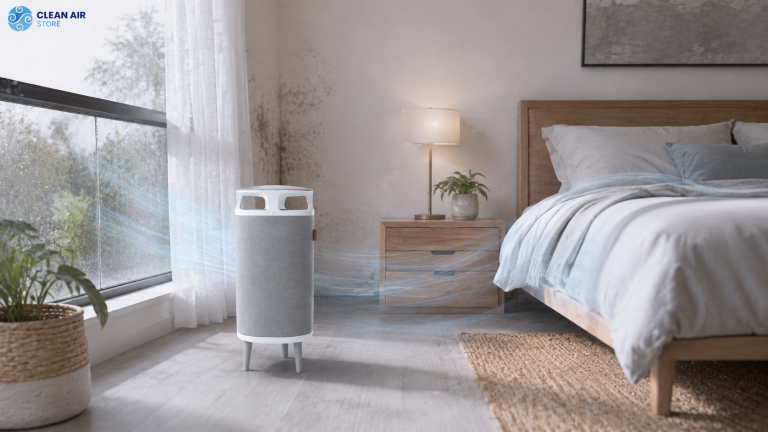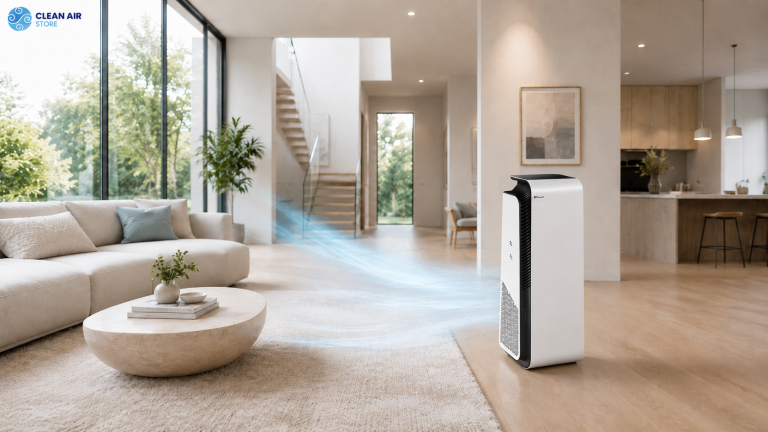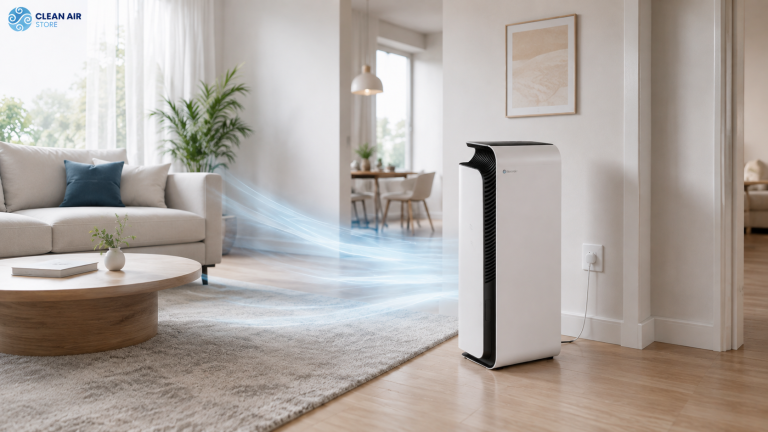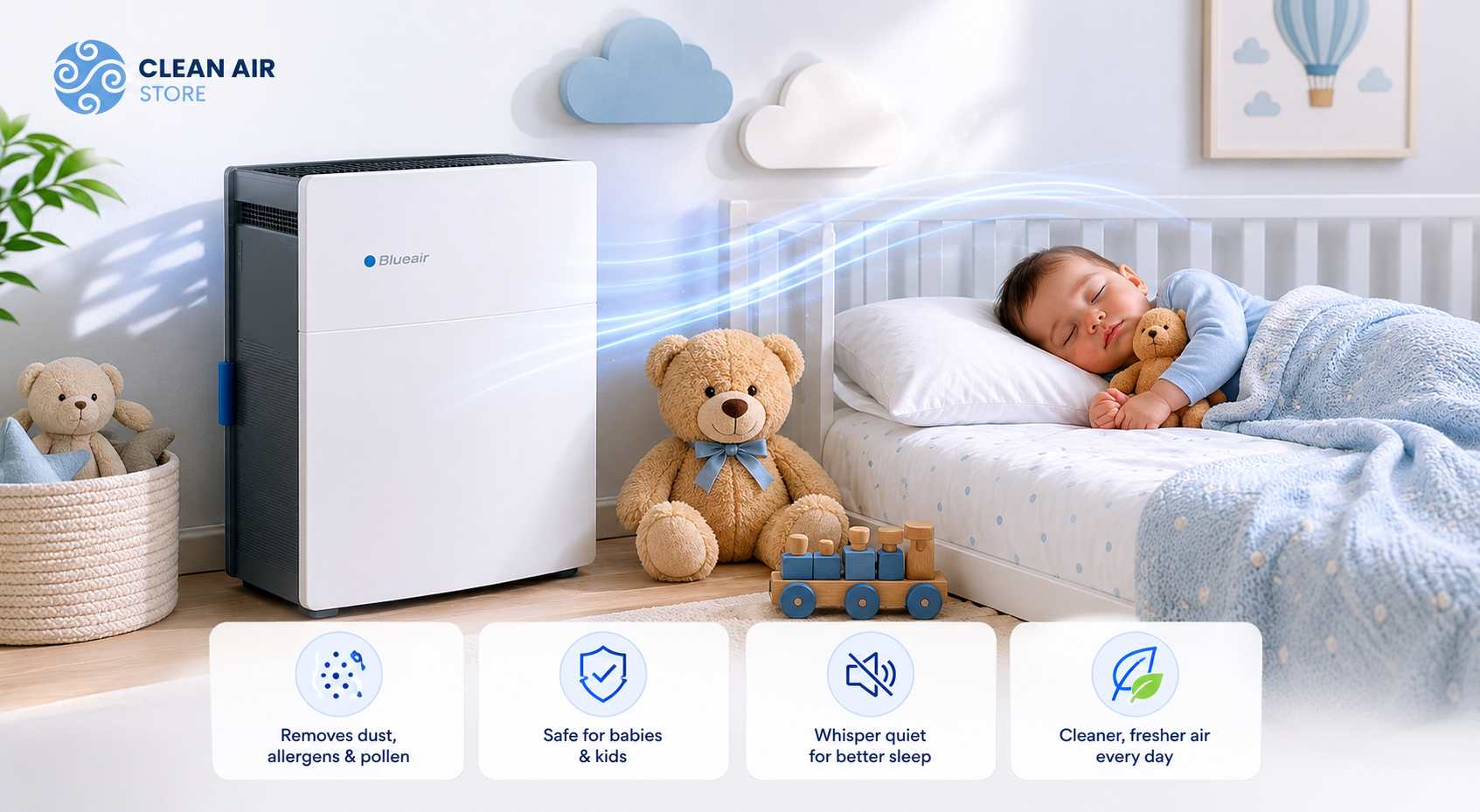
The best air purifier for a baby’s room is a quiet, appropriately sized model with strong particle filtration, low operating costs, and safe overnight operation. For most Nepali parents, the right choice depends on room size, sleep noise, filter availability, and how dusty your home gets.
Nepalese families often deal with dust, traffic pollution, construction dust, seasonal smoke, pet dander, and indoor particles from bedding, curtains, and soft toys. A good purifier does not solve every indoor air problem, but it can reduce airborne particles that make a nursery or kids’ bedroom feel less clean.
This guide helps you choose the best fit for your home, compare three Blueair models, avoid common buying mistakes, and understand what matters before you spend money.
What is the Best Air Purifier For Baby’s Room
For most baby rooms and small kids’ bedrooms, Blue 411 is the best overall choice because it is the quietest of the three at 17–46 dB(A), is designed for small rooms up to 17 m², and has a very low power range of 1.5–10 watts, which makes it practical for overnight and daily use. If the room is bigger or you want much stronger coverage, HealthProtect 7470i is the better upgrade, while DustMagnet 5240i sits in the middle as a good small-bedroom option.
| Model | Best for | Stated room size | Noise | Wattage | Price | Best strength |
| Blue 411 | Small nursery | Up to 17 m² | 17–46 dB(A) | 1.5–10 W | Rs. 22,000 | Compact, simple, low running cost |
| DustMagnet 5240i | Dust-prone kids room | 20 m² core spec | 23–47 dB(A) | 4–22 W | Rs. 45,000 | Pulls dust before it settles |
| HealthProtect 7470i | Larger baby room/premium use | 38 m² in 12.5 min; 95 m² in 1 hour | 25–45 dB(A) | 9–43 W | Rs. 96,000 | Stronger coverage, smart features, and a child lock |
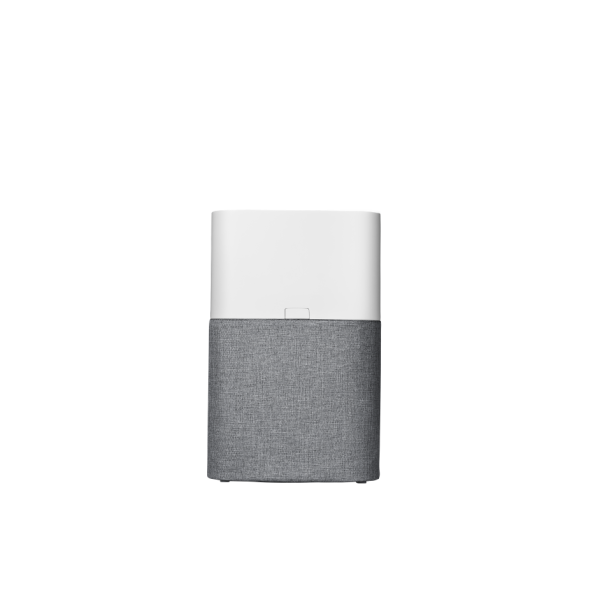
Blue 411: Simple and compact air purifier for everyday use
If your nursery or baby room is small, Blue 411 is one of the most practical places to start. It is compact, lightweight, and easy to use, making it a strong fit for parents who want a quiet air purifier for a baby’s room without moving into a much higher price range. Clean Air Nepal lists Blue 411 with 17–46 dB(A) noise, 1.5–10 watts of power, and room coverage of up to 17 m², making it well-suited for smaller sleeping spaces.
What makes Blue 411 especially useful is its simple, everyday design. It uses HEPASilent™ technology to remove dust, pollen, and other airborne particles while staying energy-efficient and bedroom-friendly. It is not overloaded with advanced features, which can actually be a benefit for parents who just want a purifier that is easy to place, run, and live with.
Why Blue 411 works well in a baby room:
- compact size for smaller spaces
- quiet enough for night use on lower settings
- low power use for long-hour running
- easy to move between rooms if needed
- simple setup without feature overload
Blue 411 fits best in spaces such as a nursery, newborn sleep room, single-child bedroom, or a small study-sleep room for a young child. Its small footprint also makes it easier to place in tighter rooms where parents may not want a larger unit near the cot or taking up too much visible space.
At the same time, it is important to choose it for the right reason. Blue 411 is the better fit when your priority is simple, compact, steady air purification in a small room. It is not the ideal choice if the room is large, if you want advanced smart controls, or if you plan to move the purifier later to a much bigger family bedroom.
DustMagnet 5240i: best for parents worried about visible dust
DustMagnet 5240i is a strong middle-ground choice for parents who want more performance than an entry-level purifier but don’t want to go straight to a premium model. Priced at Rs. 45,000, it is especially useful in homes where visible dust keeps returning on beds, shelves, toys, and side tables.
What makes it stand out is its dust-attracting airflow system, designed to pull airborne dust before it settles. It also uses HEPASilent™ technology to remove dust, allergens, smoke, and other airborne particles, making it a practical fit for baby rooms and kids’ bedrooms.
Clean Air Nepal lists the DustMagnet 5240i with 23–47 dB(A) noise, 4–22 watts of power consumption, a 6–12-month filter life, and a 20 m² room capacity in its core specs. It also includes useful features such as auto mode, night mode, smartphone control, air quality indicator, and voice control, which make everyday use easier for parents.
Why it works well
- Good for homes where dust builds up quickly
- suitable for bedrooms and smaller spaces
- quiet enough for everyday and night use
- more feature-rich than a basic compact unit
- useful beyond the nursery stage
DustMagnet 5240i is the better choice when your baby’s room is not tiny, your home gets dusty often, and you want one purifier that can move from the nursery to a toddler room or a child’s bedroom later.
HealthProtect 7470i: Best Premium Choice for Larger Rooms
If you want the strongest and most advanced option among these three, HealthProtect 7470i is the premium pick. Priced at Rs. 96,000, it is best suited to larger baby rooms, shared kids’ bedrooms, or master bedrooms where a baby sleeps with parents. Clean Air Nepal lists it at 25–45 dB(A) noise, 9–43 watts of power, a 6–12-month filter life, and room coverage of 38 m² in 12.5 minutes and up to 95 m² in one hour.
It uses HEPASilent™ technology and is positioned as a 24/7 air-protection system for parents seeking stronger room coverage and greater control. Clean Air Nepal also highlights features such as app control, auto mode, night mode, child lock, scheduling, brightness adjustment, and voice control, which make it a strong long-term option for families wanting a more premium setup.
Why it works well
- stronger coverage for bigger rooms
- premium smart features for easier daily use
- A child lock is useful in homes with curious kids
- quiet enough for sleep and regular bedroom use
- Better long-term flexibility if you can move it between rooms
HealthProtect 7470i makes the most sense when you truly need larger-room performance, want a higher-end nursery air purifier, or are looking for a single advanced purifier that stays useful as your child grows.
Why An Air Purifier Matters In a Baby Room or Kids’ bedroom
An air purifier matters in a baby room or kids’ bedroom because it helps keep the air cleaner by reducing dust, allergens, smoke, and other fine particles that young children breathe in every day.
A baby’s room should feel calm, clean, and comfortable. It does not need to be perfect, but it should be a space where the air feels fresh and easier to breathe. Babies and young children spend many hours sleeping, resting, and playing indoors, so the quality of the air in that room matters more than many parents realise. An air purifier or a kids’ room air purifier can help improve that environment by:
- reducing dust and fine particles in the air
- helping with smoke smell and indoor odours
- making the room feel fresher and less stuffy
- supporting a more comfortable sleeping environment
- keeping air cleaner around bedding, curtains, and soft furnishings
- giving parents more peace of mind during dusty or polluted days
WHO says children are especially vulnerable to environmental risks, including air pollution, because they are still developing and often crawl or play close to the floor, where dust and pollutants accumulate. That is why a nursery air purifier is not only about “fresh air” as a vague idea. It is about reducing day-to-day airborne particles in the exact room where a child sleeps, rests, feeds, and plays.
What to Consider when Choosing an Air Purifier for a Baby’s Room?
When choosing an air purifier for a baby’s room, first check five things: filtration, room size, noise level, operating cost, and safe placement. These five factors matter more than flashy marketing terms.
Choose proven particle filtration.
The first job of a baby-room purifier is to remove particles. Look for high-efficiency particle filtration. Many strong units use HEPA or comparable high-efficiency systems. Under standard test conditions, HEPA filters are designed to capture 99.97% of 0.3-micron particles. Real-life results still depend on the purifier’s seal, fan strength, and filter condition.
For homes in Nepal, particle filtration matters because dust and fine airborne particles are a daily concern in many areas.
Look for:
- A clear filtration claim from the brand
- A sealed filter design
- A pre-filter that catches larger dust
- An activated carbon layer if odours or light smoke matter to you
Match the purifier to the actual room size.
Buying an air purifier with the wrong capacity for your room size is one of the biggest buying mistakes. A purifier that is too small will need to run harder and still may not clean the room fast enough.
Measure the room or estimate its usable size. A small nursery may need a compact unit. A bigger kids’ bedroom or a shared parent-and-baby room may need a stronger one.
A safe buying rule is simple: buy a purifier rated for a room slightly larger than your actual room. That gives you better performance at lower fan speeds, which usually means less noise.
Prioritise quiet sleep performance.
Parents do not buy a purifier for noise. They buy it for sleep-friendly clean air. A quiet air purifier for a baby’s room should run gently at night and still clean the room well enough for overnight use. A purifier can clean well on high mode during the day and switch to a quieter setting at night. That often works better than forcing a small purifier to stay on turbo mode all night.
Look for:
- Low-noise sleep mode
- A dim or switchable display light
- Stable airflow without rattling
- Good performance on low or medium speed
Check the 24/7 running cost.
The running cost of an air purifier includes electricity use and the cost of replacement filters over time. A model that looks cheaper at first can cost more later if the filters are expensive or need replacing too often.
It is always smart to check how often the filter needs to be replaced, whether genuine filters are available in Nepal, how much power the purifier uses under normal operation, and whether it has an auto mode that helps reduce power use when the air is cleaner.
Avoid risky features in a nursery.
For a baby room, prioritise an air purifier with effective particle filtration, stable fan performance, easy filter replacement, and a carbon layer if smell is a concern.
It is better to be careful with features that add unnecessary risk or hassle, such as ozone-generating functions, strong fragrance add-ons, units that are difficult to clean, or cords that a child can easily reach. Air purifiers with simple, proven features are easily the best choices.
How to Use an Air Purifier Properly in a Baby’s Room?
An air purifier in your baby’s room works best when it runs regularly in a closed room, sits in the right spot, and has enough open airflow around it.
1. Keep it on regularly.
An air purifier works best when it runs consistently. In a baby room used every day, regular use is usually more effective than turning it on only occasionally when the room already feels dusty or stuffy.
2. Keep windows and doors closed when needed.
If the purifier is running, it helps to keep windows and doors closed during dusty hours. This reduces the amount of outdoor dust, smoke, and fine particles that enter the room.
3. Place it in the right spot.
Placement affects performance. Keep the purifier out in the open, not hidden behind curtains, furniture, or in a corner. It should have enough surrounding space to pull in and push out air properly.
4. Leave enough clearance around the unit.
Blueair recommends keeping at least 10 cm of clearance around the purifier. This small detail helps airflow move more freely, improving the purifier’s performance.
5. Use night mode or a lower speed during sleep.
During naps and bedtime, a lower setting or night mode is usually the best choice. This helps the purifier stay quiet in the background while still supporting cleaner air in the room.
6. Change the filter on time.
A purifier only works well when the filter is in good condition. If the filter is overdue for replacement, performance drops. Changing the filter on time helps maintain steady air purification.
7. Use it as part of the room’s daily routine.
An air purifier for a baby’s room works best when it becomes part of the room’s normal setup. Regular use, proper placement, and timely filter changes all help keep the room feeling cleaner and more comfortable.
Find the Right Air Purifier for Your Precious Baby
For a small baby room, Blue 411 is the cleanest simple answer. For a dust-prone room where surfaces get dirty fast, DustMagnet 5240i is the smarter choice. For parents who want more power, more room coverage, and premium features, HealthProtect 7470i is the stronger long-term investment.
If you are choosing a home, start with room size first, then decide how much quiet performance, smart control, and long-running efficiency you really need. Clean Air Nepal can then guide you to a model that makes sense for your child’s room, not just a model that sounds impressive.
FAQs
Is an air purifier good for a baby’s room?
Yes. A good nursery air purifier can help reduce airborne dust, pollen, smoke particles, and other common indoor pollutants in the room where your baby sleeps. It works best when the purifier matches the room size and runs consistently.
Which is the best air purifier for a baby’s room in Nepal?
For a small nursery, Blue 411 is the simplest fit. For dust-heavy bedrooms, DustMagnet 5240i is better. For larger rooms or premium use, HealthProtect 7470i is the strongest option.
Is it safe to run an air purifier all night in a nursery?
Yes, that is one of the main reasons parents buy one. Just place it safely, keep airflow clear, and do not aim strong airflow directly at the crib. Lower-speed or night settings are usually the most comfortable for sleep.
Where should I place a kids’ room air purifier?
Place it in the room where the child spends the most time, with space around it for airflow, away from corners and obstacles, and not right beside the bed or cot. Blueair recommends at least 10 cm of clearance.
Does a quiet air purifier for a baby’s room cost a lot to run?
Usually not. Running cost depends on wattage, fan speed, and your electricity tariff. Among these three, Blue 411 has the lowest stated power use, while HealthProtect 7470i uses the most.