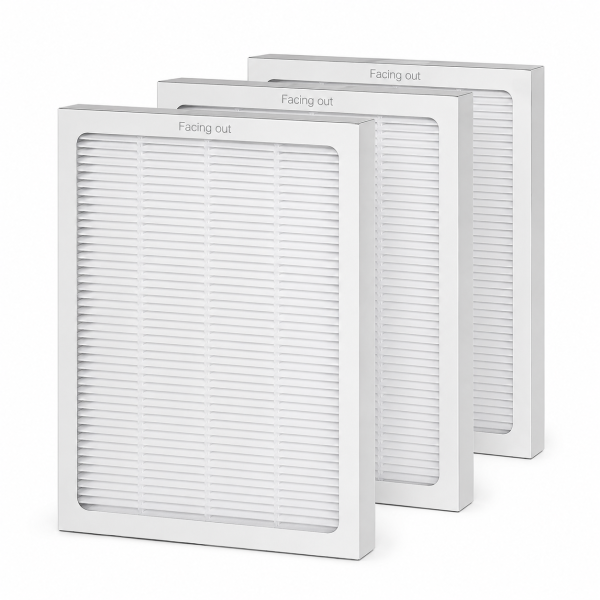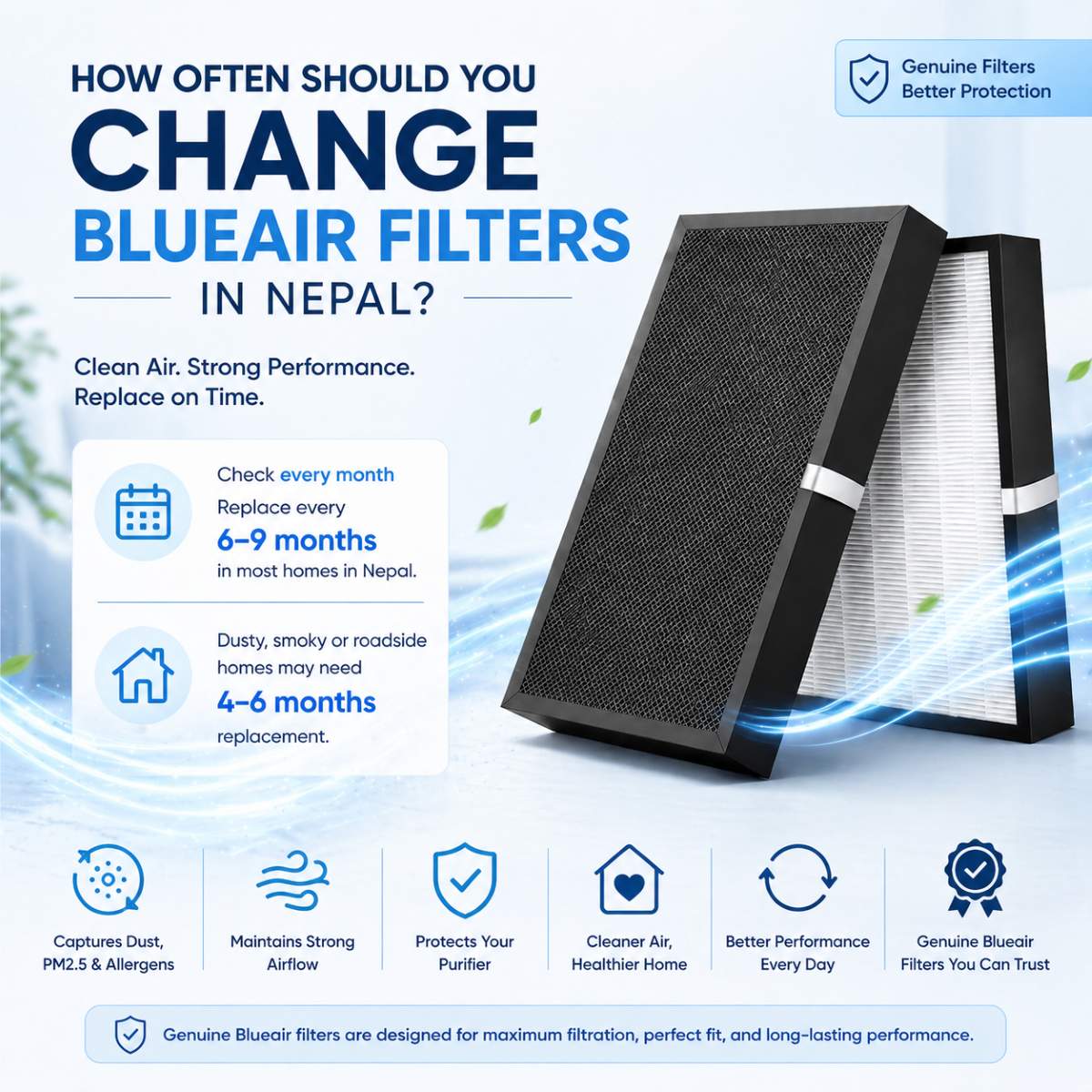
You should check your Blueair purifier filter every month and expect to replace it every 6 to 9 months in most homes in Nepal. Filters last around 9 months in cleaner homes and 4 to 6 months in homes & offices located in dustier, smokier areas or near busy roads.
Filter replacement is crucial because Nepal’s air is hard on filters. Dust, traffic pollution, seasonal haze, indoor cooking fumes, pet hair, and open windows all shorten filter life. If you wait too long, airflow drops, the purifier works harder, and air-cleaning performance declines.
This guide explains how often to change an air purifier filter in Nepal, why Blueair filter replacement may be needed sooner in local dust and pollution conditions, how to spot the signs of a full or dirty filter, and how to choose the right genuine Blueair filter in Nepal.
Air Purifier Filter Replacement Times By Use Case
Depending on your home/office conditions, your filter replacement timeframe may shorten or lengthen by several months. Although most users can expect to replace it every 6 months, cleaner homes may stretch to 6–9 months, while dusty, high-use, pet, smoke, or roadside homes need replacement sooner.
Closed apartment with light dust
If you live in a closed apartment with minimal dust and use the purifier in a controlled indoor setting, your filter may last closer to 9 or even 12 months. In areas with low pollution, filter life can be longer, but 6-12 months is a safe, practical replacement range to plan for.
Average urban family home in Nepal
For a typical urban home in Nepal, a good practical benchmark is around 6 months. This works well for homes that deal with regular dust, traffic-related pollution, and everyday indoor particle buildup.
Dusty roadside home or high-dust area
In homes and offices near a busy road, a construction area, or a place where visible dust builds up quickly, the filter may fill up faster. In these conditions, it is wise to watch for replacement in the 3 to 6 month range, depending on how heavy the dust and pollution load is.
Homes with pets, smoke, or frequent indoor cooking
If you have pets, frequent cooking fumes, smoke exposure, or recurring odour issues, your filter may need to be changed slightly sooner than 6 months, typically 4 to 5 months. These conditions add more particles and odours to the air, so you must replace the filter sooner for healthier living conditions.
Purifier running for long hours every day
Purifiers that run for most of the day in bedrooms, family rooms, offices, or other regularly used spaces have filters that work harder. In this case, it is best to follow the filter indicator light or the app alert, since many Blueair models track filter life based on actual usage conditions rather than a fixed calendar time.
Signs it is Time to Replace Your Filter
- Filter indicator light turns on: The clearest sign is the filter indicator light or app reminder on your Blueair purifier.
- Airflow feels weaker: If less air seems to be coming out than before, the filter may be fully blocked.
- Room feels less fresh: If the air does not feel as clean or fresh as it used to, the filter may not be working effectively.
- Dust returns faster: More dust settling on surfaces may indicate that the purifier is not capturing particles effectively.
- Smell lingers longer: If cooking smells, smoke, or indoor odours remain in the room longer than usual, the filter may need to be replaced.
- Pre-filter looks dirty: Some Blueair models have washable fabric pre-filters that can be cleaned, but the main filter still needs to be replaced on time.
- Main filter is overdue: Even if the purifier is still running, the main filter is not reusable and should be replaced according to the indicator, app alert, or recommended timeline.
Why Should You Replace Your Blueair Filter on Time?
A Blueair purifier can only clean the air properly when its filter is still in good working condition. Over time, that filter gradually fills up with dust, smoke particles, pet dander, and other airborne pollutants. As more particles get trapped, airflow can weaken, meaning the purifier may not move and clean air through the room as effectively as it did when the filter was fresh.
1. A filter does not last forever.
Your Blueair purifier depends on its filter to trap dust, fine particles, smoke, pet dander, and other airborne pollutants. As the purifier runs day after day, the filter gradually collects more of these particles. Over time, it becomes loaded, which means it cannot perform as effectively as it did when it was new.
2. Delayed replacement reduces airflow.
As the filter fills up, air cannot pass through it as easily. This can reduce airflow, making the purifier less efficient at drawing in polluted air and pushing cleaner air back into the room. When airflow drops, overall air-cleaning performance can also decline.
3. Performance can gradually decline.
One important thing to understand is that a purifier can still be running even when the filter is no longer performing well. Many users assume that if the machine turns on, it must still be cleaning properly. In reality, a loaded filter can reduce the purifier’s effectiveness at removing dust, smoke, odours, and other pollutants from the air.
4. A full filter can affect everyday comfort.
When a filter is overdue for replacement, the difference may show up in how the room feels. You may notice:
- More dust is settling around the room
- odours staying longer than before
- slower response during pollution spikes
- less fresh-feeling indoor air
- weaker day-to-day improvement in air quality
5. Nepal’s air pollution makes replacement crucial.
In Nepal, filters often face higher levels of pollution in urban areas. Road dust, traffic pollution, seasonal haze, cooking fumes, open windows, and general indoor particle buildup can all make filters fill up faster. This means many users in Nepal may need to replace their air purifier filters sooner than those living in lower-dust environments.
6. On-time replacement protects purifier performance.
A Blueair purifier performs best when the correct filter is replaced on time. Timely replacement helps maintain stronger airflow, more reliable filtration, better odour control, and more consistent indoor air quality. It also helps ensure that you continue getting the full benefit of the purifier you already invested in.
What Happens If You Delay Replacing Your Air Purifier Filter?
Delaying air purifier filter replacement can reduce your purifier’s airflow, filtration performance, and overall air-cleaning, even if the machine runs normally. As the filter fills with dust, PM2.5, smoke, pet dander, and other pollutants, the purifier has to work harder and may not clean indoor air as efficiently as before.
- Weaker airflow: Less air passes through the loaded filter.
- Slower air cleaning: Dust, smoke, and pollution may take longer to clear.
- More dust settling: Surfaces may get dusty faster than usual.
- Smelly room: Cooking smells, smoke, and stale air may linger longer.
- Less fresh indoor air: The room may not feel as clean or comfortable.
- Extra strain on the purifier: The unit may work harder to pull air through a full filter.
- Faster performance drop in Nepal: Road dust, traffic pollution, haze, cooking fumes, and dust from open windows can make delayed replacement more noticeable.
Why Filters May Need Changing Sooner in Nepal
Like all air purifier filters, Blueair filters may need to be changed sooner in Nepal because they handle heavier pollutants like fine dust, PM2.5, traffic emissions, smoke, and seasonal haze. When outdoor pollution enters the home and mixes with indoor dust, cooking fumes, pet dander, and smoke, the filter fills up faster.
- High PM2.5 exposure: Fine particles like PM2.5 are small enough to remain suspended in the air and collect inside the filter over time.
- Kathmandu’s local pollution: World Bank Nepal reports that 63% of PM2.5 in Kathmandu Valley comes from local sources, meaning nearby traffic, dust, and combustion directly affect indoor air.
- Road dust and traffic pollution: Homes near busy roads collect more soot, fine dust, and vehicle-related particles.
- Seasonal haze and forest-fire smoke: During dry months, haze and smoke can increase particle load and shorten filter life.
- Open windows bring pollution inside: Dust, pollen, smoke, and roadside particles enter the room and pass through the purifier repeatedly.
- Cooking fumes add to the indoor load: Frying, oil vapour, smoke, and kitchen odours can fill the carbon and particle layers more quickly.
- Pets and textiles increase particles: Pet hair, dander, lint, and fabric dust add more material for the filter to capture.
- Long daily use fills filters faster: A purifier running many hours per day processes more polluted air, so the filter reaches replacement time sooner.
- Airflow can weaken as the filter loads: Once the filter collects too much dust and pollution, less air passes through, reducing cleaning performance.
What Affects Blueair Filter Life in Nepal?
Blueair filter life in Nepal depends on how much dust and pollution the purifier handles each day. Homes near busy roads, dusty areas, open windows, pets, smoke, cooking fumes, and long daily purifier use can all cause the filter to fill up faster and require replacement sooner.
1. Home location and surrounding dust
A home near a busy road, construction site, unpaved area, or high-traffic urban zone will expose the purifier to more dust, soot, and fine airborne particles than a quieter indoor environment. This means the filter collects pollutants faster and reaches replacement time sooner.
2. Daily usage time
The more hours your purifier runs, the more air passes through the filter, and the more particles it captures, building up a larger load more quickly. If you keep the purifier on 24/7, especially during dry, dusty seasons, the replacement interval may be shorter than 6 months.
3. Pets, smoke, and indoor cooking
Indoor conditions can shorten filter life just as much as outdoor pollution. Pet dander, hair, smoke particles, cooking fumes, odours, and grease-related airborne particles all add extra load to the filter over time. In homes with pets, frequent frying, incense, candles, or regular smoke exposure, the purifier has to work harder, which can push the filter toward replacement sooner.
4. Room size and purifier workload
Filter life also depends on how hard the purifier has to work in the room where it is placed. A unit used in a larger room, a more polluted room, or a space with frequent air-quality changes may run at higher speeds more often and process more air. In those conditions, the filter can fill up faster than the same model used in a smaller, cleaner, and more controlled space.
5. Open windows and outdoor air entry
If you keep windows open, it can bring in a large amount of outdoor pollutants that the purifier has to handle. In Nepal, especially during dusty hours, dry weather, roadside activity, or seasonal haze, open-window living can noticeably shorten the time a Blueair filter remains effective.
How to Make Your Blueair Filter Last Longer
You can help your Blueair filter last longer by reducing the amount of unnecessary dust, smoke, and indoor pollution that reaches it each day. The goal is not to delay replacement too long, but to help the filter work more efficiently so it stays effective for as long as it safely can.
- If your model has a washable pre-filter or fabric pre-filter, clean it every 2-4 weeks.
- Keep windows closed during dusty hours, heavy traffic periods, or seasonal haze.
- Vacuum floors, curtains, rugs, and soft furniture more often to reduce the indoor dust load.
- Reduce indoor smoke, incense, and strong cooking fumes where possible.
- Place the purifier in a spot with good airflow, not blocked by walls, curtains, or furniture.
- Run the purifier consistently instead of waiting until the air already feels dirty.
- Use the right fan speed for room conditions so pollution is managed early.
- Keep pets groomed and clean pet areas regularly to reduce airborne hair and dander.
- Avoid placing the purifier too close to kitchens or direct dust sources unless that is the room that truly needs it.
- Check the filter regularly so you can respond early instead of forcing extra life out of an already full filter.
Keep Your Blueair Purifier Working the Way It Should
Replacing your Blueair filter on time helps maintain airflow, filtration performance, and everyday comfort, especially in Nepal’s polluted conditions. If you are unsure which filter matches your purifier, Clean Air Nepal offers genuine Blueair series replacement filters to help you choose the right one more easily.
| Blueair Filters | Filtration Benefits | Price (NPR) |
| HealthProtect™ 7470i | SmartFilter with particle + carbon filtration, GermShield™ support, and app-based tracking | 13,000 |
| HealthProtect™ 7770i | Advanced SmartFilter with multi-layer filtration and smart filter-life tracking | 22,500 |
| DustMagnet™ 5210i | Particle + carbon filter for dust, irritants, and light odours | 8,500 |
| DustMagnet™ 5240i | ComboFilter with particle filtration and carbon absorption | 8,500 |
| DustMagnet™ 5440i | Advanced ComboFilter for dust capture and odour control | 13,000 |
| Blueair JoyS | Particle and odour filtration for fine dust and indoor smells | 4,000 |
| Blue 3410 | Particle + activated carbon filtration with strong airflow support | 7,000 |
| Blue 3610 | Washable fabric pre-filter for larger dust, lint, and hair | 12,500 |
| Classic 280i | Particle removal with stable airflow | 7,800 |
| Classic 405 | Reduces dust, allergens, and everyday airborne particles | 15,000 |
| Classic 480i | DualProtection particle + carbon filtration for VOCs and odours | 15,000 |
| Classic 680i | Advanced particle filtration + SmokeStop carbon filtration | 21,000 |
| Cabin P1 | HEPA + activated carbon filtration for PM2.5, smoke, and odours | 4,000 |
| Cabin P2i | Particle + odour filtration for dust, PM2.5, smoke, and enclosed cabin smells | 4,000 |
FAQs
How often should I change my Blueair filter in Nepal?
In most homes in Nepal, you must check your Blueair filter every month and expect to replace it every 6 months. In cleaner homes, it may last 6 to 9 months, while homes near busy roads, with pets, smoke, cooking fumes, or heavy daily use may need replacement sooner.
How do I know when my Blueair filter needs replacing?
The clearest sign is the filter indicator light or app reminder. You may also notice weaker airflow, more dust settling throughout the room, lingering odours, or air that feels less fresh than before.
Why do Blueair filters need to be changed sooner in Nepal?
Blueair filters may fill up faster in Nepal because they often handle dust, PM2.5, traffic pollution, smoke, seasonal haze, cooking fumes, and particles entering through open windows. These conditions increase filter load and can shorten filter life compared with cleaner environments.
Can I clean and reuse a Blueair filter instead of replacing it?
In some Blueair models, the outer fabric pre-filter can be vacuumed or washed, but the main filter still needs to be replaced on time. Cleaning the pre-filter can help with maintenance, but it does not replace proper main-filter replacement.
Should I buy a genuine Blueair filter in Nepal?
Yes, a genuine Blueair filter is the safer choice because it is designed for the correct fit, stable airflow, and reliable purifier performance. Using the right original filter helps maintain filtration efficiency and long-term reliability across Blueair models.